Why Not? Why Must We Drive SUVs and Wagons?
Range Rover Sport SVR
Range Rover 3.0 V6 SuperCharged VOGUE LWB
Range Rover 3.0 V6 Supercharged Vogue Long Wheelbase
Mercedes-Benz C 220 d Stationwagon
Why not? Why Must We Drive SUVs and Wagons?
Among the ever-expanding lineup of imported cars, Fumio Ogawa proposes "Why not?" – a call to "choose what you like." This third installment focuses on SUVs and wagons, vehicles with large rear gates and ample luggage space, offering high utility.
Why not? Why Must We Drive Sports Cars?
Why not? Why Must We Drive Sedans?
Text by OGAWA FumioPhotographs by ARAKAWA Masayuki
Why Not a Cayenne?—Range Rover Sport SVR
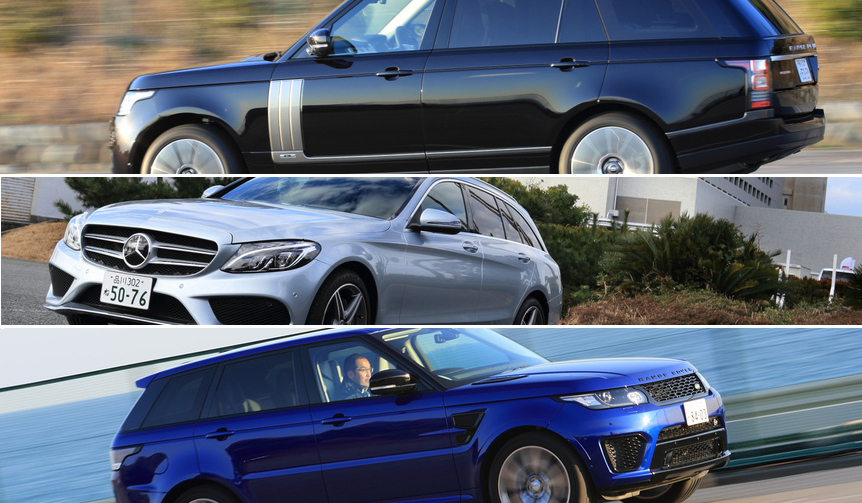
This is the "special model" that Jaguar Land Rover's "Special Vehicle Operations (SVO)" claims to have designed and developed.Range Rover Sport SVRIntroduced to the Japanese market in October 2015, it features specially designed headlamps, deep front air dams, and 21-inch tires that create a powerful visual presence. The 5-liter V8 engine produces a maximum output of 550 horsepower (405kW) and a maximum torque of 680Nm. It's an SUV that drives like a sports car.
The Range Rover Sport SVR is billed as "Land Rover's fastest and most powerful high-performance model." It's still fresh in memory how Land Rover widely reported its Nürburgring Nordschleife lap time of 8 minutes and 14 seconds, setting a new SUV lap record. Many users likely find value simply in the fact that it was engineered by the team at the Special Vehicle Operations division.
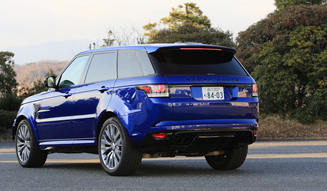
The performance of accelerating from a standstill to 100 km/h in just 4.7 seconds is convincingly real when you drive it. The acceleration is astonishing, and the handling is unlike that of a typical SUV. The car reacts quickly, and its stability in corners is remarkable. The suspension system combines air springs, adaptive dampers, and a variable roll-canceling system, essentially shared with the standard model, though tuned with a focus on sporty driving. It's not just stiff; it moves well, offering a surprisingly supple ride. It's fast and fun when pushed, yet comfortable on long tours. It's a remarkably well-executed model.
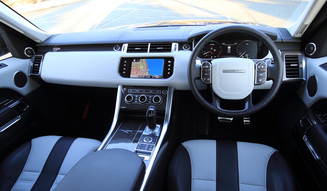
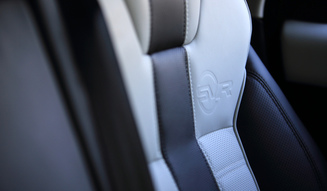
Another appeal of the Range Rover Sport SVR is its styling. The exterior, which adopts sports car idioms within an SUV package, feels quite special. Furthermore, the interior builds upon the Range Rover Sport's inherent strength of combining function and emotion, with the addition of sports seats and unique color schemes, creating a world exclusive to the SVR.
The two-tone color scheme is eye-catching in the interior. The test model featured white and black, enhancing the sporty feel. The sense of color coordination from Land Rover is truly superb.
Sports SUVs were once the exclusive domain of German manufacturers. The PorscheCayenne Turbo(¥17.38 million) is a popular model. Its 4,806cc V8 engine is paired with a full-time 4WD system, delivering a maximum output of 520 horsepower (382kW) and accelerating from 0 to 100 km/h in 4.5 seconds. The body measures 4,855mm in length. It can be considered a direct competitor to the Range Rover Sport SVR (¥16.05 million) with its 5.5-liter V8 engine in a 4,880mm long body.
The Range Rover Sport SVR excels in the "ambiance" crucial in this market class. The background of its development by "Special Vehicle Operations" is also a pleasing factor. The car itself is excellent, and the interior exudes a luxury that speaks of craftsmanship found only in this vehicle. Stepping away from German cars to drive this vehicle offers an encounter with unknown pleasures, which is a significant appeal.
Why not? Why Must We Drive Sports Cars?
Why not? Why Must We Drive Sedans?
Range Rover Sport SVR
Range Rover 3.0 V6 SuperCharged VOGUE LWB
Mercedes-Benz C 220 d Stationwagon
Why not? Why Must We Drive SUVs and Wagons? (2)
Why Not a Mercedes-Benz GLE?
—Range Rover 3.0 V6 Supercharged Vogue Long Wheelbase
Range Rover 3.0 V6 Supercharged Vogue Long WheelbaseThe "Range Rover 3.0 V6 Supercharged Vogue Long Wheelbase" is a rare existence. While car evaluations often rely on numbers like speed, space, and fuel efficiency, this vehicle transcends them. If asked what's good about it, one could mention the 3-liter V6 engine's surprising power, the ample space of its 5.2-meter body, or the comfortable interior, but its greatest charm is its sheer comfort.
The Range Rover 3.0 V6 Supercharged Vogue Long Wheelbase was launched in Japan in March 2014. Jaguar Land Rover explained its positioning as "meeting the demand for a model that replaces traditional long-wheelbase sedans." This marked the first long-wheelbase Range Rover model in 20 years, since the "Range Rover LSE" sold from 1992 to 1994.
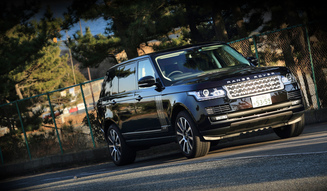
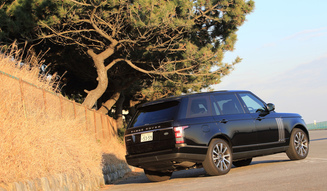
It features a wheelbase extended to 3,120mm, compared to the standard model's 2,920mm. By lengthening the section ahead of the rear wheels, the rear legroom is increased by 200mm. Additionally, the seat upholstery quality is enhanced, and the reclining angle is greater than the standard model, establishing its unique position as a large limousine exceeding ¥16 million.
The 2,994cc V8 engine produces a maximum output of 380 horsepower (280kW) and a maximum torque of 450Nm, with peak torque available from 3,500rpm. In an era of increasing power, these figures are surprisingly modest. Paired with a full-time 4WD system and mounted in a large 5,205mm body, it's understandable if some might wonder if it's sufficient.
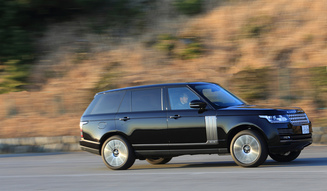
Of course, it is more than sufficient. Despite weighing 2.4 tons, it performs better than expected. Initial acceleration is brisk, and mid-range acceleration is quite sharp. A slight press of the accelerator pedal causes the car to pick up speed effortlessly. The V6 engine not only delivers strong power from low revs but also offers a smooth feel as it revs up, making it one of the most satisfying cars to drive.
The suspension, with its electronically controlled air suspension system, moves supplely, utilizing the heavy sprung weight to provide a luxurious, relaxed ride. This is another significant merit. One can only admire the skill in completing this vehicle as a luxurious limousine that ensures off-road capability while providing a comfortable high-speed touring experience, fully leveraging the Range Rover's potential.
When considering large luxury SUVs, there's the Mercedes-BenzGLEformerly known as the "M-Class." In Japan, the 3-liter V6 diesel "GLE 350 d 4MATIC" (from ¥9.29 million) is the main offering, with the Mercedes-AMG "GLE 63 S 4MATIC" featuring a 5.5-liter V8 engine (¥17.4 million) positioned above it. The body length is 4,825mm, considerably more compact than the Range Rover 3.0 V6 Supercharged Vogue Long Wheelbase (with its lengthy name).
The Mercedes GLE offers a comfortable on-road experience and impressive off-road capability, perhaps making it similar to the standard wheelbase Range Rover in that regard. It's a worthy rival to the Range Rover in terms of reliability, brand prestige, and driving performance. Against this backdrop, the Range Rover 3.0 V6 Supercharged Vogue Long Wheelbase shines with its unique individuality, offering something irreplaceable, especially for owners who prioritize rear-seat comfort.
Range Rover Sport SVR
Range Rover 3.0 V6 SuperCharged VOGUE LWB
Mercedes-Benz C 220 d Stationwagon
Why not? Why Must We Drive SUVs and Wagons? (3)
Why Not a BMW 320d Touring?
—Mercedes-Benz C 220 d Stationwagon
Mercedes-Benz's Japanese subsidiary is enthusiastic about introducing diesel models (along with hybrids). The Mercedes-Benz "C 220 d Stationwagon," launched in Japan in September 2015, impresses with its successful balance of fuel efficiency and power.C 220 d StationwagonThanks to sophisticated technology like a two-stage turbocharger and the C-Class's first 9-speed automatic transmission, it achieves over 20 km/L for the sedan and 19.6 km/L for the station wagon (JC08 mode).
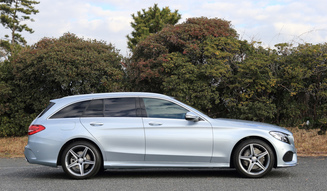
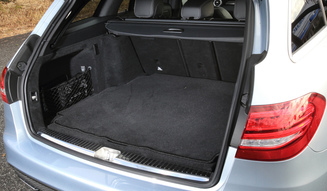
The C-Class station wagon itself has a well-proportioned body of about 4.7 meters in length, offering comfortable seating for four adults, though not excessively spacious. The luggage compartment has a capacity of 490 liters. As a bestseller used in various ways by owners, its capabilities as a long-distance tourer are exceptional. While station wagons are the origin of SUVs, this vehicle fulfills its original function perfectly. The ride is smooth (especially with normal tires), the cabin is quiet, and the seats are comfortable, significantly reducing fatigue.
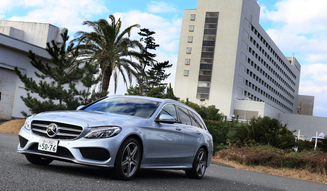
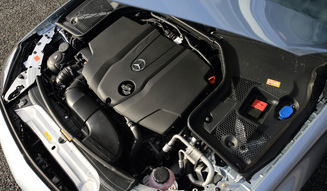
The 2.2-liter 4-cylinder diesel engine is state-of-the-art, employing a latest-generation common rail system with piezo injectors for enhanced efficiency. A key feature is the use of two turbochargers of different sizes. A smaller turbo excels at low-rpm efficiency, while a larger turbo provides power at higher revs. The two-stage turbocharger uses a variable flap to control exhaust flow, eliminating turbo lag while delivering the necessary boost pressure. This setup yields a maximum output of 170ps (125kW) and a maximum torque of 400Nm.
The driving impression is one of abundant power, just as the manufacturer claims. With maximum torque available from 1,400rpm, the benefits of diesel driving at low revs are fully realized. The reduced need to press the accelerator pedal from city streets to highway speeds makes fuel economy a significant draw for owners. Furthermore, with 400Nm of torque, the C 220 d Stationwagon is, in simple terms, effortless. The excellent sound insulation of the body, combined with the engine's primary use at low revs, contributes to a quiet cabin. The characteristic diesel knocking sound is also barely audible inside.
The C 220 d Stationwagon's other strength is that it's not merely an economy model. The handling is precise, and the car's stability during cornering is particularly noteworthy. There is absolute confidence at all times and in all conditions. This demonstrates the vitality of Mercedes-Benz's engineering. It's a model that grows on you, increasing your trust the more you drive it.
The styling conveys a sporty impression. The front grille with its large three-pointed star, flanked by the headlamps, and the large air dam suggest a car designed for enthusiastic driving rather than just being a family car. The side profile, with its gracefully arched side window graphics, adds a sense of dynamism. The rear view exudes condensed power.
A highly successful diesel-powered station wagon is the BMW320d Touring(from ¥5.28 million). This model is equipped with a 2-liter 4-cylinder engine producing 184 horsepower (135kW) and 380Nm of torque. Its 4,645mm body is similar in length to the C 220 d Stationwagon's 4,705mm body (¥5.95 million). BMW has leveraged its stylish looks, responsive steering from low speeds, and fuel efficiency of 19.4 km/L (JC08 mode) as selling points. For those seeking a versatile station wagon, the C 220 d Stationwagon undoubtedly presents a compelling option. It's a model you won't regret choosing.