CHAPTER 2: The History of Early Tudor Divers' Watches, Unveiled Through Epochal Models | TUDOR
TUDOR | The Watchmaker
Text & Edit by TSUCHIDA Takashi
A Deep Dive into TUDOR Divers' Watches from 1954-1968
In the approximately 15 years since the birth of TUDOR divers' watches, eight epochal models have emerged.
1954 Ref. 7922 TUDOR Oyster Prince Submariner 1955 Ref. 7923 TUDOR Oyster Submariner 1958 Ref. 7924 TUDOR Oyster Prince Submariner “Big Crown” 1959 Ref. 7928 TUDOR Oyster Prince Submariner “Square Crown Guard” 1960 Ref. 7928 TUDOR Oyster Prince Submariner “Pointed Crown Guard” 1964 Ref. 7928 TUDOR Oyster Prince Submariner “Tropical” 1967 Ref. 7928 TUDOR Oyster Prince Submariner 1969 Ref. 7016 TUDOR Oyster Prince Submariner
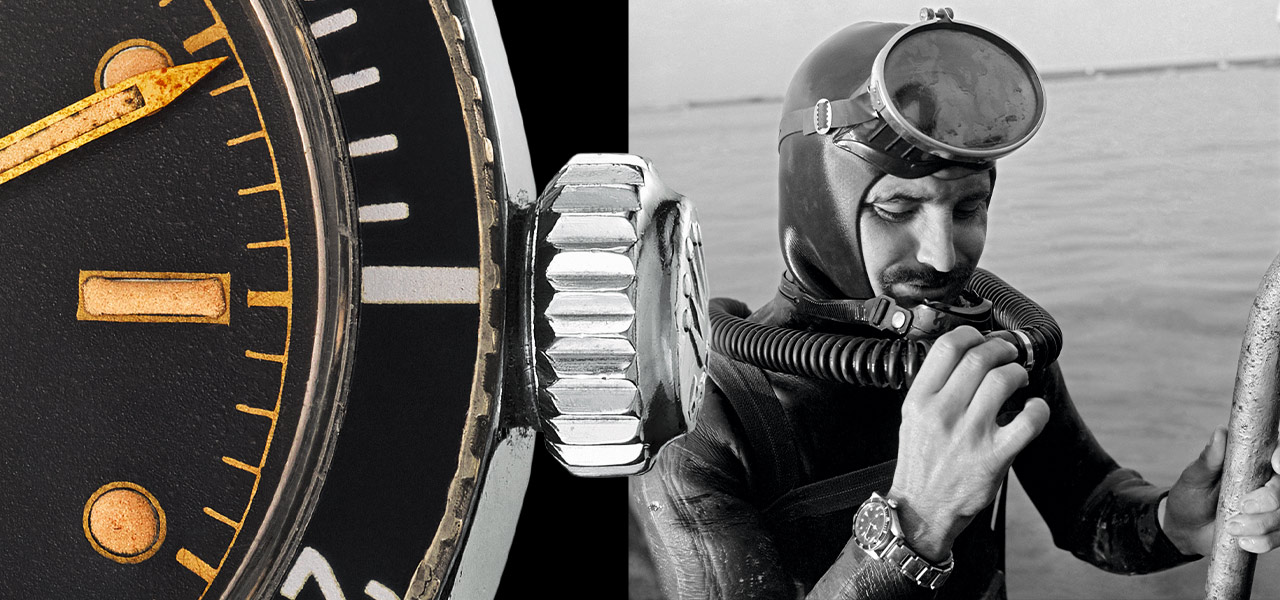
In 1954, TUDOR released its first-ever diver’s watch, the “TUDOR Oyster Prince Submariner” (Ref. 7922). This in-house developed model, meeting high standards for durability, reliability, accuracy, and water resistance, quickly became the tool of choice for professionals. From then on, this practical instrument continued to evolve, meeting the demands of all types of divers.
Notably, early TUDOR Submariners came in various versions, showing remarkable performance advancements in a short period. For instance, the water resistance of the first model (Ref. 7922) was 100m, which increased to 200m just four years later with the Ref. 7924. Beyond improvements in water-resistance mechanisms, numerous experiments were conducted in the pursuit of the ideal diver’s watch.
Thus, by the early 1960s, the final version of the Ref. 7928, characterized by its round crown guards, established the silhouette and technical features of subsequent TUDOR Submariners.
Meanwhile, the 1958 Ref. 7924, known as the “Big Crown,” serves as the basis for the current “Black Bay Fifty-Eight” model.
Let’s explore these epochal models one by one.
1954 Ref. 7922 TUDOR Oyster Prince Submariner
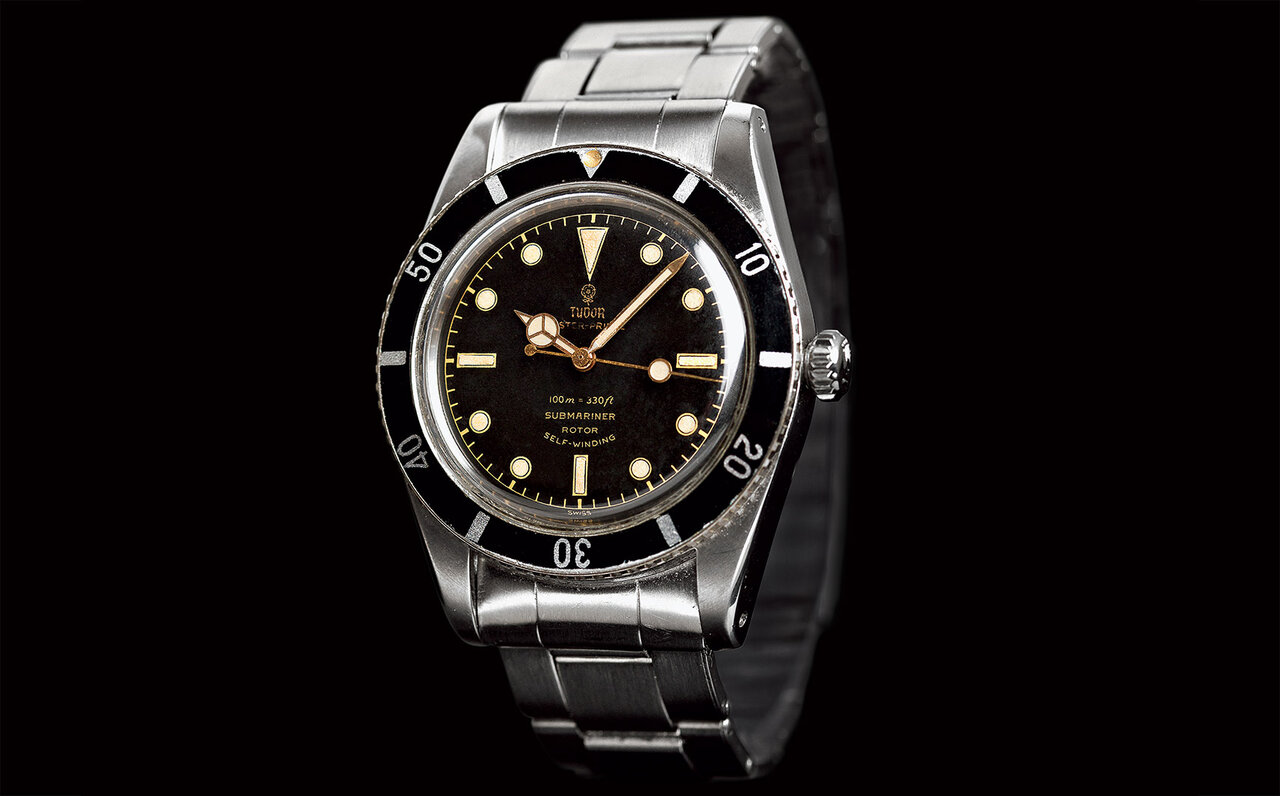
TUDOR’s first diver’s watch achieved a water resistance of 100 meters. Its features included a screw-down case back and crown, large hour markers and hands with luminous paint, and a bidirectional rotating bezel with five-minute markers for precise dive time measurement.
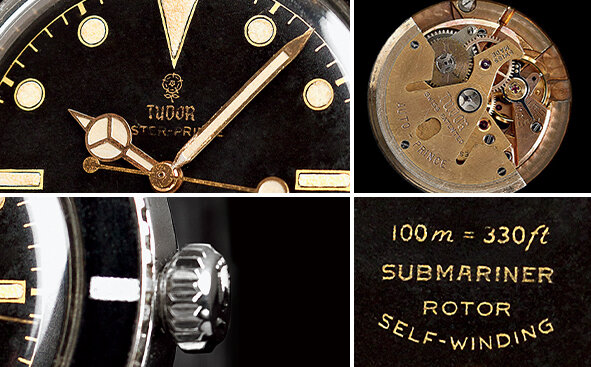
The dial featured a black lacquer finish. Below the brand logo at 12 o’clock, the dial read “OYSTER PRINCE,” while at 6 o’clock, it stated “100m=330ft,” “SUBMARINER,” “ROTOR,” and “SELF-WINDING.” These inscriptions were gold-plated prints (note: in later references, this text color would change to silver, then white).
Listing meters and feet at 6 o’clock served to remind the world of its water resistance. The Tropic-style plexiglass crystal employed a domed shape to enhance water pressure resistance.
The movement was the self-winding Caliber 390, developed from a FHF ebauche with a frequency of 18,000 vibrations per hour. The 5mm screw-down crown and the Oyster-style bracelet with riveted links (Ref. 6636) bore the Rolex logo.
Ref. 7922
1955 Ref. 7923 TUDOR Oyster Submariner
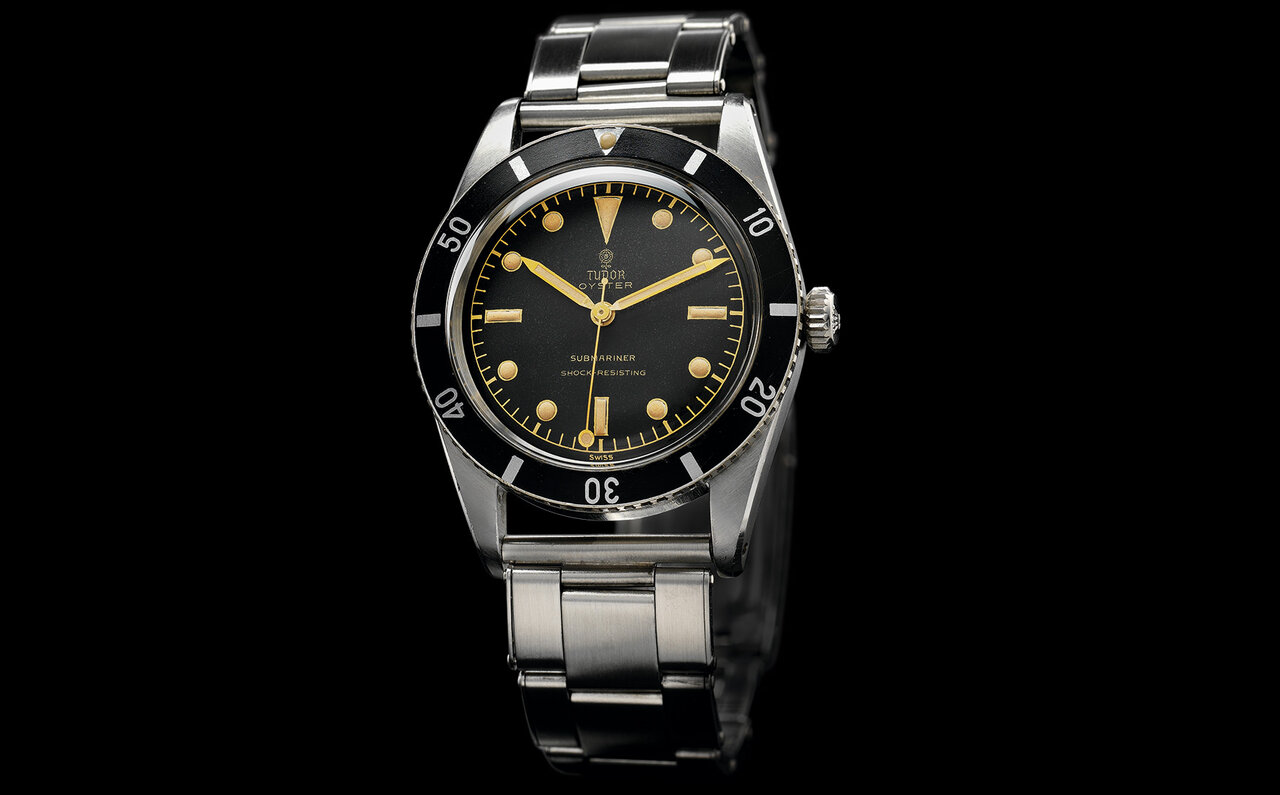
The Ref. 7923 is the only TUDOR Submariner to feature a manual-winding movement. This technical choice resulted in a slimmer, flatter case profile. However, thanks to the characteristic Oyster case back and crown, along with the domed crystal, the “TUDOR Oyster Submariner” maintained its water resistance of 100 meters.
As the movement was not self-winding, the dial lacked the “ROTOR” and “SELF-WINDING” inscriptions at 6 o’clock. Instead, it read “SUBMARINER” and “SHOCK-RESISTING.” Unlike the Ref. 7922, there was no mention of water resistance, and the hour and minute hands were of a simpler baton design.
The Ref. 7923 was equipped with an ETA manual-winding movement (Cal. 1182) operating at 18,000 vibrations per hour. The riveted Oyster bracelet (Ref. 6636) featured the Rolex logo. The archival image shows the bracelet connected to the case by two cylindrical bars, rather than the typical curved end links.
Ref. 7923
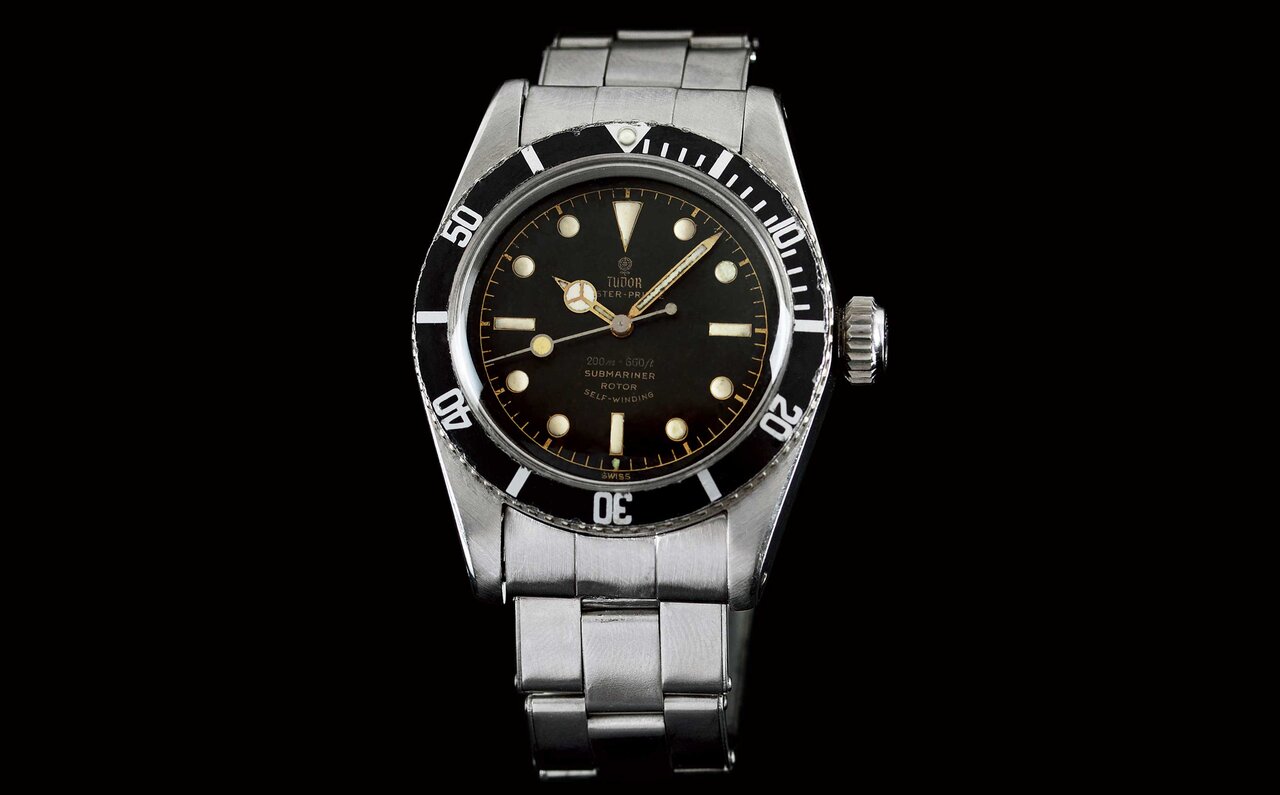
1958 Ref. 7924 TUDOR Oyster Prince Submariner “Big Crown”
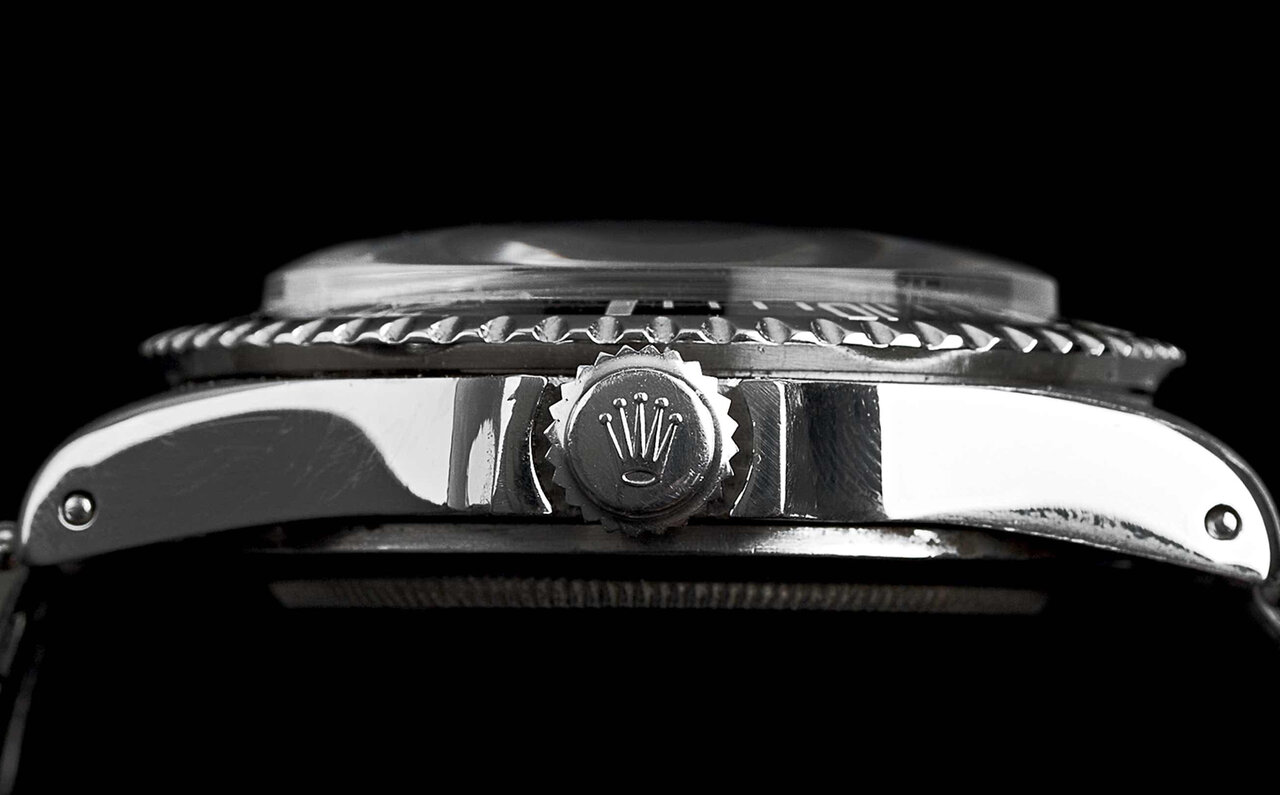
Dubbed the “Big Crown” by collectors due to its prominent 8mm winding crown, the Ref. 7924 achieved a significant technical advancement, doubling the water resistance to 200 meters. Consequently, the 37mm case was made thicker, and fitted with a larger screw-down crown.
The Tropic-style domed plexiglass crystal was also modified to be thicker, designed to withstand the higher water pressure at greater depths.
The movement was the same self-winding Caliber 390 as the Ref. 7922. The dial featured a black lacquer finish. At 6 o’clock, the inscription “200m=660ft” reappeared, indicating the water resistance. The hands returned to the same design as the Ref. 7922. The riveted Oyster bracelet (Ref. 7206) bore the Rolex inscription.
Ref. 7924
1959 Ref. 7928 TUDOR Oyster Prince Submariner “Square Crown Guard”
TUDOR developed a distinctive case shape to protect the crown from impacts, introducing it with the Ref. 7928. While the crown guard design would evolve, the reference number remained the same—a testament to the early TUDOR Submariner’s dynamic pursuit of functionality.
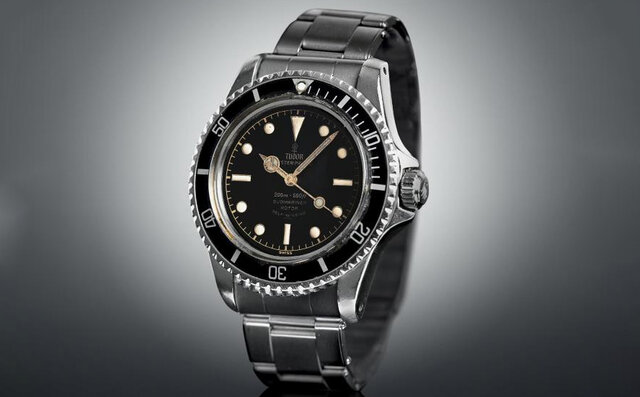
This model from 1959 (Ref. 7928, same as the front view image below) is known among collectors as the “Square Crown Guard” type, featuring square-shaped crown guards. The crown size is 6mm, the case is 39mm in diameter with the inscription “ORIGINAL OYSTER CASE BY ROLEX GENEVA,” and it boasts a water resistance of 200 meters.
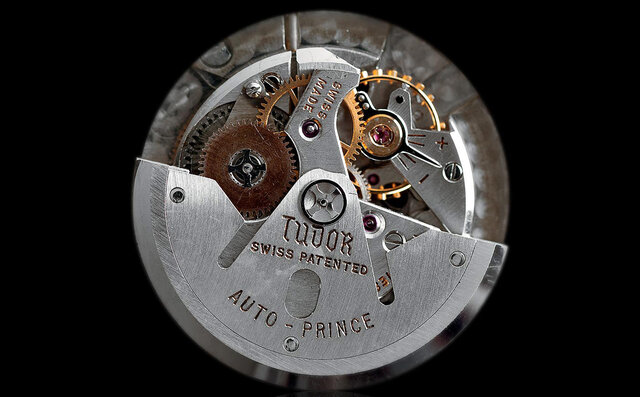
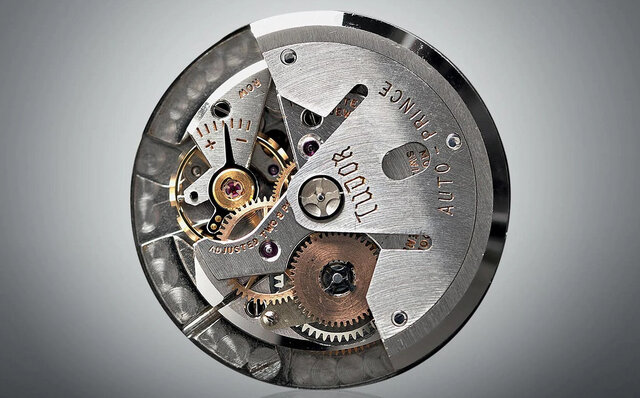
The dial, hands, and bezel followed the designs of the Ref. 7922, 7924, and 7925. The movement was also the same self-winding Caliber 390.
Ref. 7928 “Square Crown Guard”
Cal. 390
1960 Ref. 7928 TUDOR Oyster Prince Submariner “Pointed Crown Guard”
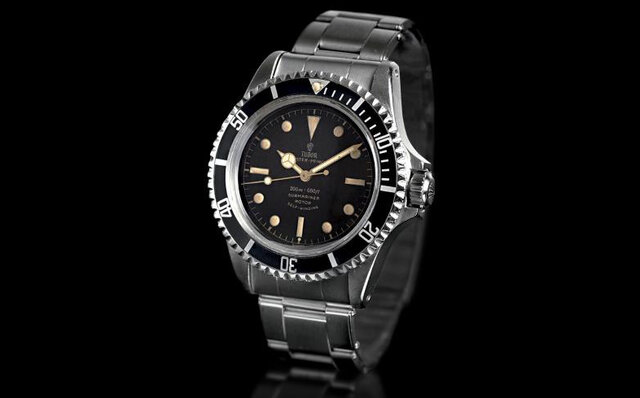
The evolution of the Ref. 7928 continued. The crown guards were modified from the initial square shape to a more pointed version. For this reason, collectors refer to it by the nickname “Pointed Crown Guard.”
A few years later, the ultimate crown guard design was perfected: a round shape. This round design remained unchanged until the final models of the TUDOR Submariner.
The case, boasting 200m water resistance, measured 39mm. The crown and the Oyster-style bracelet, as before, bore Rolex inscriptions. The dial displayed “OYSTER PRINCE” below the brand logo at 12 o’clock, and “200m=660ft,” “SUBMARINER,” “ROTOR,” and “SELF-WINDING” in gold plating at 6 o’clock.
The self-winding Caliber 390 movement was used. The bidirectional rotating bezel featured minute markers, with a luminous insert at the zero position.
Ref. 7928 “Pointed Crown Guard”
Cal. 390
1964 Ref. 7928 TUDOR Oyster Prince Submariner “Tropical”
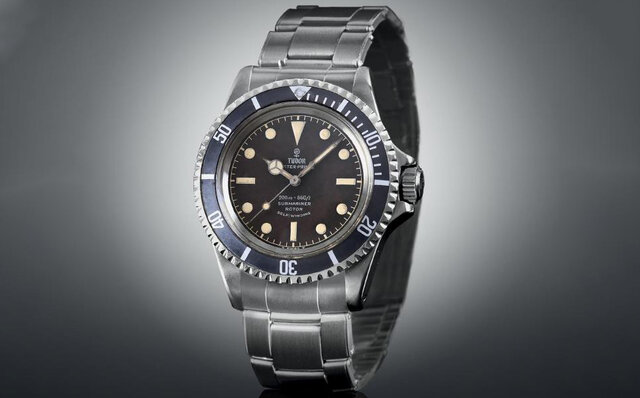
The 1964 “TUDOR Oyster Prince Submariner” has two distinguishing features. One is the new round crown guard design, a form that gradually emerged after the earlier square or pointed versions of the Ref. 7928. Its ergonomic shape was carried forward until the late 1990s.
The bezel and dial in the photograph have faded due to prolonged exposure to strong UV rays; collectors refer to such changes as “tropical” and highly value them.
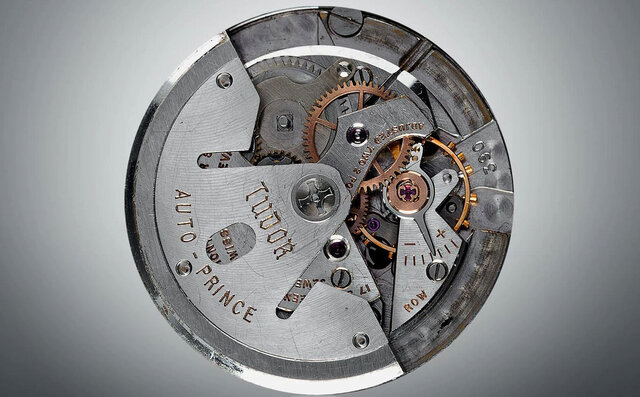
The text on this model’s dial is silver. It uses unique components for the Ref. 7928, with Rolex inscriptions on the case and screw-down crown. The case offers 200m water resistance and houses the self-winding Caliber 390 movement.
Ref. 7928 “Tropical”
Cal. 390
1967 Ref. 7928 TUDOR Oyster Prince Submariner
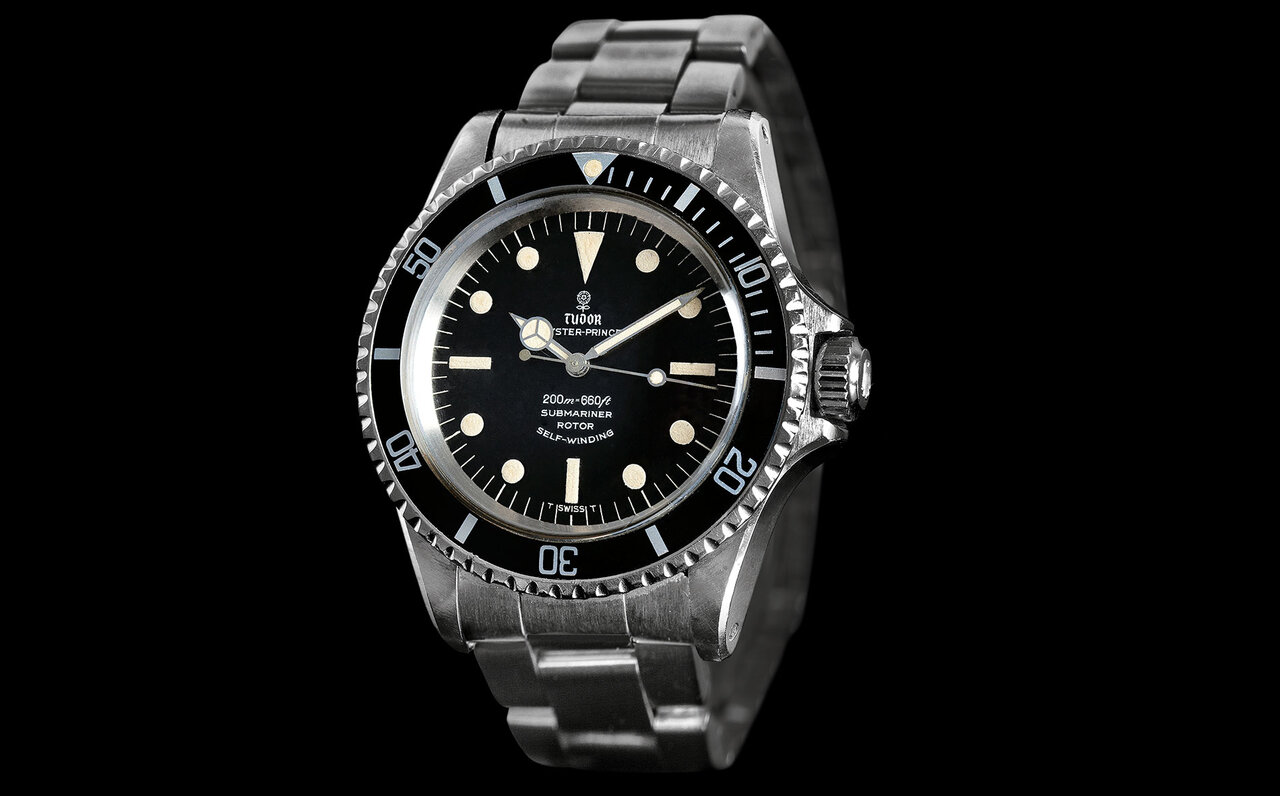
The TUDOR Oyster Prince Submariner manufactured in 1967 represents a subtle evolution of the Ref. 7928 dial throughout the 1960s. Previously, the minute track was printed inside the circle; in this model, the track extends to the edge, eliminating the circle. The text color, which had transitioned from gold-plated to silver, is now white.
With its distinctive Mercedes hands, Rolex-logo case featuring round crown guards, domed plexiglass crystal, robust 200m water resistance, self-winding Caliber 390 movement, and Rolex Oyster bracelet, this Ref. 7928 can be considered the definitive form of the early TUDOR Submariner.
The culmination of 13 years of experimentation and research in the field of dive watches, this model laid the foundation for TUDOR Submariners produced over the next three decades.
Ref. 7928
1969 Ref. 7016 TUDOR Oyster Prince Submariner
The 1969 catalog introduced two new TUDOR Submariner models: the Ref. 7016 and the Ref. 7021 (with date). This marked the beginning of the second generation of TUDOR divers’ watches.
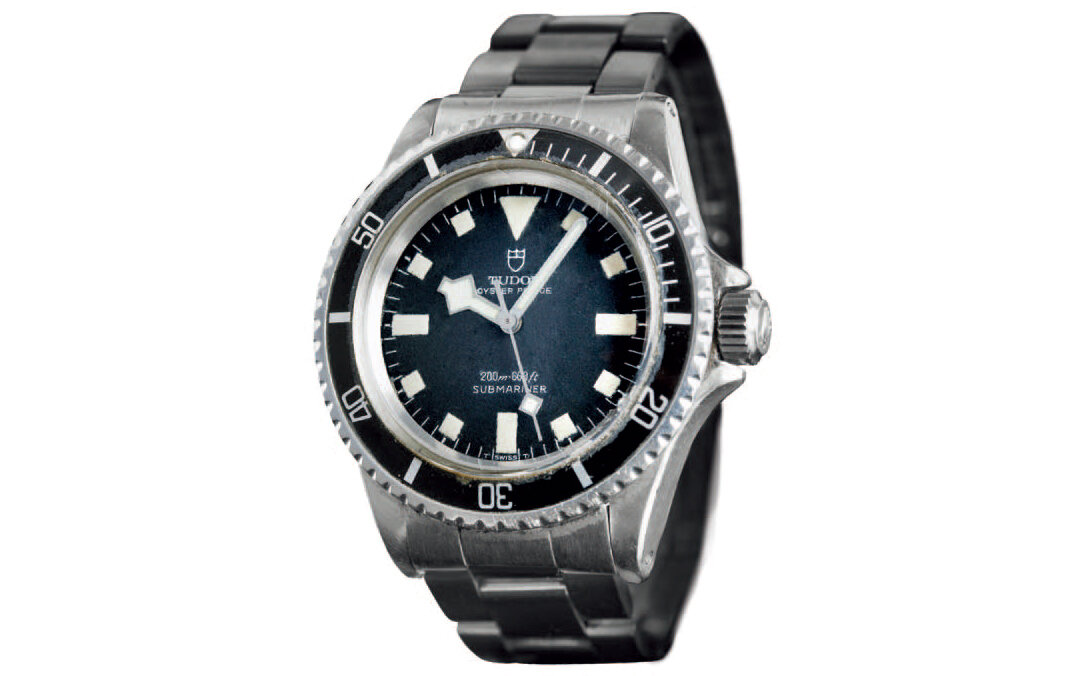
The Ref. 7016 shown here features distinctive dial and hand designs. The hour hand is large and square. In place of the rose logo at 12 o’clock, a shield logo symbolizing durability and reliability was adopted. The hands, known as “Snowflakes” by collectors, are coated with luminous paint for maximum visibility.
This new look, instantly recognizable, contributed to establishing TUDOR’s identity. These updated specifications have become the standard for TUDOR to this day.
Another significant change in the Ref. 7016 was the replacement of the Caliber 390 self-winding movement with the ETA 2483 movement, which maintains the same 18,000 vibrations per hour frequency. Conversely, features established by the previous generation were retained: the 39mm case with Rolex inscriptions, 200m water resistance, round crown guards, a screw-down crown with the Rolex crown mark, a bidirectional rotating bezel marked in five-minute intervals up to 60 minutes, and an Oyster-style folding link bracelet with Rolex inscriptions. The plexiglass crystal is now flat and thick, rather than domed.
Ref. 7016
This concludes our look at the epochal models of the early TUDOR Submariner. The emergence of so many distinct models over 16 years highlights the strong demand for divers’ watches during this era.
On the other hand, the idea of enhancing durability by enlarging the crown head without crown guards offered a uniquely stylish approach. The “Black Bay Fifty-Eight,” our boutique edition’s base collection, recreates this design balance while incorporating modern technology for functional preservation. Fifty-Eight refers to the last two digits of the year 1958, when the Ref. 7924 “Big Crown” was born.