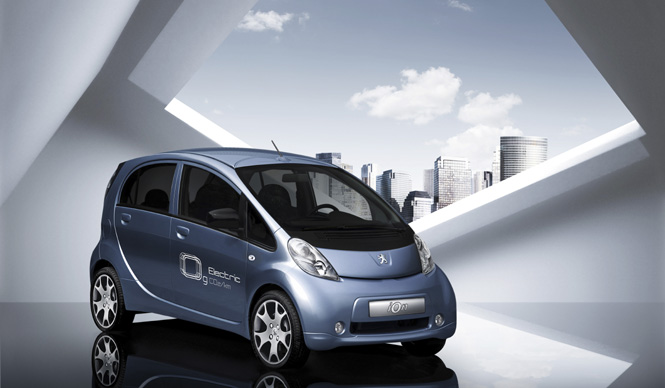
PEUGEOT iOn | The Half-French, Half-Japanese EV
Peugeot iOn | The Peugeot iOn
The Franco-Japanese EV
Peugeot will unveil the new EV 'iOn,' a Peugeot version of the Mitsubishi i-MiEV, at the Frankfurt Motor Show.
By Giraffe
To Be Launched by End of 2010 Under Both Brands
This new Peugeot iOn was born from a basic agreement between PSA Peugeot Citroën and Mitsubishi Motors concerning the development and supply of the i-MiEV, and can be called the Peugeot version of the Mitsubishi i-MiEV.
While the exterior shows little change from the i-MiEV, the overall length has been extended by 85mm, and it features a specially designed bumper, a Peugeot emblem on the front, and Peugeot-designed aluminum wheels.
The EV system is also shared with the i-MiEV, with the rear-mounted motor producing a maximum output of 64ps and a maximum torque of 18.4kgm. It uses a lithium-ion battery (16kWh capacity) as its secondary battery, installed beneath the floor.
Charging takes about 30 minutes to reach approximately 80% capacity using a rapid charger. A full charge can be achieved in about 6 hours using a household 220V outlet. The top speed is 130km/h, with a maximum cruising range of 130km.
PSA plans to launch this new EV under both the Peugeot and Citroën brands by the end of 2010. Initially, the plan is to sell it to governments and large corporations in various European countries.
BRAND HISTORY
Peugeot, one of France's leading brands, also owns Citroën. It is a full-line manufacturer, producing everything from mass-market cars to state limousines, and is actively involved in the 24 Hours of Le Mans and the World Rally Championship.
Peugeot began manufacturing automobiles in 1890. Ten years after Gottlieb Daimler developed the world's first internal combustion engine automobile (the precursor to the Mercedes-Benz), Peugeot was already actively involved in car manufacturing, receiving engines from Daimler.
Peugeot's product development is characterized by its solid, orthodox approach, avoiding eccentric designs. Its close relationship with the Italian coachbuilder Pininfarina also contributes to the elegant design that is a hallmark of Peugeot cars.
In Japan, due to a smaller dealer network and its relatively understated, orthodox design, Peugeot was once a brand known only to enthusiasts. However, the sporty hatchback 205 GTI, introduced in 1986, ignited its popularity. Subsequently, with the 306 and 307, which targeted the VW Golf, the brand significantly expanded its market share, gaining particular attention as an urban vehicle popular among women.
Peugeot's product planning prowess is another key characteristic. The brand was also an early adopter of the CC (Coupé Cabriolet) concept, featuring retractable hardtops for open-top driving.
Another factor behind Peugeot's market growth is its active involvement in motorsport and its consistent success. The brand secured titles in the World Rally Championship in 1985, 1986, and from 2000 to 2002. It achieved overall victories at the 24 Hours of Le Mans twice in the 1990s and again in 2009 with a diesel-powered machine.
As of June 2010, the Japanese lineup includes the 207 (hatchback, station wagon, coupé cabriolet), 308 (hatchback, station wagon, coupé cabriolet), and 407 (sedan, station wagon, coupé). In June, the crossover concept 3008 was added, followed by the sporty compact coupé RCZ in the autumn.