The 3rd Generation Audi TT Makes Its Debut | Audi
Audi TT | The Audi TT
The Third-Generation Audi TT Debuts
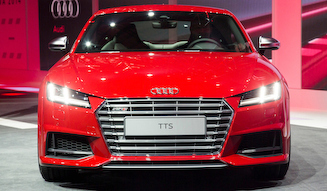
AudiAudi has unveiled the third-generation Audi TT at the Geneva Motor Show. As anticipated, the front fascia strongly suggests a connection to the "Allroad Shooting Brake" concept Audi presented at the Detroit Motor Show in January. Audi positions this look as a key element of its new design language, which it plans to evolve further.
Text by SAKURAI Kenichi
A Front End as Foretold
It has been fifteen years since the first Audi TT was released in 1998. Now, as the third generation,Geneva Motor Showthe new Audi TT, unveiled at the show, may appear to be a continuation of the current second-generation model at first glance. However, its front fascia is adorned with new design elements that herald the dawn of a new era.
The striking front design shows a clear link to the concept car that Audi revealed at the U.S.Detroit Motor Showin January: theAllroad Shooting Brake. The new hexagonal grille with its solid design, the sharp headlights flanking it, the flared wheel arches emphasizing the tires, and the rear design including the sleek taillights are all inherited from the Allroad Shooting Brake. The rumors at the show that the Allroad Shooting Brake was a preview of the new TT have proven true.
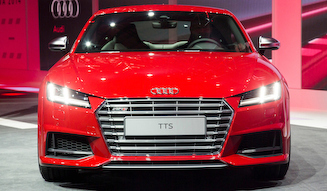
Audi TTS
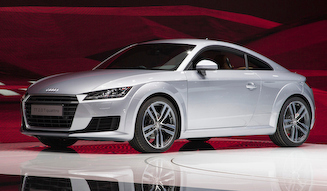
Audi TT 2.0T quattro
While the new Singleframe grille design shares similarities with the current "A3" series, the TT's version is sharper and more minimalist. The mounting of the headlights extending from the grille and the depth created in the hood signify a departure from previous Audi design languages, showcasing the latest aesthetic. How this new design language will be applied to future models is also a point of keen interest.
The body dimensions are 4,180mm in length, 1,832mm in width, and 1,353mm in height. Compared to the current model, all these figures are slightly smaller. However, the wheelbase has been extended by 37mm to 2,505mm, and by shortening the front and rear overhangs, the car achieves a dynamic sports car silhouette within a compact size. The aluminum fuel filler cap, inscribed with the "TT" logo, is a traditional element.
The flat headlights, featuring distinctive design light guides, are another highlight of the new TT. Xenon headlights are standard, with LED headlights available as an option.
Furthermore, the Matrix LED technology, first introduced in the new "A8," is available as an option. This system uses twelve LEDs that switch on and off to control the high beam without dazzling oncoming traffic, ensuring optimal visibility at night.
When equipped with Matrix LEDs, the turn signals also consist of multiple LEDs that illuminate sequentially, creating a flowing effect to clearly indicate the direction of the turn. The cornering lights also work in conjunction with navigation terrain data, activating before the steering input to illuminate the road ahead of the corner.
The rear spoiler, integrated between the taillights, deploys at speeds above 120 km/h to enhance rear stability at high speeds.
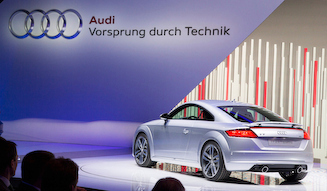
Audi TT
All models feature round exhaust pipes on each side. However, the TTS, positioned as the high-performance version, has these replaced with a sportier dual-pipe setup.
The optional "S line" package includes a dedicated sport design for the bumpers, air intakes, side sills, rear diffuser, and the new Singleframe grille. The ride height is lowered by 10mm, and it comes with 18-inch wheels.
Audi TT | The Audi TT
The Third-Generation Audi TT Debuts (2)
The Relentless Pursuit of Lightweight Design
Internally, the new TT's body, reflecting its new exterior design, combines aluminum and steel in a strategically appropriate manner, similar to previous models. The use of aluminum has increased compared to the second generation, with components like the roof, hood, doors, and trunk lid now made of aluminum. Conversely, the application of high-strength steel has also been expanded. The passenger cell is constructed from this ultra-high-strength steel, accounting for 17% of the entire body structure.
The body weight of the 2.0 TSFI engine model is 1,230 kg, representing a 50 kg reduction compared to the second-generation model. Notably, the second-generation model itself achieved a weight reduction of up to 90 kg over the first TT, demonstrating a consistent trend of weight reduction with each iteration.
Considering the improvements in safety and the integration of modern comfort features, the effort invested in this advanced lightweight construction is considerable. Weight reduction not only enhances driving performance but also significantly contributes to improved fuel efficiency and reduced CO2 emissions. This dedication to lightweight design is truly a core development policy forAudi.
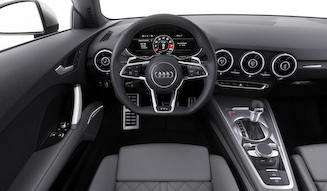
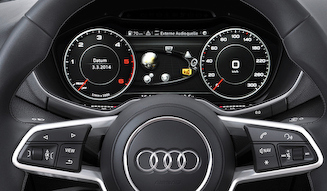
The "Virtual Cockpit": Developed with the Driver in Mind
The interior, which carries over the horizontal lines from the exterior, features a flat center console and a minimalist cockpit with few switches. Its most significant characteristic is the newly developed digital display integrated within the instrument cluster.
The "Virtual Cockpit," a 12.3-inch TFT monitor with a resolution of 1,440 x 540 pixels, is housed within the driver's instrument cluster. Users can switch between two modes – the standard view displaying the speedometer and tachometer, and a navigation screen mode – using buttons on the steering wheel or the newly designed MMI controller (which retains the combination of a large rotary dial and two toggle switches). In navigation mode, essential driving information such as speed and engine RPM is still displayed.
The key advantage is the minimal eye movement required to view the navigation screen. It's a fresh approach to have the navigation display, a feature expected in modern cars, not on the center console or dashboard. It cleverly subverts the trend of prioritizing large, prominent dashboard screens. While usability can only be fully assessed through experience, Audi explains that this system was developed from a driver-oriented perspective.
The distinctive round air vents, echoing the traditional design, display temperature and climate control modes in their center. As mentioned, with the navigation screen now integrated into the instrument cluster, the central dashboard monitor found in the current model is absent in the new TT.
Audi TT | The Audi TT
The Third-Generation Audi TT Debuts (3)
Three 2.0-Liter Engine Options
The European specifications announced include three 2.0-liter four-cylinder direct-injection turbo engines. The entry-level "2.0 TFSI" model features a gasoline engine producing a maximum output of 169 kW (230 hp) and 370 Nm (37.7 kgm) of torque. The high-performance TTS model is equipped with the same engine but with dedicated engineering, delivering a maximum output of 228 kW (310 hp) and 380 Nm (38.7 kgm) of torque. Both these models can be paired with either a 6-speed manual transmission or a 7-speed S tronic. The third option is a diesel engine with a maximum output of 135 kW (184 hp) and 380 Nm (38.7 kgm) of torque, available exclusively with a 6-speed manual transmission.
In addition to front-wheel drive, Audi's renowned "quattro" all-wheel-drive system is also available. The quattro system has been revised and made lighter, incorporating the "AudiDrive Select" for enhanced driving dynamics. The front McPherson strut suspension and the rear four-link suspension, both made of aluminum, have also been further lightened. The adaptive damper control system, standard on the TTS and optional on the TT, has also entered its third generation.
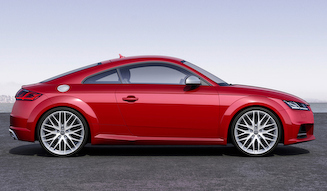
Audi TTS
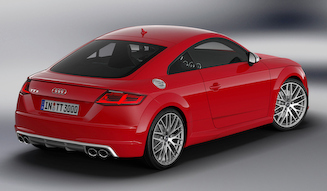
Audi TTS
For the TT, the front-wheel-drive 6-speed manual version achieves 0-100 km/h in 6.0 seconds and a top speed of 250 km/h (electronically limited). The 4WD "TT quattro" with the 6-speed S tronic accelerates from 0-100 km/h in 5.3 seconds, with a top speed of 250 km/h (electronically limited), and CO2 emissions are rated at 159 g/km. The "TTS," exclusively 4WD, shortens the 0-100 km/h acceleration time to 4.7 seconds.
The standard wheels are 17-inch with 225/50R17 tires, but 19-inch wheels are available as an option. Additionally, 20-inch wheels produced by quattro GmbH are also part of the lineup.
The new TT also enhances its entertainment features with the "Audi Connect" system, which includes Wi-Fi with LTE support, and the familiar 14-channel amplifier and 12-speaker "Bang & Olufsen Sound System." The woofers mounted in the doors are equipped with adjustable ambient lighting. We eagerly await the first reports of its arrival in Japan, rumored to be within this year.
Audi TT 2.0TFSI | Audi TT 2.0TFSI
Body Dimensions | Length 4,180 x Width 1,832 x Height 1,353 mm
Wheelbase | 2,505 mm
Weight | 1,230 kg
Engine | 2.0-liter inline 4-cylinder direct-injection turbo
Max Output | 169 kW (230 ps)
Max Torque | 380 Nm
0-100 km/h Acceleration | (6-speed MT + FWD) 6.0 sec (6-speed S tronic + AWD) 5.3 sec
Top Speed | 250 km/h (electronically limited)
Fuel Economy | (6-speed S tronic + AWD) 6.8 ℓ/100km (approx. 14.7 km/ℓ)
CO2 Emissions | (6-speed S tronic + AWD) 159 g/km
Trunk Capacity | 305 liters
Audi TTS | Audi TTS
Body Dimensions | Length 4,180 x Width 1,832 x Height 1,343 mm
Wheelbase | 2,505 mm
Engine | 2.0-liter inline 4-cylinder direct-injection turbo
Max Output | 228 kW (310 ps)
Max Torque | 380 Nm / 1,800-5,700
0-100 km/h Acceleration | 4.7 sec
Top Speed | 250 km/h (electronically limited)
Trunk Capacity | 305 liters
Audi TT 2.0TDI | Audi TT 2.0TDI
Body Dimensions | Length 4,180 x Width 1,832 x Height 1,353 mm
Wheelbase | 2,505 mm
Engine | 2.0-liter inline 4-cylinder common rail direct-injection turbo diesel
Max Output | 135 kW (184 ps)
Max Torque | 380 Nm
0-100 km/h Acceleration | 7.2 sec
Top Speed | 235 km/h
Fuel Economy | 4.2 ℓ/100km (approx. 23.8 km/ℓ)
CO2 Emissions | 110 g/km
Trunk Capacity | 305 liters