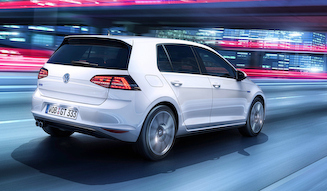
Volkswagen Adds Plug-in Hybrid Model to Golf Lineup | Volkswagen
Volkswagen Golf GTE
The Golf Plug-in Hybrid with a 939km Range
Volkswagen willGeneva Motor Showunveil a plug-in hybrid model of theGolfat the. This makes Volkswagen the world's first automaker to offer five solutions for a single model: gasoline, diesel, natural gas, EV, and plug-in hybrid.
Text by SAKURAI Kenichi
The Diversifying Golf Powertrain
Currently, a key factor for automakers is responding to energy diversity. This is closely related to globalization; for example, gasoline cars may be the appropriate solution depending on regional energy circumstances, while EVs and hybrids are welcomed in other countries and regions.
To put it more simply, while users in urban areas may welcome EVs and hybrids as the optimal cars, in developing countries, gasoline might be the only realistic energy source due to insufficient power generation. Therefore, high-tech systems like fuel cells are not necessarily the sole advantage for next-generation solutions.
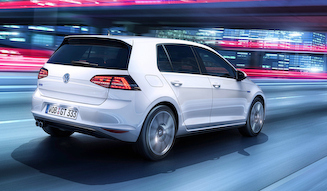
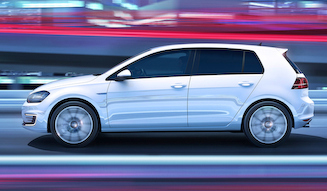
In today's world where globalization is essential for survival, automakers face the challenge of supporting various fuel systems until the next-generation fuels that will succeed fossil fuels are determined.
Volkswagen has therefore been quick to announce solutions that accommodate diverse energies. For its core model, the Golf, the company has already released four powertrain types: gasoline, diesel, natural gas, and EV. Now, it has added the Golf GTE, equipped with a new plug-in hybrid system.
The 'GTE' designation follows the two sporty icons,GTIandGTD, signifying that it delivers not just plug-in hybrid performance but also sporty driving. Volkswagen positions the GTE as its third sporty model, inheriting the traditional 'GT' philosophy.
Volkswagen Golf GTE
The Golf Plug-in Hybrid with a 939km Range (2)
Capable of 50km on Electric Power Alone
The powertrain features a 1.4-liter, four-cylinder direct-injection turbo engine (1.4 TSI), already available in Japan, producing a maximum output of 110kW (150ps), and an electric motor with a maximum output of 75kW (102ps). The combined system output boasts a high 150kW (204ps). The transmission is a 6-speed DSG (dual-clutch) with modifications specifically for the hybrid model.
The battery is an 8.8kWh lithium-ion unit weighing 120kg. This brings the vehicle's weight to 1,524kg (compared to around 1,320kg for the Japanese gasoline version with the same engine), yet it remains commendably light.
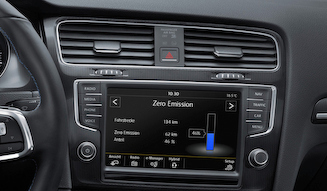
With a top speed of 222km/h and 0-100km/h acceleration in 7.6 seconds, its brisk performance justifies the GT designation. In EV mode, it achieves a practical top speed of 130km/h and a 50km zero-emission range.
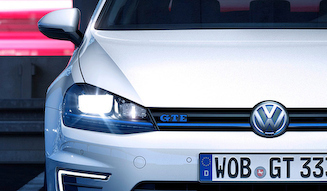
The combined range of the motor and gasoline engine reaches an impressive 939km, allowing travel between major German cities without refueling.
Full charging takes about three and a half hours with standard charging in Germany, but using a dedicated wall box in a home garage or a public charging station completes the charge in approximately two and a half hours. The charging port is integrated within the front grille's emblem.
Fuel economy is an outstanding 55.5km per liter for the plug-in hybrid model, with CO2 emissions as low as 35g/km.
Volkswagen Golf GTE
The Golf Plug-in Hybrid with a 939km Range (3)
GTI, GTD, and GTE
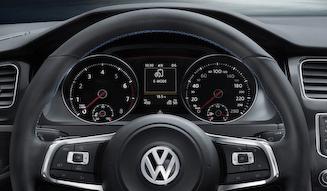
As mentioned earlier, the exterior adopts a sporty design similar to the GTI and GTD. It features 18-inch alloy wheels, a sports exhaust system, and, true to the GTI, checkered sports seats. Blue accents in the interior subtly hint at its plug-in hybrid nature.
Volkswagen's Golf powertrains are fully modular, based on what they call the Modular Transverse Matrix, or 'MQB'. This allows any powertrain to be assembled on the same production line, a principle that will also apply to the upcoming fuel cell vehicle (FCV).
While Japanese automakers are focusing on dedicated HV and EV models to differentiate and compete on added value, Volkswagen has pursued development to support energy diversity within a single model. It's difficult to definitively say which approach is superior, but powertrain modularization should also lead to reduced manufacturing costs. When considering what is necessary to popularize new technologies, it seems that Japanese manufacturers, clinging to high-tech myths, may not possess the firm vision and execution capabilities required.