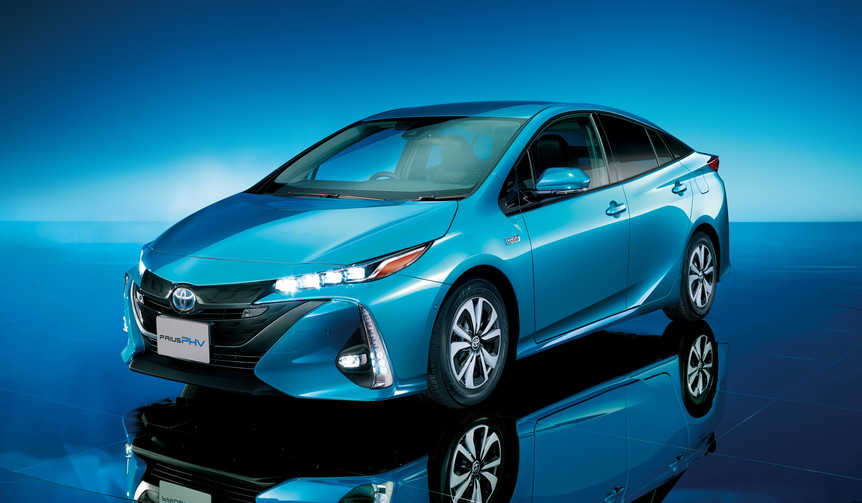
Toyota Launches Prius PHV | Toyota
Toyota Prius PHV | The Toyota Prius PHV
Toyota Launches Prius PHV
Toyota announced the new Prius PHV on Wednesday, February 15, and began sales nationwide on the same day.
Text by HORIGUCHI Yoshihiro (OPENERS)
Adopts Dual Motor Drive System
The model had its world premiere at the New York Auto Show last March,Toyota Prius PHVhas finally gone on sale in Japan.
The new Prius PHV's powertrain features a 1.8-liter gasoline engine producing a maximum output of 72 kW (98 ps) and a peak torque of 142 Nm (14.5 kgm). This is combined with a drive motor with an output of 53 kW (72 ps) and 163 Nm (16.6 kgm) of torque. Additionally, a generator motor with an output of 23 kW (31 ps) and 40 Nm (4.1 kgm) of torque, which temporarily assists the drive motor via a one-way clutch, is employed in what is called a "Dual Motor Drive System," delivering powerful acceleration.
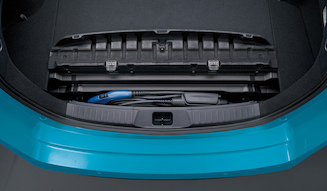
The drive battery, housed beneath the luggage compartment, is an 8.8 kWh lithium-ion unit. While its capacity has been doubled compared to the previous generation, its weight has increased by 1.5 times and its volume by 1.6 times. To prevent performance degradation in low temperatures, a "battery heating system" that maintains a constant temperature using a heater has also been adopted.
For heating during EV driving, a heat pump that efficiently collects heat from the outside air has been adopted for the first time, rather than using engine heat or a heater. Numerous other improvements have been made to enhance efficiency, resulting in improved fuel economy during hybrid driving from the previous 31.6 km/ℓ to 37.2 km/ℓ. Furthermore, the maximum driving range in EV mode has dramatically expanded from 26.4 km to 68.2 km, and the maximum speed in EV mode has been increased from 100 km/h to 135 km/h.
Toyota Prius PHV | The Toyota Prius PHV
Toyota Launches Prius PHV (2)
Diverse Charging Options: Rapid Charging, Home Outlets, and Solar Power
A rapid charging socket, absent in the previous generation, has been added. This allows for charging up to 80 percent of the battery's capacity in approximately 20 minutes using rapid charging facilities installed at commercial facilities, highway service areas, and convenience stores. Additionally, a 100V/6A socket has been added for charging at home without the need for dedicated wiring. Combined with the conventional 200V/16A standard charging, three charging methods are now available. Full charging via conventional 200V standard charging takes about 2 hours and 20 minutes, while using a 100V outlet takes approximately 14 hours.
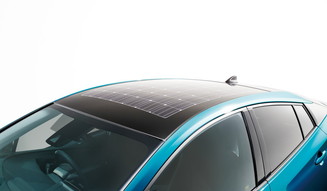
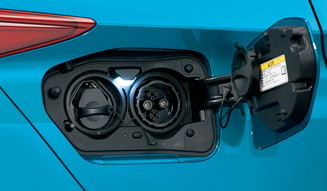
Furthermore, the new Prius PHV is equipped with a solar power generation panel on the roof, capable of producing a maximum of 180W. While parked, it can charge the drive battery, storing enough power for up to 6.1 km of driving per day. During driving, it charges the 12V auxiliary battery, helping to reduce fuel consumption.
The vehicle also features an external power supply function that utilizes the large-capacity battery. In addition to the EV power supply mode, which operates without the engine running, the HV power supply mode offers an output of up to 1,500W and can supply power for up to two days on a full tank of gasoline.
Toyota Prius PHV | The Toyota Prius PHV
Toyota Launches Prius PHV (3)
Features an 11.8-inch Large Display, Becoming a Connected Car
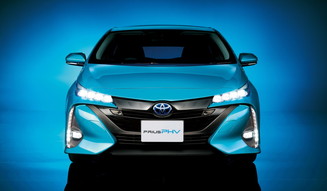
Unlike the previous generation, the exterior, differentiated from the standard "Prius" Prius," features translucent acrylic resin in the front grille. The headlights consist of 16 LEDs on each side and are equipped with an Adaptive High-beam System that optimizes the illumination range according to surrounding conditions. The double-bubble shaped rear hatch utilizes CFRP material for the first time in a Toyota brand, achieving approximately 40 percent weight reduction compared to aluminum.
Inside, the center console is equipped with a large, vertical 11.6-inch tablet-like touch panel display. This allows for flexible access to information, such as split-screen display of navigation and audio, or a spacious navigation view on the large screen.
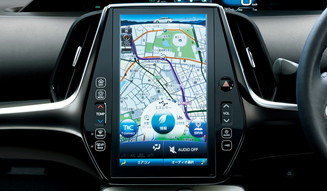
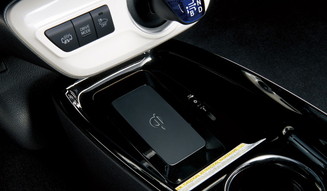
A communication module (DCM) is standard equipment. The "T-Connect DCM Package," a connected service provided by Toyota, is offered free of charge for three years.
The latest safety technologies are also incorporated. All models come standard with Toyota Safety Sense P, which includes pre-collision system with pedestrian detection, lane departure alert, and radar cruise control with lane tracing assist, utilizing cameras and millimeter-wave radar for sensing.
Prices range from 3,261,600 yen for the S grade to 4,222,800 yen for the A Premium grade.

Toyota Prius PHV | The Toyota Prius PHV
Body Dimensions | Length 4,645 x Width 1,760 x Height 1,470 mm
Tread Front/Rear | 1,530 / 1,540 mm
Wheelbase | 2,700 mm
Curb Weight | 1,510 kg
Engine | 1,797 cc Inline 4-cylinder
Engine Max Output | 72 kW (98 ps) / 5,200 rpm
Engine Max Torque | 142 Nm (14.5 kgm) / 3,600 rpm
Motor 1 Max Output | 53 KW (72 ps)
Motor 1 Max Torque | 163 Nm (16.6 kgm)
Motor 2 Max Output | 23 KW (31 ps)
Motor 2 Max Torque | 40 Nm (4.1 kgm)
Drivetrain | FF
Transmission | CVT (Electronic Continuously Variable Transmission)
Hybrid Fuel Economy (JC08 Mode) | 37.2 km/ℓ
EV Driving Range | 68.2 km
EV Max Speed | 135 km/h
Drive Battery | 8.8kWh Lithium-ion Battery
Seating Capacity | 4 persons
Tires | 195/65R15
Price | (S) 3,261,600 yen (A) 3,807,000 yen (A Premium) 4,222,800 yen