December 16, 2014
Paris Motor Show 2014: The Final Report
Mondial de l’Automobile 2014
From the Paris Motor Show: The Final Installment
The Paris Motor Show 2014, France’s largest automotive exhibition, which began on October 4th, finally closed its curtains on the 19th. We have brought you on-site reports in four installments. In this final piece, we will explore the “future of automobiles” glimpsed in Paris. This report is by automotive journalist Fumio Ogawa.
Text by OGAWA Fumio
From the Paris Motor Show Vol. 1
From the Paris Motor Show Vol. 2
From the Paris Motor Show Vol. 3
From the Paris Motor Show Vol. 4
The Light and Shadow of European Automakers
This fifth report from the 2014 Paris Motor Show focuses on the light and shadow of European automakers, glimpsed amidst the joyful atmosphere of the venue.
As mentioned in our series of reports, the Paris Motor Show featured manufacturers from France and Italy presenting impressive exhibits that created a lively atmosphere. This was in stark contrast to the somewhat overly serious booths of German manufacturers, despite the considerable cost involved.
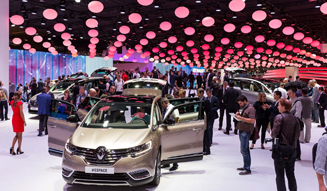
Renault entertained visitors with a fantastical display where countless spherical lamps suspended from the ceiling gently moved up and down like jellyfish. They also prominently featured the new Twingo, jointly developed with Mercedes-Benz, emphasizing its diverse interior and exterior color options.TwingoThis was a distinctive feature.
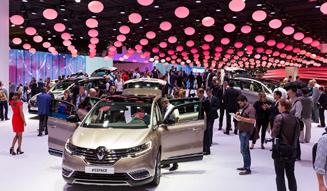
Renault's Booth Expressing the Joy of Driving

Fiat 500: Full of Playfulness
Citroën presented its separate brand, DS, as a modern gallery. It emphasized French elegance and creativity reminiscent of the fashion capital. The compact hatchback "C1," announced in early 2014, made a strong impression.
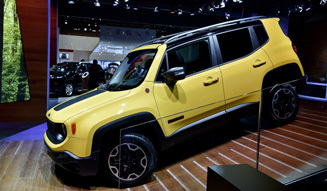
Fiat also focused on the fun of driving with its best-selling compact, the500" . Special editions of the 500, painted in camouflage or denim patterns, and others with artistic color schemes, attracted the attention of visitors. Within the same group, Ferrari, Maserati, Abarth, Lancia, and even Jeep all shared a common appeal: the joy of owning a car.Ferrari, Maserati, Abarth, Lancia, and even Jeep all shared a common appeal: the joy of owning a car.
Mondial de l’Automobile 2014
From the Paris Motor Show: The Final Installment (2)
A Steep "Fine" of 95 Euros Per Car
However, when looking at future prospects, including sales and economic conditions, it may be the German automakers who see brighter days. The EU Commission, prioritizing global warming issues, has imposed a target of 95 grams of CO2 emissions per kilometer by 2020 for 95% of production vehicles.
"The solutions will be costly. It would be a burden if automakers are forced to bear them." This statement by Ford Europe CEO Stephen Odell was widely quoted in European newspapers covering the Paris Motor Show. Similar sentiments seem to be shared by other manufacturers.New SmartFor example, the current CO2 emissions for the new Smart are 97 grams/km. It is understandable that achieving the regulated level will be a significant challenge.
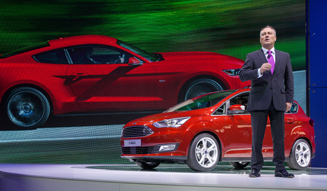
Ford Europe CEO Stephen Odell
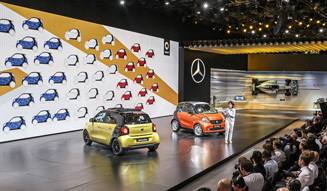
Smart forfour / Smart fortwo
In response, German manufacturers have decisively shifted towards reducing CO2 emissions early on. "Volkswagen invests 10 billion euros annually in development," stated Dr. Martin Winterkorn, Chairman of the Board of Management of the Volkswagen Group, with confidence.
They also announced the "XL Sport" concept car, powered by a 1199cc two-cylinder engine from the motorcycle brand Ducati, and have begun actively introducing hybrid technology to Lamborghini and Porsche.XL SportThis strategic shift is in anticipation of the 2020 regulations. "For the time being, we will navigate the new era with electric vehicles and plug-in technologies," Dr. Winterkorn added.Lamborghini, and Porsche. This strategic shift is in anticipation of the 2020 regulations. "For the time being, we will navigate the new era with electric vehicles and plug-in technologies," Dr. Winterkorn added.
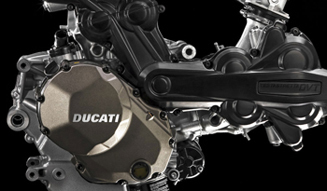

VW's "XL Sport" Featuring a Ducati Engine
Of course, the move towards CO2 reduction on a larger scale is to be welcomed. Automobiles are always about moving forward. In 1974, when the Muskie Act was enacted in the US to prevent worsening air pollution, many lamented that this was the end of the automobile. But did the mandatory catalytic converters truly make cars disappear?
In the short term, Latin automakers are wary of this trend among German cars. This is because technologies for fuel efficiency, low CO2 emissions, and weight reduction, which German manufacturers are pursuing, have not yet become a reality for them. Failure to meet the targets will result in a hefty "fine" of 95 euros per car for each gram of excess emissions.
Mondial de l’Automobile 2014
From the Paris Motor Show: The Final Installment (3)
The Dominance of German Cars
This poses a significant challenge, especially for manufacturers whose core products are compact hatchbacks. Reducing engine displacement might compromise the nimble driving feel, even if fuel economy improves. They face a dilemma.
While Volkswagen faces scrutiny over the profitability of its massive investment in the "MQB" front-wheel-drive platform, which underpins models like theGolf, they are making steady progress in this area. The technology of using turbochargers and other methods to boost small-displacement engines, balancing fuel efficiency and power, can be clearly experienced in the new "Polo" released in Japan in September 2014, and the new "Passat" arriving in the Japanese market in 2015.
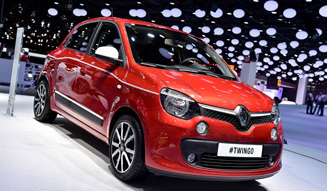
Renault Twingo
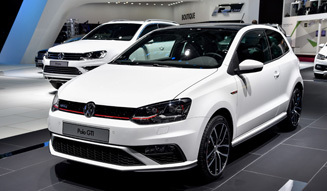
The hot version of the new Polo, the Polo GTI, was also unveiled at Paris.
Although the venue was Paris, this show was particularly illuminated by the significant presence of German cars. "Our intention is not to conquer Europe. We recognize the need to minimize any negative impact on other countries, including market share and local employment," stated a German manufacturer's spokesperson. Yet, it felt like a stark reminder that only those with a clear vision of the path ahead can reach the future.
The new Renault Twingo, mentioned earlier, is essentially the Mercedes new "Smart Forfour." Dr. Annette Winkler, who oversees Smart, emphasized that this car is "more French than ever" and is produced in France. However, the Euro 6 compliant engines and the in-car connectivity with internet and smartphones, which is becoming a "must" in Europe, are undoubtedly enabled by Mercedes' core technology.
Mondial de l’Automobile 2014
From the Paris Motor Show: The Final Installment (4)
Glimpses from the Paris Motor Show
Meanwhile, both German and Latin cars, including French models, face challenges. Some EU member states are experiencing fiscal deterioration, the Russian market is unstable due to the Ukraine crisis, and promising markets like India and Brazil are shrinking due to high-interest rate policies. The economic downturn is more severe than anticipated just a short while ago.
"Looking only at the present, the growth in the Chinese and US markets is stronger than ever before," said a Maserati spokesperson, but this applies to luxury cars. European mass-market manufacturers, who have focused on expanding into countries where the economic situation is not as stable as in Western Europe, must compensate for thin profit margins by selling large volumes.
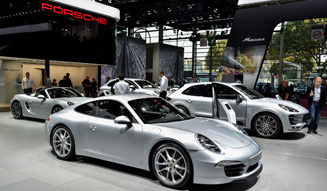
Manufacturers with strong technological capabilities will dominate the market. However, to avoid an oligopoly... If this is the future of the automotive industry, it may ultimately lead to OEM (Original Equipment Manufacturer) arrangements, where companies source core components from others and focus solely on their own styling and branding.
What was glimpsed at the Paris Motor Show was a future for automobiles that is not entirely welcome. But how can smaller manufacturers afford the massive investment required to develop platforms and powerplants that balance fuel efficiency and power? And how can they sell them on a global scale? Solutions to these challenges will likely be presented at shows from 2015 onwards, but I want to believe in the forward momentum of automotive manufacturers.