January 5, 2015
Introducing the New Rear-Wheel-Drive Twingo | Renault
Renault Twingo
The RR-Layout Third-Generation Renault Twingo Unveiled
Renault hasGeneva Motor Showunveiled the new Twingo. The third generation, which draws significant inspiration from previous Twingos as well as the "Renault 5," has been reborn with a rear-engine, rear-wheel-drive (RR) layout.
Text by HORIGUCHI Yoshihiro (OPENERS)
Two Gasoline Engines Offered
At the Geneva Motor Show, Renault held the world premiere of the third-generation Twingo. As previously announced, this compact model features a shorter body than its predecessor, offering a more spacious interior and adopting the increasingly rare RR layout.
In line with Renault's recent new car strategy, the Twingo is part of the "Life Cycle Strategy," which expresses six key moments in life, and represents the fifth "PLAY" stage.
The new Twingo measures 3.59 meters long, 1.64 meters wide, and 1.55 meters high. By pushing the wheels to the extreme corners, it achieves a wheelbase of 2.49 meters. While its overall length is 10 cm shorter than the second generation, the interior length from the dashboard to the hatch door is 13 cm longer, allowing for the transport of items up to 2.20 meters long.
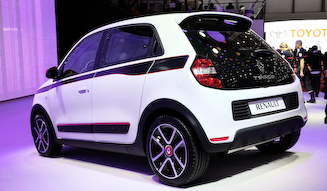
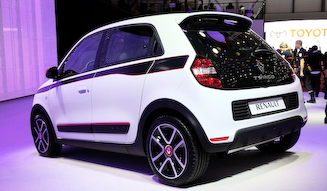
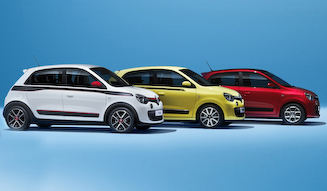
Previous Twingoas well as the styling, which is heavily influenced by the classic "Renault 5," inherits features from the concept modelsEV "Twin'Z"and"Twin'RUN" with its mid-ship V6 engine.Its front adopts the latest Renault face. The line that wraps around the body from the edges of the headlights to the rear becomes thicker, reflecting the bulging fenders, serving as a key accent that emphasizes its powerful stance.
While the third generation is the first Twingo to feature five doors, the rear doors are blacked out along with the C-pillar, similar to the newClio, creating an illusion of a two-door car from a distance.
Renault Twingo
The RR-Layout Third-Generation Renault Twingo Unveiled (2)
Two Gasoline Engines Offered
Two engine options are available, both positioned beneath the luggage compartment. These are water-cooled, inline 3-cylinder gasoline engines, uniquely tilted at a 49-degree angle to fit into the compact space.
The newly developed 999cc inline 3-cylinder naturally aspirated engine, dubbed "SCe 70," produces a maximum output of 70 hp and 91 Nm of torque. This engine can be paired with an idling stop function depending on regional demand. The other option is the "Energy TCe 90," an 898cc inline 3-cylinder turbo engine delivering 90 hp and 135 Nm of torque. To comply with EU6 emissions standards, this engine comes standard with an idling stop system.
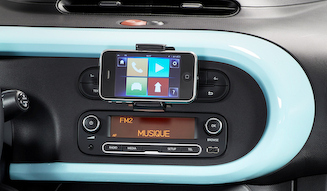
With R&GO, your smartphone integrates with the radio to provide various infotainment features.
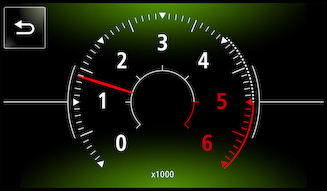
Tachometer display with R&GO
The front seats, integrated with the backrest, are designed for an upright driving position. Renault states this is to maximize rear seat space and to allow drivers to enjoy the agile driving feel characteristic of the new Twingo.
Driving information is consolidated within a large, single-eye instrument cluster positioned in front of the driver. The white ring surrounding it doubles as the speedometer, with information displayed digitally in the center. The center console houses infotainment functions, including the radio.
Two types of multimedia terminals are available for the European market. One is the latest infotainment system, "R-Link Revolution," also found in other Renault models. The other is called "R&GO," offered as a smartphone application that interfaces with the car's radio.
When equipped with R&GO, the radio unit includes a universal mount for a smartphone. Placing an iOS or Android smartphone here and launching the application transforms it into an onboard computer, providing 3D navigation, a media player, and vehicle information display.
Renault Twingo
The RR-Layout Third-Generation Renault Twingo Unveiled (3)
Developed Jointly with Next-Generation Smart
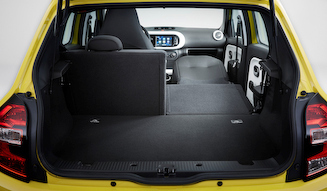
The luggage capacity is 219 liters. The rear seats feature 50:50 split-folding backrests, allowing for cargo up to 1.35 meters long when folded, and up to 2.20 meters when the front passenger seat is also folded down.
Due to the engine space located beneath the luggage compartment, the floor is raised higher than in front-wheel-drive compact cars, set at the same height as the door sill. This design facilitates easier loading and unloading of luggage and allows for a square cargo area unaffected by wheel arches, turning a potential disadvantage into a clever advantage.
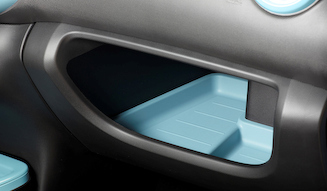
Additionally, numerous storage solutions and optional features are provided, including the center console, glove box, door pockets, and under the rear seats, maximizing the use of the compact space.
The new Twingo's adoption of the RR layout, a departure from its previous platform and a pursuit of space efficiency, was made possible by cost reductions achieved through joint development with Daimler. Daimler is expected to launch the next-generation model of its "Smart" car, which also features an RR layout, in the near future.