December 25, 2014
Peugeot's 208 Hybrid: A Masterclass in Lightweight Design | Peugeot
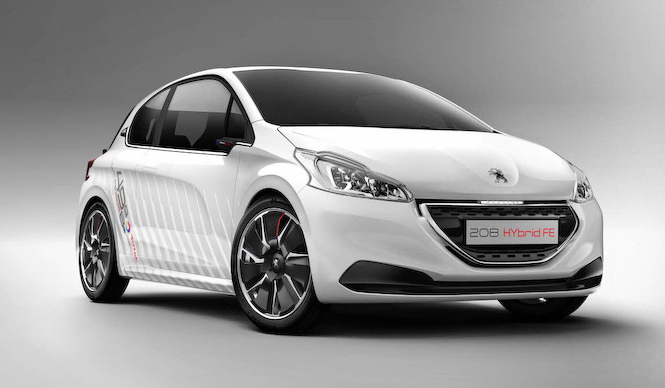
Peugeot 208 HYBRID FE Concept
Peugeot Reveals Details of 208 Hybrid
Held this past March,Geneva Motor Showsaw the announcement of its existence.Hybrid Model Based on Peugeot "208"The full picture of the hybrid model, based on the Peugeot "208",Frankfurt Motor Show 2013will be revealed at the Frankfurt Motor Show 2013. Alongside the latest hybrid system, jointly developed with Total, the extensive weight reduction measures are also noteworthy.
Text by SAKURAI Kenichi
Outstanding Environmental Performance: 47.6 km/L, 49 g/km CO2 Emissions
At the Frankfurt Motor Show, Peugeot will unveil the "208 HYBRID FE Concept," a concept model intended for production.
The Peugeot 208 HYBRID FE Concept was first revealed at the Geneva Motor Show this past March. However, only the hybrid system, jointly developed with TOTAL, and an overview of the model were announced. The vehicle itself was displayed as a white object, its appearance hidden from view.
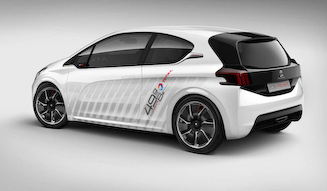
The model appearing now is a realistic representation. Although it carries the "Concept" designation, it is clearly intended for production. Once the show "makeup" is removed, the production model's form becomes visible.
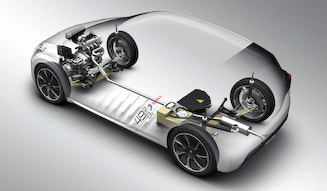
The noteworthy hybrid system incorporates technology from the Peugeot "908 HYBRID4" that competed in the Le Mans Series in 2009. It comprises a 1.2-liter, three-cylinder gasoline engine producing 68 ps (50 kW), a 40 ps (30 kW) electric motor, and a lithium-ion battery with a capacity of 0.56 kWh. It is capable of driving up to 12 miles (approx. 19 km) on electric power alone. However, alongside the hybrid system, the thorough weight reduction efforts are equally significant.
The Peugeot "208 HYBRID FE Concept" to be unveiled at the Frankfurt Motor Show weighs approximately 440 pounds (200 kg) less than the 1.0-liter "VTI" base model (vehicle weight 2,149 lbs / 975 kg). This reduction of about 20 percent was achieved through a combination of factors: employing engine parts that offer both lightness and strength, such as a crankshaft made of nitrided steel, titanium connecting rods, and aluminum and copper alloy valves; extensive use of composite body panels, including a carbon fiber hood (minus 5 kg), rear spoiler (minus 2.1 kg), and door panels (minus 2 kg); and the use of lightweight polycarbonate for the glass sections, excluding the door windows. These painstaking weight-saving measures, reminiscent of racing machines, have resulted in this remarkable achievement.
To further enhance aerodynamic performance, a small camera replaces the rearview mirror, and specially developed, large-diameter yet narrow 145/65R19 tires from Michelin are fitted. The wheels feature carbon fins to improve airflow.
The suspension is also sophisticated. In the McPherson strut suspension adopted by the Peugeot "208 HYBRID FE Concept," the springs, wishbones, and anti-roll bars have been replaced with rear blades made of fiberglass. This reduces unsprung weight by approximately 10 kg.
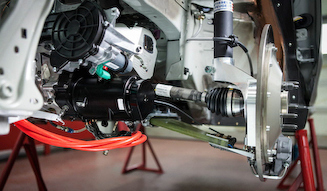
Naturally, these are part of the "show" elements. It is expected that more conventional components will be used in the production version.
The benefits of the hybrid system and weight reduction are evident in its brisk acceleration from 0-62 mph (0-100 km/h) in 8 seconds. With CO2 emissions of just 135 mpg (49 g/km) and fuel economy of 2.1 L/100km (47.6 km/L), these figures illustrate how the Peugeot 208 HYBRID FE Concept embodies both FE (Fuel Economy) and FE (Fun & Emotion). It will be interesting to see how closely the production model, when it eventually sheds the "Concept" from its name, will approach this level of performance.