Test Drive, BMW i8 | BMW
BMW i8 | BMW
An Unprecedented Hybrid Sports Car
Test Drive: BMW i8
Following the electric vehicle 'i3', the next model to arrive under BMW's sub-brand 'i' is the plug-in hybrid 'i8'. In stark contrast to the i3, which has a strong character as a city commuter, the i8 boasts a dedicated 2+2 seating configuration, a wide and low styling, and performance figures like 0-100 km/h in 4.4 seconds and a top speed of 250 km/h, all clearly positioning it as a sports car. Automotive journalist Yasuhiko Kawamura experienced it firsthand in America, from city streets to highways and winding roads, praising the i8 as 'unprecedented'. Here's why:—
Text by KAWAMURA Yasuhiko
Redefining Expectations for a 'Sports Car'
What do you imagine when you think of a sports car with a price tag of around 20 million yen?
An engine with over 500 horsepower, perhaps an eight or ten-cylinder? Tires so fat you could stand them up on their own? Or maybe blistering speed performance capable of lapping the Nürburgring's old course in under seven minutes?
However, a new model has emerged that, far from touting any of these elements traditionally considered hallmarks of super sports cars, actively avoids them. Instead, by deliberately sidestepping these very symbols, it proposes an entirely new set of values.
Its name is the BMWi8.
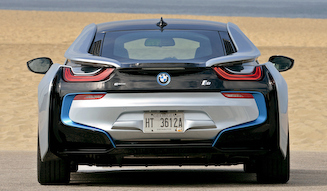
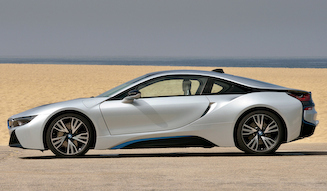
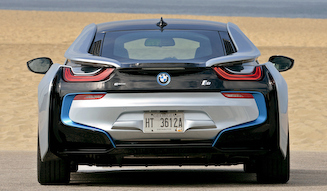
BMW's new sub-brand, established to offer sustainable mobility for the next generation,BMW i.
While the first model under this brand, the 'i3', was launched earlier as a four-seater electric vehicle for urban environments,i3, this i8, a sports car with a 2+2 configuration, is described by BMW as 'the bookend of the i brand, serving as a counterpoint to the i3'.
A key difference lies in their powertrains: unlike the i3, which is a pure EV or an EV with a range extender, the i8 is designed as a plug-in hybrid capable of significantly longer driving distances. With its standard 30-liter fuel tank, or the optional 42-liter tank available in certain markets, the i8 boasts a claimed range of 600 km under EU test conditions. This 'long stride' is nearly double that of the range-extended i3.
BMW i8 | BMW
An Unprecedented Hybrid Sports Car
Test Drive: BMW i8 (Part 2)
The Beginning in 2009
The 'origin' of the i8 can be traced back to the concept model 'Vision EfficientDynamics', unveiled at the 2009 Frankfurt Motor Show.—It's truly astonishing to realize now that the appearance of this model, which seemed to have leaped straight out of a science fiction film and bore a striking resemblance to the i8, had already incorporated virtually all legal requirements for various markets without compromise.
While the drag coefficient had to be increased from the show model's Cd of 0.22, which was developed with Formula 1 know-how, the i8's achieved figure of 0.26 still proves it is 'one of the most aerodynamically efficient production cars'. The subtly illuminated front grille, a feature of the show car, is gone, but the butterfly doors, which one might have assumed were mere show car theatrics, have been retained, adding to the surprise.
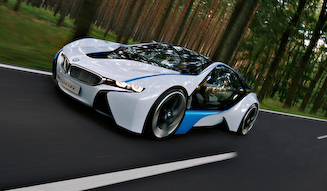
BMW Vision Efficient Dynamics (2009)
A 2+2 Configuration with Practicality
Regarding the question of why the packaging is 2+2 rather than a pure two-seater, the development team's answer was 'a decision made with practicality in mind'. Initially, I questioned this for a pure sports car, but upon inspecting the actual vehicle, I understood.
The front hood, housing the radiator and other components, cannot be opened. The only luggage space is a small area beneath the rear window at the back of the body. In such a configuration, opting for a pure two-seater would have made it difficult to even accommodate luggage for two people.
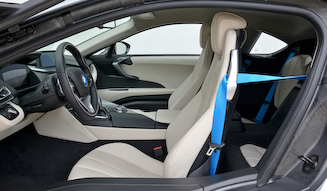
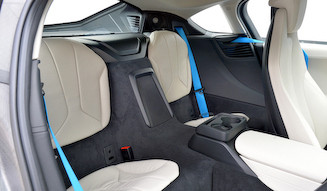
However, with the rear seats, that space serves as a convenient place for luggage. This very space provides the 'practicality' needed for a couple to travel for a few nights.
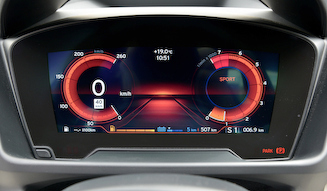
The interior of the i8 boasts a futuristic appeal that matches its striking exterior. Colorful virtual meters are laid out in the cluster on the dashboard, and a high central tunnel housing the lithium-ion battery, with about one-third the capacity of the i3's, creates a cockpit-like feel befitting a sports car.
Conversely, elements like the shift selector, iDrive controller, and the light switch on the dashboard are familiar from other BMW models. Surprisingly, operating the system, including starting up and selecting gear ranges, was easier than in the i3, which uses a unique logic. In short, 'anyone familiar with the latest BMWs can operate it without any confusion'.
BMW i8 | BMW
An Unprecedented Hybrid Sports Car
Test Drive: BMW i8 (Part 3)
An Engine Unbecoming of a Super Sports Car
The body structure, similar to the i3, consists of an aluminum 'drive module' housing the powertrain and suspension, connected to a CFRP (carbon-fiber reinforced plastic) 'life module' cabin. Although the individual modules displayed at the international test drive appeared to sandwich the central life module front and rear, the official description states it's a 'two-piece structure, with the drive module fixed beneath the passenger cell'.
When the battery has sufficient charge, city driving primarily utilizes the power from the electric motor located almost directly above the front axle.
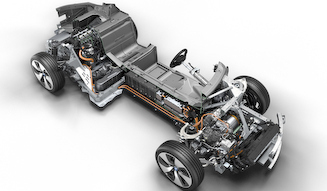
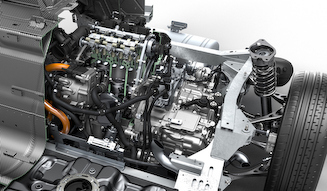
With its distinctive structural design and the use of resin panels for all body parts except the aluminum doors and hood, the i8 weighs approximately 1.5 tons. The electric motor, delivering maximum torque of 250 Nm from a standstill and an output of 131 hp, is more than adequate for city driving. While the engine is designed to assist when motor power is insufficient, in reality, even a slight easing of the accelerator rarely prompts the engine to engage.
Conversely, when the battery charge is low or full acceleration is required, the engine located transversely behind the rear seats immediately activates. Its power is transmitted directly to the rear wheels via a 6-speed automatic transmission. Naturally, if slippery surfaces are encountered, it instantly switches to all-wheel drive.
The automatic engine start/stop system operates with seamless smoothness.
In fact, the 'rear-wheel drive' power pack, which also includes a 15 kW starter/generator responsible for engine start, regenerative braking, and 'a slight torque boost', shares its core components with the new 'MINI Cooper'.MINI CooperThis means it's a combination of a compact 1.5-liter, 3-cylinder engine and a 6-speed automatic transmission. Although the engine is a direct-injection unit with turbocharging, by conventional standards, it could be described as 'an engine unbecoming of a super sports car'.
However, the engine's maximum output is 231 hp, significantly higher than that of the MINI Cooper. Consequently, the hybrid system's total output reaches 362 hp, which, combined with the i8's relatively light weight of approximately 1.5 tons for a super sports car, provides the motive force for its 4.4-second 0-100 km/h acceleration.
While the car relies on electric power for initial acceleration, during hybrid mode driving after starting, the control system prioritizes the engine's power. Unlike in EV mode, the electric motor's contribution is minimal in this situation, with the display graphics confirming that it primarily operates as a 'rear-wheel-drive gasoline car'.
BMW i8 | BMW
An Unprecedented Hybrid Sports Car
Test Drive: BMW i8 (Part 4)
Agility Awakens on Winding Roads
Furthermore, the i8's engine note, while retaining a hint of its three-cylinder nature, is quite sporty with a distinct low-frequency tone. During cruising, the cabin is remarkably quiet, partly due to the low aerodynamic drag. Even in these conditions, the car responds instantly to throttle inputs, offering a linear torque delivery characteristic of a sports car. However, the pronounced choppiness felt even in city driving became more noticeable on the rough concrete surfaces of the freeway.
This somewhat negative impression persisted regardless of the selected mode for the electronically controlled variable damping system. In an era where many high-end sports cars offer a supple and refined ride, including BMW's M models, this aspect must be considered a clear weakness of the i8.
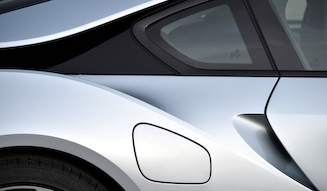
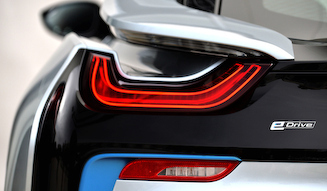
While its futuristic design captivates everyone and its acceleration truly feels like a glimpse into the future, it's a shame that the driving dynamics seem somewhat left behind by time. This is the area where I most strongly felt the need for refinement in the i8's performance.
The driving dynamics, which were somewhat lacking in city and cruising scenarios, made a significant comeback when the car hit winding roads.
The sensation of effortlessly navigating through a series of corners, darting nimbly from one to the next, clearly benefits from the car's lightness and low center of gravity. While the grip from the large-diameter but narrow, newly conceived tires isn't exceptionally high, the 'neutral steering' feel, with its excellent front-to-rear grip balance, is remarkably pleasant.
BMW i8 | BMW
An Unprecedented Hybrid Sports Car
Test Drive: BMW i8 (Part 5)
Continuously Proposing New Values
Moving the AT selector to the left engages Sport mode, sharpening throttle response and causing the engine to hold higher revs. It was at this point that I noticed the 'engine sound was almost too good'. During downshifts using the paddle shifters, a 'popping sound' characteristic of a high-performance engine accompanied the rev-matching, creating an impression of power akin to a V8 unit.
To put it bluntly, this was achieved by speakers mounted externally beneath the rear bodywork, emitting a 'virtual sound'! It created a powerful soundscape, blending with the actual three-cylinder engine noise, befitting the i8's styling.
Incidentally, the development team stated it was 'inspired by the inline-six sound, an icon of BMW cars'. However, to my ears, it was undeniably a sound that anyone would recognize as a V8.
The i8 is truly a car where 'everything is new', not just in its styling and hardware.—From one perspective, it's a model that seems to challenge traditional sports car enthusiasts by continuously proposing new values.
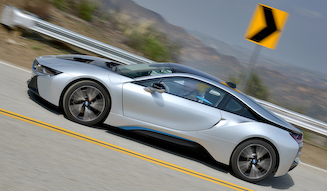
Larger displacement and more cylinders mean higher status, and faster lap times at the Nürburgring also signify superiority.—For those who think this way, it is likely an 'incomprehensible super sports car'.
On the other hand, for those who are not bound by such conventional values and believe that a modern premium sports car must possess strong individuality and embrace challenges with cutting-edge technology, this sports car, with its unique approach, stands as a solitary masterpiece.
'Unprecedented!'—Yes, this is undoubtedly the most fitting phrase to succinctly describe the i8's characteristics and to offer praise for this model.
BMW i8 | BMW
Body Dimensions | Length 4,689 x Width 1,942 x Height 1,298 mm
Wheelbase | 2,800 mm
Weight | Under 1,490 kg
Engine | 1,499 cc Inline 3-cylinder Direct Injection DOHC Turbo
Maximum Output | 170 kW (231 ps)
Maximum Torque | 320 Nm (32.6 kgm)
Electric Motor Max Output | 96 kW (131 ps)
Electric Motor Max Torque | 250 Nm (25.5 kgm)
System Max Output | 266 kW (362 ps)
System Max Torque | 570 Nm
Transmission | 6-speed Automatic
Drivetrain | 4WD
Tires Front/Rear | 195/50R20 / 215/45R20
0-100 km/h Acceleration | 4.5 seconds
Top Speed | 250 km/h
Max Speed in EV Mode | 120 km/h
Fuel Economy | 2.5 ℓ/100 km (approx. 40 km/ℓ)
CO2 Emissions | 59 g/km
Driving Range | Over 500 km
EV Driving Range | Approx. 35 km
Price (incl. tax) | 19,170,000 yen