Sustainable Mobility Initiatives by Ford | Ford
L.A. Autoshow Special Interview
Ford Fusion Energi
Ford's Commitment to Sustainable Mobility
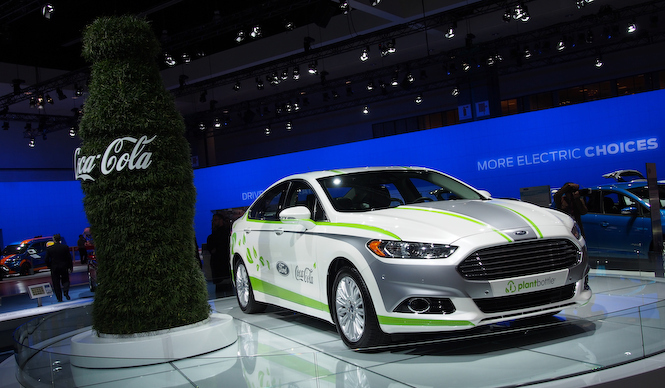
“L.A. Auto ShowThe Ford Fusion Energi, exhibited at the LA Auto Show, is the first vehicle to utilize "PlantBottle Technology" for interior materials like seat upholstery and door trim, made from recyclable materials used in Coca-Cola's plastic bottles. What exactly is this PlantBottle Technology that Ford and Coca-Cola are collaborating on? We spoke with Samantha Hoyt, a marketing manager at Ford who was involved in the development of the Ford Fusion Energi.
Text by SAKURAI Kenichi
Photographs by WATANABE Shinsuke & Ford Motor Company
Two American Icons Collaborate on Environmental Technology
Ford is actively pursuing collaborations with other industries. In the past, they developed concept cars with interior designs in partnership with P&G and Nike. Now, they are taking this a step further by establishing the "Plant PET (Polyethylene Terephthalate) Technology Collaboration" (PTC) with Coca-Cola, Heinz, Nike, P&G, and Ford. This initiative, in cooperation with the WWF (World Wildlife Fund), aims to reduce the consumption of petroleum-based raw materials and envisions the development and use of 100% plant-derived PET materials and fibers in the future.
The research vehicle Ford "Fusion Energi," exhibited by Ford at the LA Auto Show, features an advanced plug-in hybrid system and serves as a concrete example of their joint research with Coca-Cola, dubbed "PlantBottle Technology," which creates car interiors from the raw materials of plastic bottles.
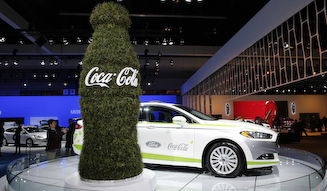
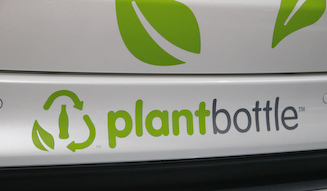
As is widely known, car interiors have traditionally been made from petroleum-based materials. As a result of PTC's research and development, Ford has pioneered the creation of car seats and interiors using the same raw materials as Coca-Cola's plastic bottles, realizing this concept in the Fusion Energi.
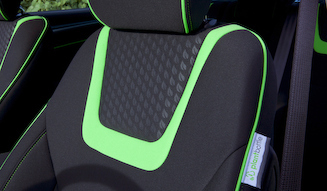
As previously reported,Coca-Cola's plastic bottles are made from 70% petroleum-based materials and 30% naturally derived materials from sugarcane. Ford processed these flakes of PET bottle material, provided by Coca-Cola as raw material for interior components, into fibers and wove them into fabric. This fabric was then used for interior elements of the Fusion Energi, including seat cushions, seatbacks, headrests, door panel inserts, and headliners. This clearly reduces the environmental impact compared to using 100% petroleum-derived materials.
L.A. Autoshow Special Interview
Ford Fusion Energi
Ford's Commitment to Sustainable Mobility (2)
A Material That Matches in Feel and Durability, and is Recyclable
"While fossil fuels are convenient, they have a significant impact on the Earth's biodiversity, climate, and other natural environments. Their supply is not infinite, and it is said that crude oil will eventually be depleted.
Cars are often seen as the epitome of fossil fuel consumption, being made from fossil fuel-derived materials and running on fossil fuels. At Ford, we are striving to reduce our reliance on these materials and minimize our environmental impact to ensure the sustainability of cars and the lifestyles they enable."
These are the words of Samantha Hoyt, a marketing manager at Ford and one of the team members involved in the development of the Fusion Energi.
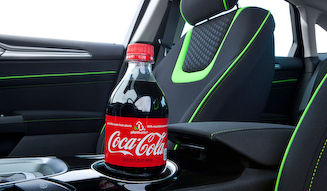
Samantha Hoyt graduated from Wake Forest University in North Carolina and joined Ford in 1991. She is a passionate car enthusiast who spends her weekends restoring vintage cars with her family, such as her beloved Porsche "914."PorscheAs a member of the automotive industry, she strongly desires the advancement of sustainable mobility. She believes it is important to embrace new technologies for the progress and development of civilization while cherishing the past.
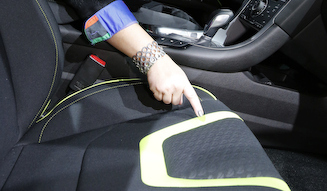
"The seat fabric, door trim, and carpets used in the interior of the 'Ford Fusion Energi' concept we exhibited are made from the same raw materials as Coca-Cola's plastic bottles. Thirty percent is derived from sugarcane, which is why we've added a green line as an accent."
"The texture is indistinguishable from conventional seat fabrics. We believe we have demonstrated the potential of this material as a viable alternative to petroleum-based materials, offering a soft feel and excellent durability. Furthermore, this material is recyclable. After the car has reached the end of its life, it can be easily transformed into other products."
Incidentally, Samantha Hoyt's nail polish today matches the green accent line used in the Fusion Energi's interior. "I thought I'd match it to the green accent in the interior," she says with a laugh. "After all, this car is like my child."
L.A. Autoshow Special Interview
Ford Fusion Energi
Ford's Commitment to Sustainable Mobility (3)
Naturally Derived Materials Are Already in Use
The "Ford Fusion Energi Concept," a plug-in hybrid with an all-electric range of 21 miles (approximately 33 km), boasts a total range of up to 620 miles (approximately 992 km).
Ford estimates that by evolving the already fuel-efficient 2.0-liter inline-4 plus motor hybrid unit into an externally rechargeable system and using it for five years, drivers can save an estimated $6,850 (approximately ¥690,000) in fuel costs compared to an average gasoline car.
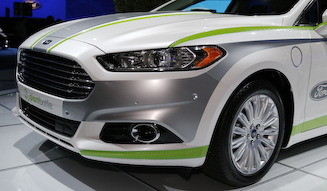

In addition to reducing daily fossil fuel consumption, the PlantBottle Technology contributes to fossil fuel reduction during manufacturing. Ford estimates that if the same interior materials used in the Ford Fusion Energi Concept were adopted in most of Ford's production models in the U.S., it could reduce petroleum-derived materials by approximately 4 million pounds.
"Our efforts to reduce fossil fuel consumption are already being implemented in Ford's production vehicles. For example, in the production model 'Fusion,' we use processed soybean-derived materials for the seat cushions. This equates to using approximately 31,250 soybeans per vehicle. Most importantly, it allows for the effective utilization of soybeans that would otherwise be discarded as unsuitable for consumption, while also reducing disposal costs and effort."
L.A. Autoshow Special Interview
Ford Fusion Energi
Ford's Commitment to Sustainable Mobility (4)
A Track Record of Reducing CO2 Emissions by Over 20 Million Pounds
The actual seat cushions of the Ford Fusion, made from soybeans, possess a conventional level of cushioning that makes it hard to believe they are derived from soybeans. Unless told, one would hardly notice. Could one, hypothetically, eat this seat cushion?
"That would be impossible (laughs). While soybeans are used as the raw material, they are processed into cushion foam. It's not like a 'down pillow' filled with actual soybeans (laughs)."
"Since Ford began introducing seat cushions made from soybean material in 2007, we have used approximately 5 million pounds (about 2,268 tons) of soybeans as raw material each year. Calculations show that this has led to a reduction of over 20 million pounds of carbon dioxide emissions to date. It may seem small, but it's an important step."
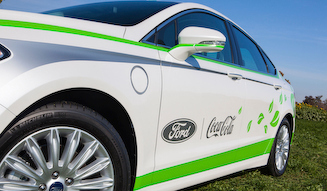
Participating companies in the PTC initiative are effectively utilizing PlantBottle Technology for products such as food bottles, apparel, footwear, and carpets, just as Ford has used PET fibers made from renewable plant-based raw materials for its interior components.
The Ford Fusion Energi is a collaboration between two American icons, Ford and Coca-Cola. In the future, new technologies and products born from such inter-company collaborations within PTC may enrich our lives even further.