The Electric Golf "eGolf" | Volkswagen
Volkswagen eGolf | Volkswagen e Golf
The Production EV Golf Arrives
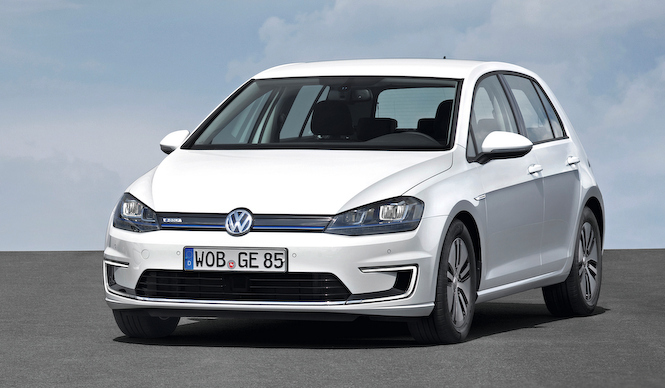
Golf 7Based on the Golf 7, the production pure EV model "e-Golf" is equipped with an electric motor that generates a maximum output of 85kW (115PS) and a maximum torque of 270Nm (27.5kgm), offering a range of approximately 190km.Frankfurt Motor Showwill have its world premiere at the Frankfurt Motor Show. Previously, we reported on Volkswagen's EV strategy when the "Golf blue-e-motion," based on the Golf 6, landed in Japan.Golf blue-e-motionAs mentioned, the arrival of the "e-Golf," intended for release in Germany, along with the "e-up!," has the potential to change the norms of European mobility.
Text by SAKURAI Kenichi
Driving Range for General Use in Germany
Alongside the announcement of its first production EV, the "e-up!," which the company had already previewed, Volkswagen will also hold the world premiere of the production EV model of the Golf, the "e-Golf," at the Frankfurt Motor Show.e-up!The "e-Golf" will be equipped with an electric motor that generates a maximum output of 85kW (115ps) and a maximum torque of 270Nm (27.5kgm) in place of a conventional engine, driving the front wheels.
It accelerates from 0-100km/h in 10.4 seconds, and its top speed is limited to 140km/h by a governor, a performance advantage over the e-up!'s 130km/h.
The battery is a 24.2kWh lithium-ion unit, offering a range of 190km on a single charge. This range is calculated based on data indicating that the average daily driving distance for users in German urban areas is about 50km. Using a CCS charging station (DC fast charger), the battery can be charged to 80% in approximately 30 minutes.
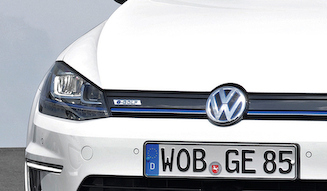
The "e-Golf" features two efficient driving modes, "Eco" and "Eco+", and four regenerative braking modes – "D1," "D2," "D3," and "B" – which utilize regenerative braking for self-charging. Standard equipment includes LED headlights with daytime running lights, a first for Volkswagen, as well as a parking heater, automatic climate control with ventilation, a wireless navigation system, and a heated front windshield.
For reference, the charging cost per 100km in Germany is approximately 3.02 euros for the "e-up!" and 3.30 euros for the "e-Golf" (as of July 31, 2013, at 0.258 euros per kWh). While it cannot be directly converted to Japanese fuel efficiency figures like kilometers per liter, considering that it can travel approximately 30.3km per euro and is a zero-emission vehicle, its significance is high. The momentum for zero-emission mobility initiatives in major metropolitan areas, which some German cities are beginning to implement, seems set to increase.