People and Companies Building a New Era: Toyota Motor Corporation
People and Companies Building a New Era――Toyota Motor Corporation
What Role Will Next-Generation Alternative Fuel Vehicles Play? (1)
Toyota Motor Corporation is preparing a new generation of alternative fuel vehicles. In 2012, they plan to launch a new generation of plug-in hybrids that can be charged, and also electric vehicles. We asked Toyota about their commitment to alternative fuel vehicles.
By Fumio Ogawa
The New Prius, Scheduled for Launch in 2012
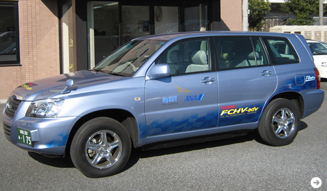
The hybrid vehicle Prius debuted in 1997. At the time, it was met with skepticism abroad, with questions like, "With fuel cell vehicles (which reform hydrogen to generate electricity to power an electric motor) expected to become mainstream in the near future, what is the point of combining a gasoline engine with an electric motor?" However, it continues to lead the pack as a passenger car with low environmental impact.
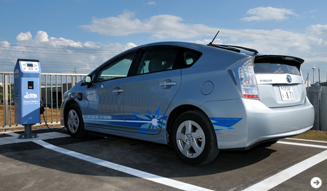
Cars Continue to Evolve――Currently, the Prius Plug-in Hybrid, a near-future variant of the Prius, is already on the road (mass sales are planned for 2012).
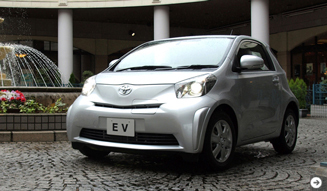
In addition, also in 2012,an electric vehicle (EV) based on the Toyota iQis scheduled for release. What role will next-generation alternative fuel vehicles (cars that use energy sources other than fossil fuels) play? We asked Toyota Motor Corporation. The response came from a technical representative in the Public Relations Department.
Evolving Hybrids
――The debut of the Prius was revolutionary, but does the hybrid system, which combines a gasoline engine and electric motor, still hold significant potential for evolution?
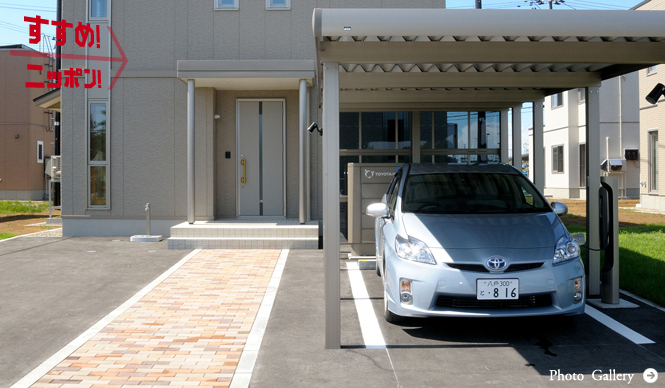
From now on, they will evolve as plug-in hybrids. In conventional hybrids like the Prius, the battery was charged by the gasoline engine. However, the new generation Prius, called a plug-in hybrid, employs a mechanism where the battery can be charged from an electrical outlet, extending the range driven by the electric motor. These have been leased to specific users such as government agencies and corporations since 2009, with mass production planned for 2012.
People and Companies Building a New Era――Toyota Motor Corporation Edition
What Role Will Next-Generation Alternative Fuel Vehicles Play? (2)
How to Use Cars with Reduced Environmental Impact
――Electric vehicles (EVs) are currently receiving a lot of media attention. In light of this, what is the significance of hybrid vehicles that also have a gasoline engine?
One reason is their longer driving range. Also, gasoline is readily available throughout Japan. Cars running on fossil fuels like gasoline engines can travel about 500 km on a single tank. EVs, on the other hand, cannot reach 200 km. Furthermore, charging takes a long time, several hours. Securing a charging spot when out and about can also be difficult. Currently, we believe that using them according to their purpose is the way to use cars with less environmental impact.
――So, conversely, are there too many negative aspects to EVs?
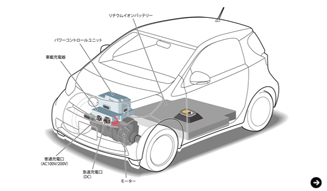
Of course, EVs have significant advantages. While it's difficult to generalize as it's closely related to how electricity is generated, cars do not emit CO2 or other harmful substances into the atmosphere, and they do not use fossil fuels. Therefore, Toyota Motor Corporation will also launch an EV based on the Toyota iQ in Japan, the US, and Europe in 2012.an EV based on the Toyota iQThe planned cruising range is about 100 km. Increasing the battery capacity would extend the range, but it could also increase costs and potentially reduce passenger space, making it a difficult decision on where to draw the line. However, it is being developed for short-distance use.
――It is said that cars equipped with electric motors require electricity for charging, and therefore must be considered in conjunction with the development of new social infrastructure.
If many households start using PHVs and EVs, and all begin charging simultaneously, even at night, there's a possibility that electricity consumption will surge. According to estimates, it could increase household electricity consumption by about 30%. Therefore, for automakers, a near-future challenge lies in dispersing peak electricity demand and reducing the load from EV charging. To achieve this, an electric management system is necessary – a social system that uses computer control to disperse peak electricity consumption, including EV charging.
People and Companies Building a New Era――Toyota Motor Corporation Edition
What Role Will Next-Generation Alternative Fuel Vehicles Play? (3)
Toyota Smart Center: Integrated Control of Energy Consumption
――So, smart homes and smart grids are also necessary for PHVs and EVs?
Cars, homes, and society must be integrated to achieve a low-carbon society through effective electricity consumption. In this context, using communication technology to manage information such as the remaining battery charge of vehicles at a central location would be effective. To this end, Toyota Motor Corporation has developed its own system, "Toyota Smart Center," which connects homes, cars, power suppliers, and users to comprehensively control energy consumption, and has also entered into a strategic partnership with Microsoft.

In April 2011, Toyota and Microsoft reached a basic agreement to build a global cloud platform. Pictured left: Microsoft CEO Steve Ballmer. Pictured right: Toyota Motor Corporation CEO Akio Toyoda.
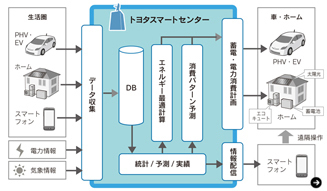
An overview diagram of the "Toyota Smart Center."
――Is this an evolution of the current G-BOOK, which connects vehicles to a call center?
By 2015, we aim to build a global cloud platform in collaboration with Microsoft. This is part of our efforts towards smart grids. We will utilize this cloud platform for the "Toyota Smart Center," a system that connects cars and homes to comprehensively control energy consumption. Beyond that, we aim to expand the "Toyota Smart Center" globally.
――Is the ultimate goal a combination of rechargeable EVs and gasoline-powered cars?
For example, fuel cell vehicles (FCVs), which generate electricity from hydrogen and drive electric motors, are one possibility. They offer the advantage of refueling time and cruising range comparable to conventional gasoline cars, while emitting no CO2. There is also potential for significant changes from the current state, such as integrating electric motors within the wheels.