People and Companies Building a New Era: Sim Drive Inc.
People and Companies Building a New Era――SIM-DRIVE
The Spread of EVs Leads to a Prosperous Future (1)
SIM-DRIVE was founded by Professor Hiroshi Shimizu of Keio University, a pioneer in EVs in Japan, with the support of Benesse Corporation. Recently, they announced the SIM-LEI, an EV that has garnered significant attention.
By Fumio OgawaPhotos by JAMANDFIX
Cars: Key to Designing the Future
There's a saying, "Designing the future." Among the most crucial elements in this endeavor is the automobile. It's said that EVs will play a vital role in the near future, replacing cars that run on fossil fuels.
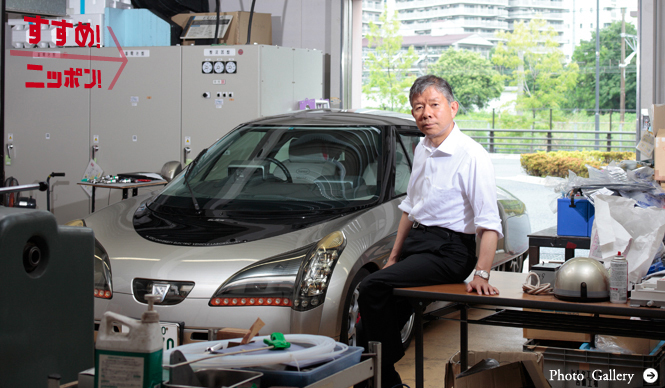
Venture companies are emerging to develop EVs. Among them, SIM-DRIVE is at the forefront of practical development. The company is headed by Professor Hiroshi Shimizu of Keio University's Faculty of Environment and Information Studies, a leading figure in the EV world. I visited Professor Shimizu's lab at the Kawasaki Industrial Creation Center to hear about the potential of EVs through an interview.
Performance Improvements Stem from Efficient Energy Management
――You've been researching EVs for a long time. Have there been any environmental shifts since the nuclear accident?
My fundamental approach hasn't changed much since I began researching EVs 30 years ago. Initially, I believed that improved battery performance was the key to EV evolution. However, I realized that by designing for efficient energy use, we could create high-performance vehicles. This includes things like fitting tires with low rolling resistance or reducing losses from electric motors and inverters. Another significant change is the increased societal recognition of EVs. People no longer look at them as strange experiments (laughs).
――Will 2011 be a major turning point for EVs?
The belief that a society built on fossil fuels would continue its upward growth persisted until the 1960s. In 1972, the private think tank, the Club of Rome, issued a warning that if trends in population growth and environmental pollution continued, global growth would reach its limits. Furthermore, the oil crises of 1974 and 1979, along with a 1988 US Senate hearing report linking abnormal weather patterns to global warming, made the urgent need for environmental countermeasures using alternative energy apparent.
EV development requires substantial investment, and the increase in companies providing financial support has been a tailwind. However, it will likely take some more time for EVs to become truly mainstream.Nissan LeafandMitsubishi i-MiEVexist, but I believe the true era of EVs will arrive only when cars emerge that people genuinely desire, thinking, "I want that!"
People and Companies Building a New Era――SIM-DRIVE
The Spread of EVs Leads to a Prosperous Future (2)
A Sustainable Society Based on the Combination of Solar Power and EVs
――At the same time, don't you think EVs need to consider the construction of social infrastructure likeSmart Housesand smart grids?
That's a much larger framework, far beyond my personal scope or the size of our company. Furthermore, I cannot definitively say what kind of battery will succeed lithium-ion.Lithium-ionEVs and the technologies supporting them will likely evolve significantly on a much grander scale. Some believe that after current charging EVs, the next step will be fuel cell vehicles that generate electricity by electrolyzing hydrogen. However, with components like platinum-iridium being essential and costly, and the immense infrastructure investment required for hydrogen stations, including risk management, widespread adoption seems unlikely.
――Slightly deviating from EVs, what kind of energy infrastructure do you envision for Japan's near future?
Solar power generation. There's much discussion about alternative energy sources to nuclear and fossil fuels, such as wind, thermal, and geothermal power. Some argue for a balanced mix of these. However, from an engineer's perspective, while many options may emerge simultaneously, technology tends to converge on a single path over time. Solar power generation converts about 10-15% of energy into electricity. Roughly calculated, if 1% of Japan's land area were used for solar power generation, it could meet the nation's electricity needs.
It's said that if 1.5% of the Earth's surface is used for solar power generation, it could support the lives of 7 billion people. Currently, only about 10% of the world's population enjoys a prosperous lifestyle. However, with successful solar power generation, everyone could have access to electricity and live a prosperous life. With that foundation, we can use EVs. I believe that is the model for a sustainable society.
――You built the eight-wheeled EV "Eliica" in 2007 and announced the SIM-LEI in 2011. Can we assume EV development is progressing smoothly?
Building an EV itself isn't particularly difficult. It's composed of an electric motor, a battery, and an inverter for power conversion. While it's impossible for an average person to build a car with an internal combustion engine, it's feasible to a certain extent with EVs. However, development costs are considerable, with a large portion attributed to personnel expenses for design and development.
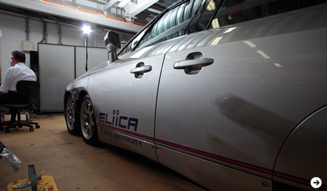
Eliica
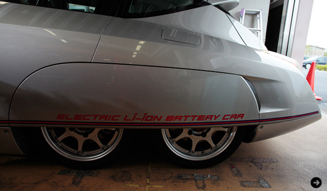
One of the advantages of EVs, in my opinion, is the flexibility in placing the powertrain and battery. For instance, the motor can be integrated into the wheels, and the battery can be placed under the floor, creating a more spacious interior and improving overall packaging efficiency. Borrowing a concept from the European automotive industry for defining vehicle size, a compact body in the B-segment, typically considered a small car, can achieve interior space comparable to the D-segment, known as upper-medium. This leads to high cost performance, which translates into market appeal. For an EV to have strong marketability, it needs a range of about 300 km on a single charge. Furthermore, factors like interior space, acceleration, and ride comfort will be crucial.
People and Companies Building a New Era――SIM-DRIVE
The Spread of EVs Leads to a Prosperous Future (3)
Professor Shimizu's Challenge, Inspired by the Ford Model T
――Are SIM-DRIVE's EVs close to achieving those goals?
The person who enabled mass production of automobiles was Henry Ford in the United States. The car Ford developed so that many Americans could drive it was named the Model T. Do you know why it was called "T"? He started with A and it was the 20th model, hence the letter T in alphabetical order. It finally reached completion. I am sometimes reminded of that episode from the dawn of the internal combustion engine automobile era. My EV is the eighth model, Eliica, and the twelfth, SIM-LEI. If we follow Ford's example, I believe my EV will be complete after building eight more (laughs). I'm working hard towards that goal.
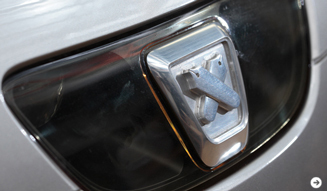
Eliica
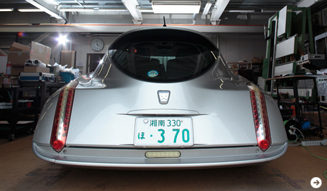
K2 (Case Square) Campus, established in the spring of 2000 through a collaboration between Keio University and Kawasaki City, Kanagawa Prefecture, aims to foster cutting-edge industry-government-academia collaborative research. In one corner of this campus lies Professor Hiroshi Shimizu's laboratory. Upon opening the door, the first thing that catches the eye is the eight-wheeled EV, "Eliica." Its low, long profile and distinctive front mask exude a powerful presence. Looking at it, one might feel that its "character" reflects Professor Hiroshi Shimizu's determination for the future of EVs.
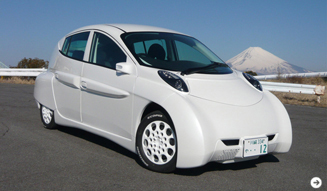
Meanwhile, the SIM-LEI, announced in March 2011 and unveiled in May, represents a further refinement of the concept. It was assembled through the contributions of 34 companies, each bringing their unique technologies, including in-wheel motors that integrate small drive motors into the wheels. Data obtained from actual driving tests is fed back to these 34 participating companies.
Peugeot-Citroën Announces Participation in the Next Project
Following this, a project succeeding the SIM-LEI has also been announced. It's called "Convert EV," focusing on research into systems for converting vehicles with internal combustion engines into EVs. The Peugeot-Citroën Group has announced its participation in this initiative.
As this illustrates, an EV is not just a finished product but also a testing ground for technology. If technology can be effectively utilized and applied to experiments, companies like SIM-DRIVE can gain recognition by contributing to the development efforts of major automobile manufacturers. By demonstrating commercial viability, they can achieve corporate sustainability. This, in turn, leads to the future of EVs.
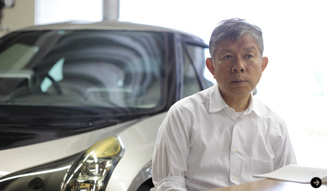
"If all cars become EVs, crude oil consumption will decrease by 27%, saving 2.7 trillion yen in oil imports," states Professor Hiroshi Shimizu. While EVs are continuously advancing in motor and battery miniaturization, leading to increased practicality, the benefits they bring are substantial. We sincerely hope that Professor Hiroshi Shimizu's broad vision will make a significant contribution to the energy society of Japan and the world.
Hiroshi SHIMIZU
Born in Miyagi Prefecture in 1947. Completed doctoral program coursework at Tohoku University's Faculty of Engineering in 1975. (Doctorate: Engineering).
Joined the National Institute for Environmental Studies (formerly the National Research Institute for Pollution and Resources) in 1976. Studied abroad at Colorado State University in the United States for 14 months in 1982. Served as Senior Researcher in the Regional Environmental Research Group at the National Institute for Environmental Studies in 1987. After retiring in 1997, he became a professor at Keio University's Faculty of Environment and Information Studies, where he remains today. His research primarily focuses on the analysis of environmental issues and countermeasures (EV development, energy system development). He has been involved in the development of 12 prototype vehicles over 30 years. Since 2009, he has also been involved in the development of electric buses in collaboration with Kanagawa Prefecture. Since August 2009, he has served as President and CEO of SIM-DRIVE Inc. In March 2011, SIM-LEI, the first prototype vehicle from SIM-DRIVE's advanced development project, was completed.
His publications include "For the Prevention of Global Warming: A Scientist's Proposal to Al Gore" (Takeda Random House Japan, 2007) and "Beyond 'Winner-Take-All' Civilization Theory" (Mishima-sha, 2009).