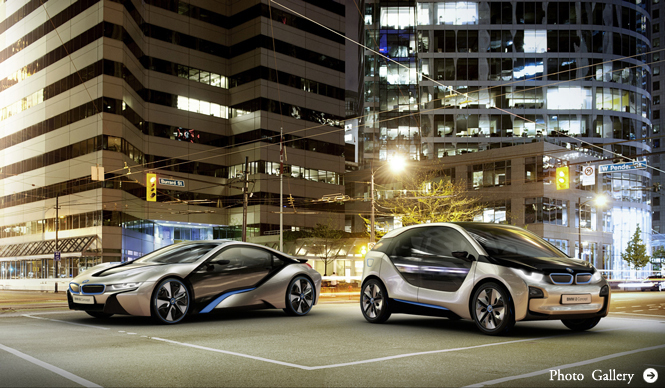
BMW i | Details Revealed for Two New Models
BMW i8 Concept
BMW i3 Concept
BMW i Sub-brand Unveils Details of PHV and EV Models (1)
BMWIn February, BMW launched its sub-brand "BMW i," dedicated to sustainable mobility solutions. At the same time, it was announced that the "i3" electric vehicle and the "i8" plug-in hybrid would be developed under BMW i. Now, both vehicles have been unveiled, and their details have come to light.
By Ryoko Koike
A Future-Forward Sports Plug-in Hybrid
First, the "i8 Concept" plug-in hybrid. Its powertrain features a motor on the front axle, combined with a 164 kW (220 hp) three-cylinder engine producing 300 Nm of torque at the rear. Achieving 0-100 km/h in under 5 seconds, it utilizes a large lithium-ion battery, recording an impressive fuel consumption of 3 L/100 km. It is also capable of zero-emission driving, with a maximum range of 35 km in that mode.
The i8's exterior is that of a truly future-forward sports car. All components, including the motor and engine, are balanced to achieve an ideal 50:50 weight distribution. Its dynamic proportions, appearing ready to surge forward even when stationary, visually convey its high performance. Furthermore, the upward-swinging doors accentuate its sporty character and improve ingress and egress to the rear seats.
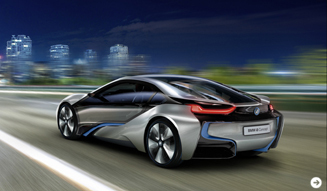
i8 Concept
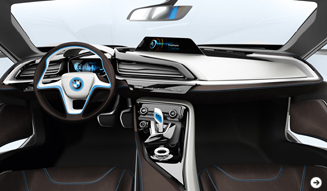
i8 Concept
Compact EV Adaptable as a Range Extender
Next is the "BMW i3 Concept," the BMW Group's first mass-production electric vehicle. Developed with a focus on urban use, this electric car is equipped with a motor on the rear axle that produces 125 kW (170 hp) and 250 Nm of torque. Its acceleration performance is more than adequate, with a top speed of 150 km/h and 0-100 km/h in under 8 seconds.
This motor features an energy regeneration function that charges the battery when the accelerator pedal is released, acting as a generator. While the typical cruising range is said to be around 130 km, similar to the MINI E, actively utilizing this function can extend the range by 20 percent.
Even with this range, user demands were largely met in field tests. However, some users expressed concerns about the limited range of 130 km. To ensure a longer driving range, the i3 can be optionally equipped with an internal combustion engine to assist with battery charging or to supplement power during high-demand situations. It can function as a range extender, similar to the Chevrolet Volt.
BMW i8 Concept
BMW i3 Concept
BMW i Sub-brand Unveils Details of PHV and EV Models (2)
The i3: A Clear and Clean Design
BMWUnder the banner of "Project i," BMW has conducted field tests worldwide using the "MINI E," an electric vehicle based on the MINI Hatch. A key feature of the i3 is its emphasis on interior space, with the motor occupying 40 percent less space than in the MINI E. Despite its compact body, it is a 4-seater, and the opposing doors make entry and exit easier.
The exterior presents a clear and clean design overall, with a front end featuring compact kidney grilles and distinctive headlights, and a rear end with a simple design and a large glass area.
The interior utilizes mocha brown leather, naturally tanned, and a wide range of natural fibers. Twenty-five percent of the plastics used are derived from renewable or recycled materials. All driving control elements (start/stop button, shift lever, etc.) are consolidated on the steering column, eliminating the need for a center console and creating an open space in the front of the cabin.
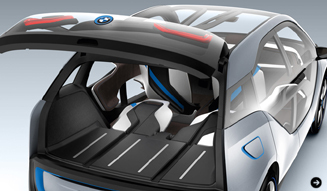
i3 Concept
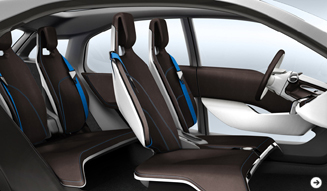
i3 Concept
A New Vehicle Architecture Developed for Electric Drive
Previous BMW EVs were essentially vehicles designed for internal combustion engines with electric components added. However, for the two concept cars announced under BMW i, a different structure called the "LifeDrive concept" has been developed. It consists of two independent functional units: the "Drive Module," which integrates the suspension, battery, and drive system into an aluminum structure, and the "Life Module," a high-strength, ultra-lightweight passenger cell made of CFRP. The active use of lightweight materials contributes to increased range, occupant protection, and cargo space.
The sales timing and pricing for the i8 and i3 have not yet been disclosed. However, despite being concept models, their highly practical designs suggest they could be released as is. We eagerly anticipate the future of these two vehicles, which will undoubtedly play a role in shaping the next generation of sustainable society.
BMW i8 Concept
Body Dimensions: Length 4,632 x Width 1,955 x Height 1,280 mm
Wheelbase: 2,800 mm
Vehicle Weight: 1,480 kg
Engine: 3-cylinder engine
Max Output: 164 kW (engine), 96 kW (motor)
Max Torque: 300 Nm (engine), 250 Nm (motor)
Fuel Consumption: 2.7 L/100 km
CO2 Emissions: 66 g/km
Max Range (Zero-Emission Driving): 35 km
Charging Time: 1.45 hours
BMW i3 Concept
Body Dimensions: Length 3,845 x Width 2,011 x Height 1,537 mm
Wheelbase: 2,570 mm
Vehicle Weight: 1,250 kg
Max Output: 125 kW
Max Torque: 250 Nm
Max Range: 130–160 km
Charging Time: 6 hours