Tomoki Yuzuka & Editor Daimaou Talk | Vol. 20 Satoshi Takamatsu (Civilian Astronaut) (Part 1)
Page. 1
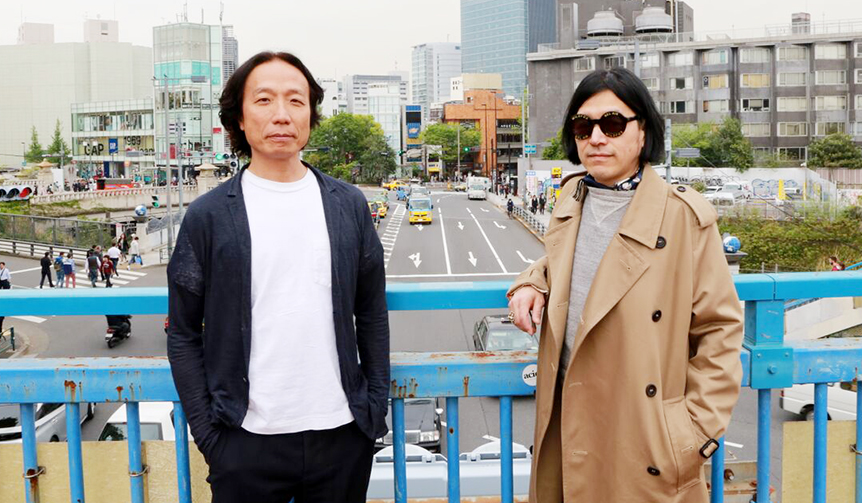
Our guest this time is Satoshi Takamatsu, who is scheduled to travel to the ISS (International Space Station) as the first Japanese civilian astronaut. He has harbored a lifelong dream of space since childhood, even gaining attention for producing the world's first space-filmed commercial during his time at Dentsu, a major advertising agency. We spoke with him about the rigorous tests and training required to become an astronaut, and his passionate aspirations for space.
Tomoki Sukezane & Editor Daimaou Talk | Vol. 21 Satoshi Takamatsu (Civilian Astronaut) (Part 2)
Interview by Tomoki SukezanePhotographs by Yuki SatoText by Sara Ando (OPENERS)
The Dream of Becoming an Astronaut, Fulfilled by a Former Dentsu Man
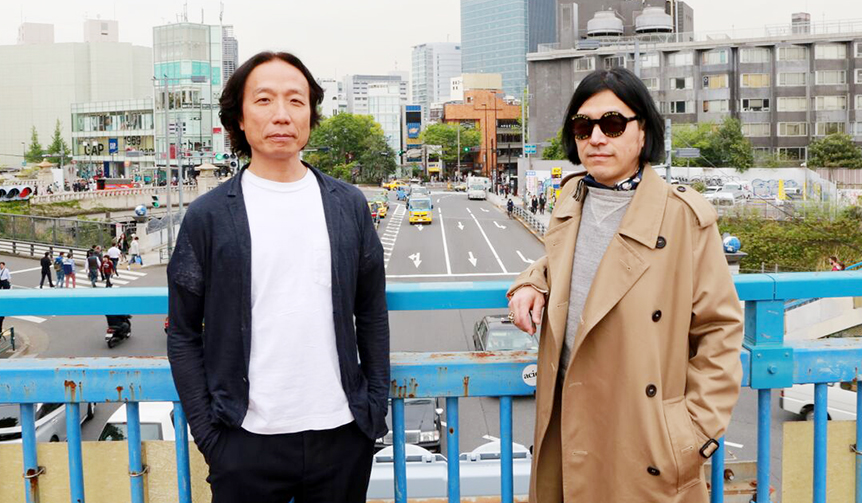
Tomoki Sukezane & Editor Daimaou (hereinafter, Sukezane)Mr. Takamatsu, you are a civilian astronaut. How does that differ from space tourists who take day trips to space with companies like Virgin Galactic? Is there a definition that separates astronauts from space tourists?
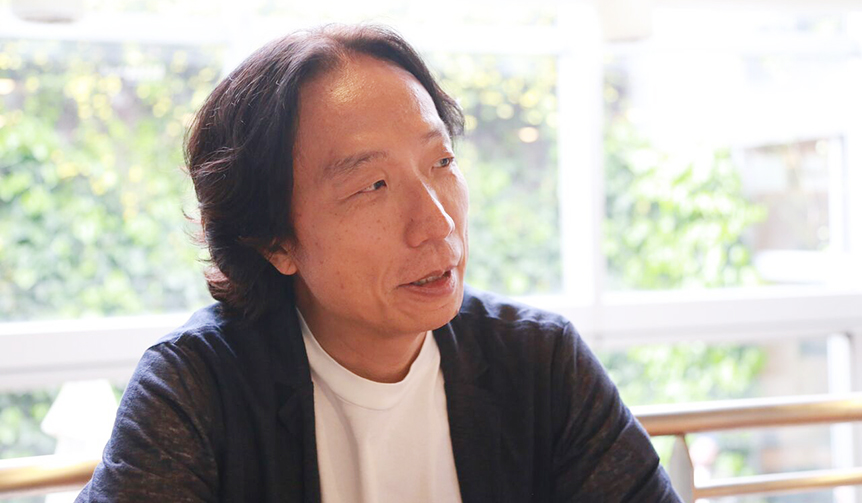
Civilian Astronaut Satoshi Takamatsu (hereinafter, Takamatsu)Actually, there isn't a single, fixed definition of an astronaut. There are various definitions and interpretations, but broadly speaking, there are two main viewpoints. One is that anyone who has been to space, even once, is an astronaut. The other is that an astronaut is a crew member who has undergone training for a human spaceflight program with a national space agency.
Under the first definition, space tourists on day trips would also be considered astronauts. Sometimes, those who contract for space travel are called 'future astronauts.' However, in reality, I don't think people who return from a day trip to space would typically claim to be astronauts.
SukezaneAstronaut sounds impressive, and it's natural to want to be called that. Even though you're going to space, you don't undergo the same series of training as astronauts, right?
TakamatsuRather than training, there's a two-day course that includes lectures on the flight procedures, emergency measures, and evacuation methods.
SukezaneI see. Even on airplanes, people sitting next to the emergency exits receive, albeit formal, instructions from the flight attendants about what to do in an emergency.
TakamatsuThat's right. Space tourists are passengers. They don't have responsibility for operating the spacecraft. In that sense, the second definition—that an astronaut is a crew member trained according to a human spaceflight program—seems more natural. Simply put, it's the difference between a crew member who operates the spacecraft and is involved in the mission, sitting in the cockpit, and a passenger sitting in the cabin. The former, whether government-affiliated or private, are trained crew members, so I think it's appropriate to call them astronauts.
SukezaneSo, you underwent crew training in Russia, Mr. Takamatsu?
TakamatsuThe cockpit of the Russian Soyuz spacecraft where I trained seats three people. The commander sits in the middle, the flight engineer 1 (co-pilot) sits to the left, and I sat to the right. I sometimes simulated the roles of commander and flight engineer 1. Unless you are a pilot by profession, professional astronauts also sit on the right during launch. The person in this seat is called the right-seater or flight engineer 2. As long as you are in a cockpit that seats only three people, even as a civilian, you have to be involved in some part of the operation. There are buttons and levers that only I, sitting on the far right, can reach. Therefore, just like NASA or JAXA astronauts, I studied, practiced, and was tested on the entire process from rocket launch to return, including operation and instrument readings, and troubleshooting. If the commander said, 'Satoshi, pull that lever,' I couldn't say, 'Which one was it?' (laughs). The commander and flight engineer 1 handle most of the piloting, but when my role comes up, the commander gives me a nod, and I respond, 'Yes, I know, click!'
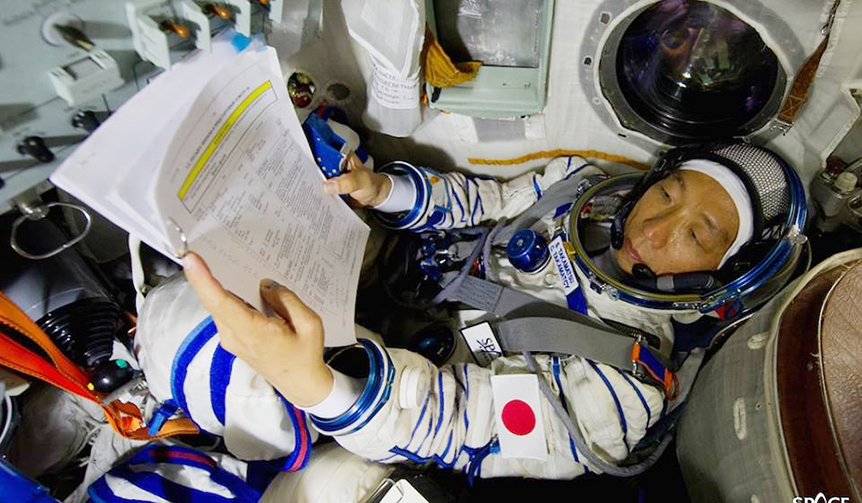
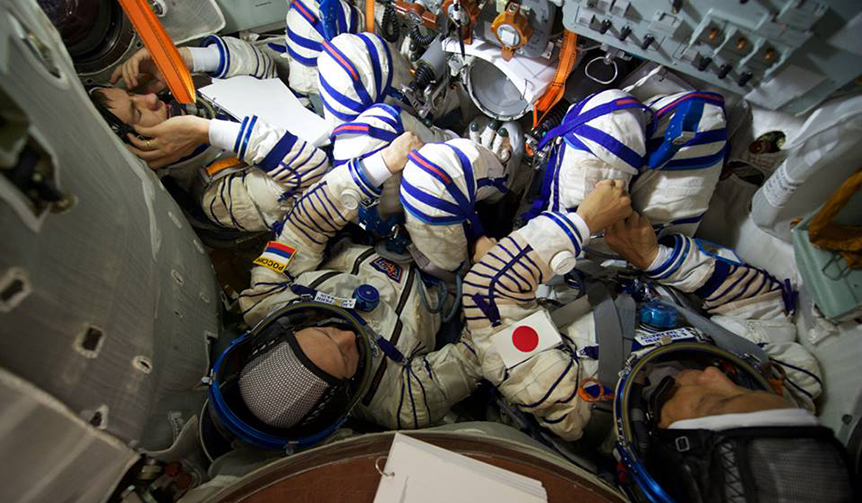
From Mr. Takamatsu's Facebook (https://www.facebook.com/Cosmo.Takamatsu/)
SukezaneJAXA astronauts also go to the ISS on Soyuz. How does your role differ from theirs?
TakamatsuJAXA astronaut Kimiya Yui was a former Japan Air Self-Defense Force pilot, and Takuya Onishi was a former ANA pilot. Therefore, they take the role of flight engineer 1, sitting to the left of the commander. JAXA astronauts who are not former pilots fly in the right-seater position, similar to how I trained. That said, JAXA astronauts are so professional in their skills and abilities that it's almost disrespectful to compare them to me. However, I am honored to have learned and trained for the same seat and role.
SukezaneSo, it's genuine astronaut training. There isn't a separate curriculum for civilians, is there?
TakamatsuNo. The tests, training, practical exercises, and simulations I underwent in Russia are all the same as what regular astronauts receive. Since civilians only come for training once every few years, there isn't a specific curriculum for them.
SukezaneI understand the definition of an astronaut better now. You mentioned being called a 'civilian astronaut.' What does that term mean?
TakamatsuIn the general sense, an astronaut is a 'governmental astronaut' from a national space agency, like those from JAXA or NASA. 'Governmental' means 'of the government.' On the other hand, 'commercial astronauts' might become more common in the future. 'Commercial' means 'related to business.' Currently, private companies like SpaceX, led by CEO Elon Musk, and Boeing, famous for its aircraft, are proceeding with plans to fly manned rockets to the ISS. Astronauts belonging to such companies are called commercial astronauts. In my case, since I am a private individual not affiliated with any government agency or private company, I explain myself as a 'civilian' astronaut. Because I am flying for personal purposes at my own expense, in English, I might be called a self-funding astronaut or a private astronaut. Some simply call me a space traveler.
SukezaneThere's no precedent for this in Japan, is there? It means you've completed astronaut training and are going at your own expense.
TakamatsuThat's right. Seven civilians have already completed training in Russia and gone to the ISS, but there are no such cases in Japan yet. Their official designation at NASA is 'spaceflight participant.' So, strictly speaking from NASA's perspective, I would be considered 'a person challenging to become a spaceflight participant.' While it's a rather unglamorous term, I believe it's natural to draw a line between astronauts who have undergone rigorous selection and training by national space agencies and civilians. In the sense of being an astronaut as a profession, a private spaceflight participant cannot be an astronaut. On the other hand, the term 'person challenging to become a spaceflight participant' is not understood at all outside the space industry. Therefore, based on the definition that an astronaut is a crew member trained according to human spaceflight programs and scheduled to fly, and because I underwent training for my own purposes and am flying at my own expense, I decided to call myself a civilian astronaut. As I'll discuss later, my goal is not to become an astronaut, but to go to space and carry out a project that only I can do. So, the name or title doesn't matter to me. I don't particularly care about the title of astronaut. Rather, I believe my role is to do things in space that astronauts cannot. For now, I am using the term 'civilian astronaut' for convenience. It is a fact that I am the first Japanese civilian to complete all training for the Soyuz spacecraft and the ISS Russian module and pass all exams. So, I think 'civilian astronaut' is acceptable. It's a bit embarrassing to use this title before actually going to space, though (laughs).
SukezaneThere are architects who haven't actually built any buildings. If you pass the selection and complete the training, you're an astronaut, right?
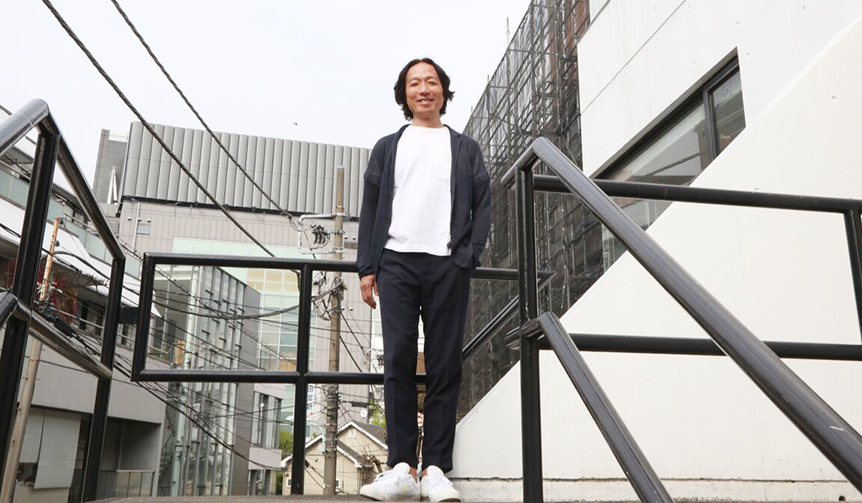
Page 02.Clearing Rigorous Aptitude Tests for Training
Page. 2
Clearing Rigorous Aptitude Tests for Training
SukezaneWhen did that astronaut training take place?
TakamatsuI entered Russia for training in January of the year before last, 2015. Before that, in July and August of the previous year, there were quite rigorous aptitude tests, also in Russia.
SukezaneWhat kind of tests were they?
TakamatsuFirst, there were medical check-ups like blood tests, urine tests, and CT scans—essentially a comprehensive health screening. All values had to be normal, which is quite difficult after the age of 50. In fact, some of my values were outside the normal range in my annual check-ups. A considerable time before the medical check-up, I started strict dietary restrictions and underwent intense physical training with a personal trainer to cleanse my body. In that sense, the real battle began around early 2014. Fortunately, all my values were normal when I had the tests in Russia. Also, even a slight cavity is not allowed. In low-pressure conditions, air in a cavity can expand and cause pain. So, I went to the dentist, whom I had avoided for 20 years, for intensive treatment to fix all my cavities and even had several implants. Going to the dentist was really daunting (laughs). There were also some things that couldn't be prepared for, such as electroencephalogram (EEG) tests and psychological evaluations.
SukezaneWhat other tests were there?
TakamatsuI was seated in a capsule, and the air was evacuated to simulate the atmospheric pressure at an altitude of 7,000 meters. This test checks if you can withstand low-pressure conditions in case of an accident. It also confirms that you don't have claustrophobia. Apparently, my electrocardiogram and pulse remained stable, to the point where they suspected the instruments might be malfunctioning, so I passed. Then there was the extremely grueling centrifuge test. While strapped into a chair with my eyes closed, I was spun around rapidly, both clockwise and counterclockwise. It was a real battle against nausea. The vestibular system goes into complete chaos. It might be easy for figure skaters or fighter pilots, but for an ordinary person like me, I felt sick within a minute, broke out in a cold sweat all over, and ultimately fought against the urge to vomit. You have to endure for over four minutes to pass, but honestly, vomit came up to my mouth, and I managed to swallow it back down to pass. That was tough. I never want to do it again (laughs). After passing all of these, on the final day, there was the acceleration test up to 8G in a large centrifuge.
SukezaneWhat is the condition like at 8G?
TakamatsuIt's a state where a person weighing 70kg feels a force equivalent to 8 times their body weight, 560kg, pressing them into the seat. You feel your bodily fluids shift, your chest feels crushed, and breathing becomes extremely difficult. You experience oxygen deprivation, lose consciousness... many people faint. The acceleration during the drop in a theme park's vertical free fall ride is frightening, but that's only 1G of acceleration, and it doesn't last more than 10 seconds. This test, however, lasts about five minutes and reaches 8 times the acceleration of a free fall, so it's extraordinary. But when I sat in the capsule and the accelerator started spinning with the ECG and pulse sensors attached, I was surprised by the acceleration, and thought, 'I can handle this' up to about 5G. However, around 6G, my vision started to blur, and at 7G, I couldn't see anything. And cruelly, at 8G, there was an eye exam. They asked, 'Which way is the 'C' facing on the far left?' but... I was conscious, but my vision was zero.
SukezaneThat's beyond imagination. Were you able to pass?
TakamatsuSince I couldn't see anything, of course, I failed. However, I was given a make-up test on August 31st, three weeks later. I returned to Japan and trained intensely, like a boxer. I had to pass this test to be able to proceed to the main training, so I was desperate.
SukezaneIt was a battle against pressure. How did you prepare for the test this time?
TakamatsuThe main focus was on increasing overall muscle strength and mastering abdominal breathing. For example, I practiced breathing exercises with a trainer pressing down on my chest and abdomen. When your chest and abdomen are being pressed, you can't expand your chest, so you train abdominal breathing by moving your diaphragm up and down. There was also a special nutritional plan with increased iron intake to enhance oxygen-carrying capacity. I also incorporated breathing techniques used by Japan Air Self-Defense Force fighter pilots. Muscle training was also crucial to prevent my lungs from collapsing under the 8G force, so I trained rigorously. On the day of the test, I wore headphones from the morning to enhance my concentration and entered the test capsule without speaking to anyone. Fortunately, my efforts paid off, and I passed on the second attempt.
SukezaneIt's amazing that you passed.
TakamatsuYes, thanks to that. The following year, in January 2015, I had a press conference, and a few days later, I arrived at Star City, about an hour and a half by car from Moscow, Russia. It's a historic astronaut training center where Gagarin also trained.
SukezaneAre the rooms in the dormitory single occupancy?
TakamatsuYes. People might imagine that someone who volunteers to become an astronaut lives a luxurious life, but my room was minimalist, probably less than six tatami mats (laughs). I imagine things might change, but since Russia doesn't have a civilian program or facilities, I learned and lived just like the Russian astronauts. There was a TV in the room, but it never worked (laughs). However, I quite liked that simple lifestyle.
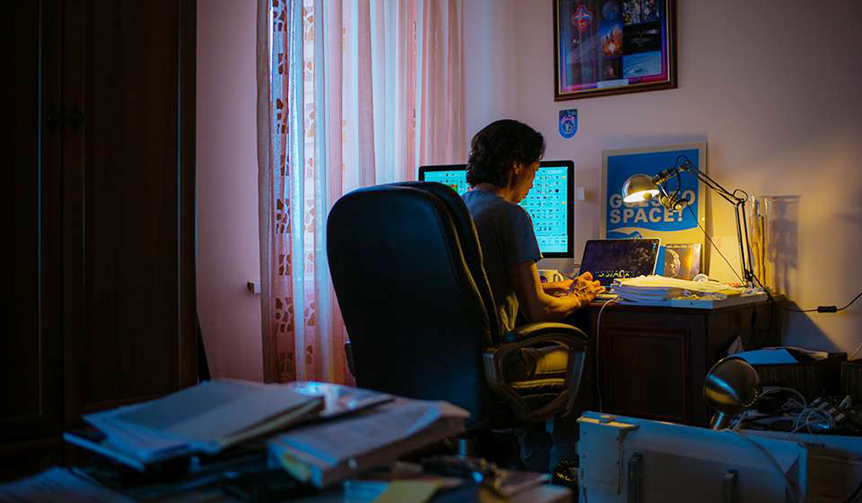
From Mr. Takamatsu's Facebook (https://www.facebook.com/Cosmo.Takamatsu/)
SukezaneCan training only be done in Russia?
TakamatsuFirstly, America does not have a program to launch civilians to the ISS. Secondly, since the Space Shuttle program was discontinued after 2011, NASA has not had any manned rockets. Therefore, the only means to reach the ISS has been the Russian Soyuz rocket, and in reality, even NASA and JAXA astronauts train in Russia and travel to space on Russian rockets.
SukezaneWhy doesn't America have a rocket?
TakamatsuThe Space Shuttle was, in a sense, the largest, most advanced, complex, and beautiful piece of industrial product humanity had created in the 20th century. It can be called a legacy of the 20th century. However, it was so complex and difficult to maintain that it was very expensive. Also, the fact that it had two catastrophic accidents resulting in the loss of all crew members was significant. The plan to build a next-generation space shuttle was also abandoned.
SukezaneAre there no American rockets currently under development?
TakamatsuOf course, the current situation is abnormal, so the development of next-generation rockets is progressing. This time, instead of NASA developing them, the scheme involves having private companies compete for development using NASA's budget. Boeing and SpaceX have both secured contracts and are in the final stages of development. Manned flights are expected to become a reality next year. The era of NASA and JAXA astronauts boarding Russian Soyuz rockets may end in a few more years.
Page 03.Even Tough Training Becomes a Fond Memory Once It's Over
Page. 3
Even Tough Training Becomes a Fond Memory Once It's Over
SukezaneSo, you underwent astronaut training for the Russian Soyuz rocket during such a rare period.
TakamatsuI truly believe that. It was close to the last chance for a civilian to receive the full astronaut training from start to finish. Once the two American companies' rockets start flying to the ISS, civilians will likely be able to board in a few years. However, I don't think they will receive the same training as astronauts in America.
SukezaneSo, in a few years, it will be possible to go to the International Space Station from America, but the training for civilians will be completely different from that for professionals.
TakamatsuYes. The rockets being developed are planned to seat seven people. The first row will have many tasks, including piloting, but civilians in the second row will likely have almost nothing to do. They won't need to train for nearly a year or study the entire process like true astronauts.
SukezaneI see.
TakamatsuTherefore, once training becomes available in America, the opportunity for civilians to receive the same training as astronauts might end. The training was incredibly tough, but looking back, it's a wonderful memory, so I truly feel fortunate to have trained during this era.
SukezaneJust hearing about it sounds difficult. What was the most challenging training?
TakamatsuThere were quite a few enjoyable parts too (laughs). But the most difficult was the water survival training. It's a simulation assuming a crash landing in the ocean. The scenario is that the capsule has deviated from its orbit and landed in the sea, but rescue cannot locate it. You have to survive for 48 hours on your own.
SukezaneWas it difficult to drift on the water?
TakamatsuThe difficulty wasn't on the water; it was getting out of the capsule. Capsules are much, much smaller than you can imagine. Three adults can barely fit, sitting shoulder-to-shoulder, with very limited space up, down, left, and right. In such a cramped space, you have to take off your spacesuit and put on a waterproof suit for water survival. That's the hard part. It's like changing clothes inside a locker. Since it's a crash landing, there's no air conditioning, of course.
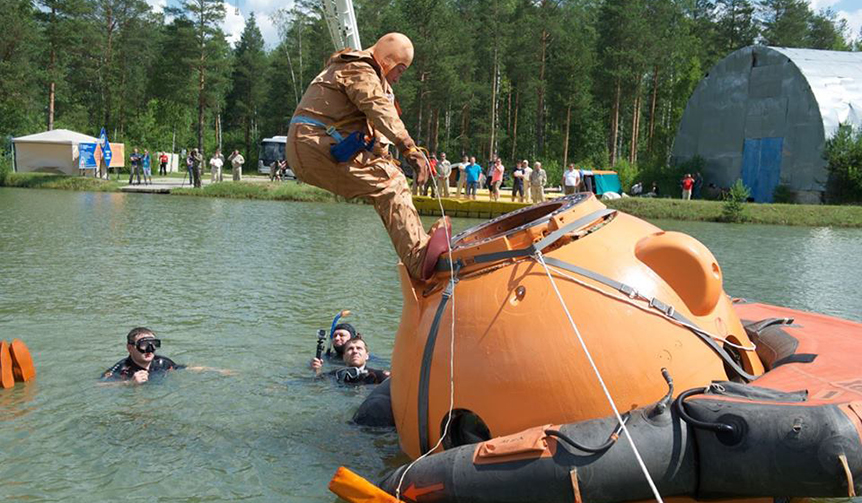
From Mr. Takamatsu's Facebook (https://www.facebook.com/Cosmo.Takamatsu/)
The temperature inside rises rapidly, reaching 30 degrees Celsius with 100% humidity. If you sweat too much and become dehydrated, it's over, so you have to hurry. You might think, 'Is it really that bad?' but it takes about an hour of continuous effort to change. We had to pull each other, contorting ourselves into acrobatic positions that men wouldn't normally do (laughs), slowly taking off layers. After removing the spacesuit, it gets even tougher. You have to put on the water survival suit, which has multiple layers. Even though it's extremely hot inside the capsule, you put on layers of knitwear and down. First, you have to find and put on a blue jumpsuit for emergencies. Then, find and put on socks, followed by a down jumpsuit, down boots, a woolen hat, and finally, an orange, fully waterproof hydro-suit. By the time all three of us finish, nearly an hour has passed. Sweating profusely, we open the capsule, take out emergency drinking water and fishing gear, inflate the flotation devices, and wait for rescue. Getting out was the hardest part, and that was the most difficult. If you drink a lot of water beforehand, dehydration isn't a concern, but then you have the problem of needing to use the restroom. I became very particular about the amount of fluids I drank beforehand.
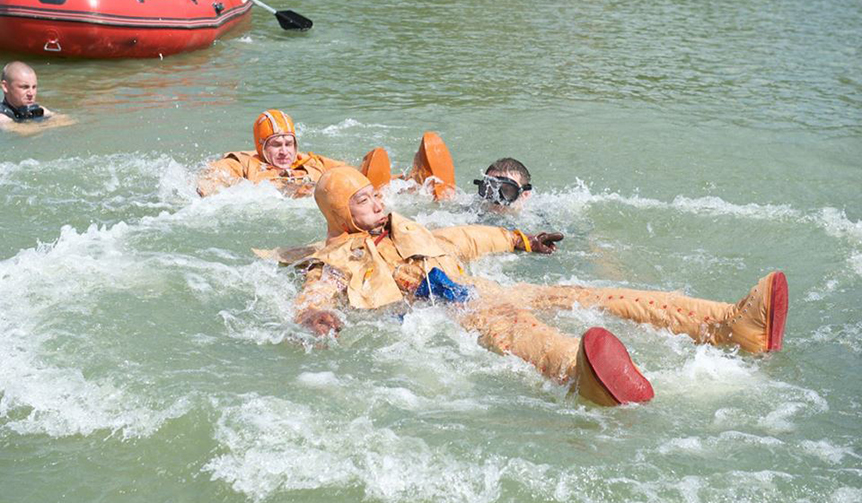
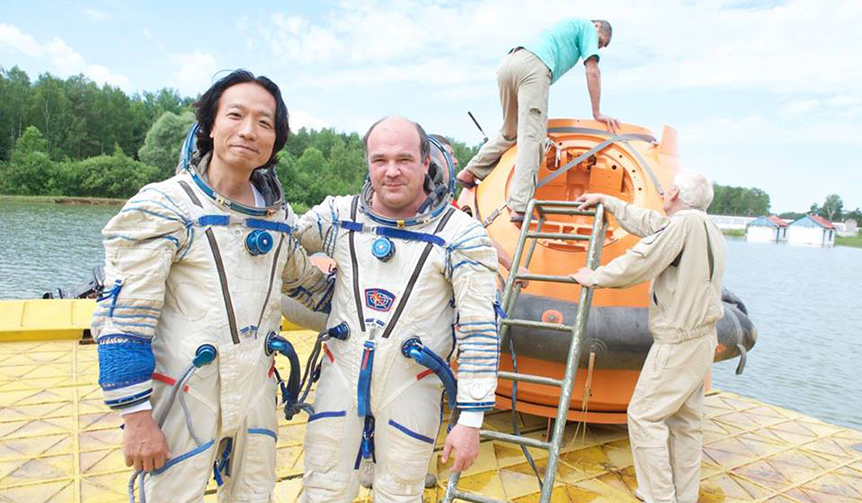
From Mr. Takamatsu's Facebook (https://www.facebook.com/Cosmo.Takamatsu/)
SukezaneAre you still in touch with the two people you trained with during that time?
TakamatsuOf course, we became good friends. It's not just like sharing meals; we helped each other undress and saw each other's less-than-ideal states. They are my comrades-in-arms with whom I split wood and secretly drank vodka disguised as coffee.
SukezaneAre they Russian?
TakamatsuIt varied depending on the training content, so there were Americans too. But during the water survival training, they were Russian.
SukezaneSo, was the conversation in Russian?
TakamatsuYes. Some of them only spoke a little English, so the communication was limited to 'Okay,' 'Come on,' 'Don't stop,' and my 'Khorosho' and 'Da' (laughs).
SukezaneThat sounds like a real ordeal.
TakamatsuYes. The Russian language classes were also difficult and tough.
SukezaneYou wouldn't use it if you were in Japan. Russian doesn't have the same familiarity as English.
TakamatsuThere were also memory-related subjects, and it was incredibly tough to cram for weekly tests every weekend, like pulling an all-nighter.
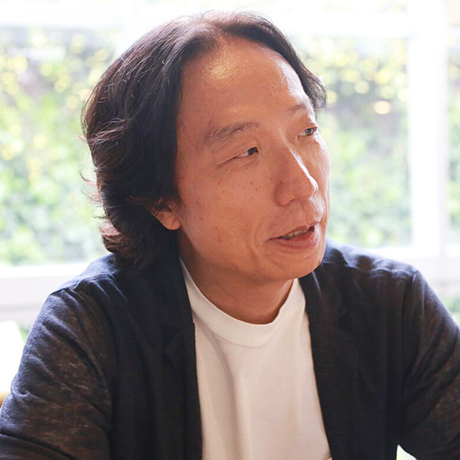
Satoshi Takamatsu
Born in Tochigi Prefecture in 1963. Graduated from the Department of Engineering Fundamentals at the University of Tsukuba in 1986 and joined Dentsu. After over 10 years in sales, he moved to the creative field in 2002. He left Dentsu in 2005 and founded the creative agency ground and the space video production company SPACE FILMS. His major works include commercials for Sky PerfecTV!, Adidas, NTT Resonant's 'goo,' and Nissin Cup Noodles' 'NO BORDER' and 'FREEDOM.' He directed the world's first commercial filmed on the International Space Station for Otsuka Pharmaceutical's Pocari Sweat, titled 'Space Commercial.'
Tomoki Sukezane & Editor Daimaou Talk | Vol. 21 Satoshi Takamatsu (Civilian Astronaut) (Part 2)