Where has the beautiful Japanese of Noh chanting gone?
A Special Conversation: Poet Akiko Baba x Noh Actor Shinya Tomioka (Kita School) - Part 2
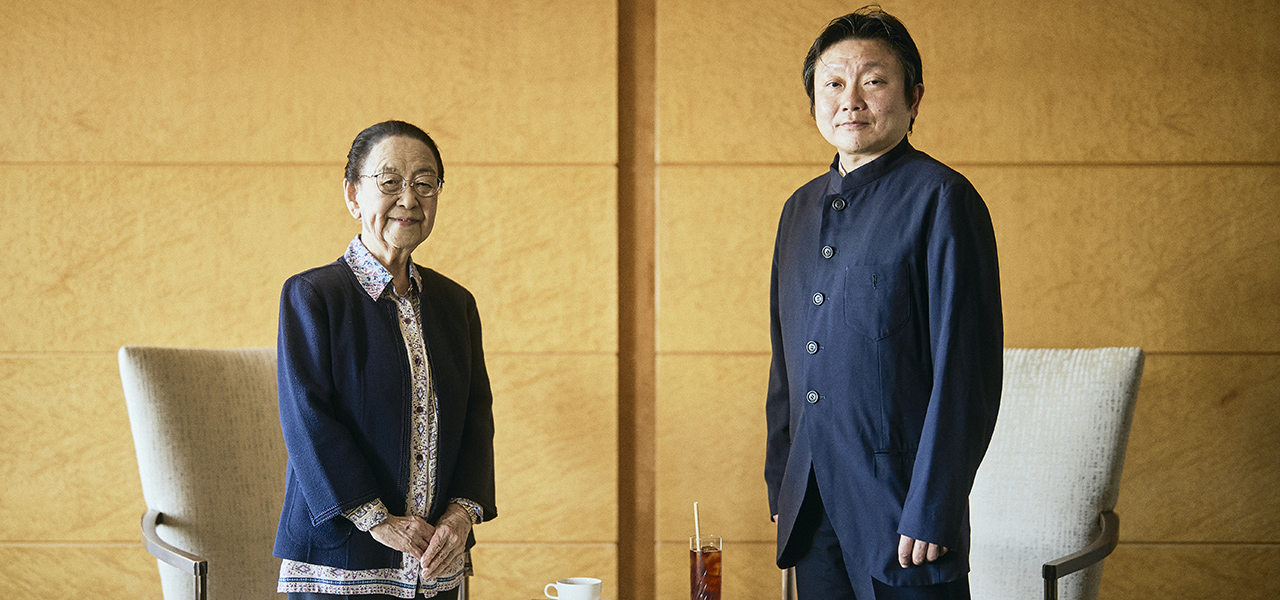
The COVID-19 pandemic accelerated digitalization and the spread of online communication, fostering non-verbal exchanges. Yet, short-form communication via social media has become the norm, shaking the mystique of the Japanese language. In today's Japan, where diverse foreigners visit and various foreign cultures flow in, where is the culture of language headed? Poet Akiko Baba and Shinya Tomioka, a lead actor (shite) of the Kita school of Noh, delve into this question, using Noh's vocalizations, or 'utai,' as their starting point.
The special conversation can be foundhere, and the first part of this special conversation can be foundhere.
The special conversation can be foundhere, and the first part of this special conversation can be foundhere.
Text by AMARI Mio Photographs by TAKAYANAGI Ken
TomiokaNoh performances consist of parts where the shite and tsure express emotions, and parts where the jiutai describes the scene and circumstances. The latter, the 'utai,' also reveals the depth of Noh.
In 'Yamanba,' for example, there's the line, 'If there is Buddhist law, there is worldly law; if there are worldly desires, there is enlightenment; if there are Buddhas, there are sentient beings; if there are sentient beings, there is the mountain witch; the willow is green, the flowers are red, in myriad colors.' I truly hope you'll savor the beauty of its rhythm. Having the text beforehand should help your imagination flourish.
BabaPerhaps because schools no longer teach classical literature properly, mixed Chinese-Japanese prose is difficult for many to understand. I was born in 1928, and as a child, I was made to memorize beautiful prose. Thanks to that, the words of Noh chants come to me easily. I quickly memorized lines like, 'The flowers of human sorrow are in full bloom; the wind of impermanence adds its sound; the moon's shadow of the long night of birth and death; the clouds of uncertainty cover all.' from the latter half of 'Sumidagawa.'
I cannot help but question the state of Japanese language education after the war. Before then, Japanese people were inspired by beautiful European poetry to create their own. But after the concise and direct style of American writing became widespread, the beauty of rhythm began to be undervalued.
TomiokaBuilding on what you just said, I have a question. Noh has the pleasure of watching and the pleasure of learning, and learning it greatly enhances the pleasure of watching, doesn't it? You are a rare individual accomplished in both. Where do you think is the quickest way to start?
BabaFor me, it was seeing 'Sumidagawa' in my late teens. I felt an unusual affinity for the shaku-mi mask, and the rhythm of the lines I mentioned earlier—'The flowers of human sorrow are in full bloom; the wind of impermanence adds its sound; the moon's shadow of the long night of birth and death'—deeply moved me. With no money, I quickly enrolled. I went all the way to the Noh theater (at the time, the Somei Nohgakudo, where Kita school performances were held) and asked, 'How can I start practicing?' They told me that if I brought this much for the teacher's fee and monthly tuition, I could become a disciple. I went home and immediately sold some of my books. I joined the tanka poetry group 'Mahiru no' around the same time. Back then, acting before thinking was the norm. Perhaps the uncertain post-war era made us that way.
TomiokaI believe word choice is crucial in tanka. With social media now a part of daily communication, isn't the Japanese language also being affected?
BabaIt's a lamentable situation. While Sweden is reportedly considering age restrictions for internet access, in Japan, the move away from print is progressing. Culture itself is at risk of extinction.
TomiokaI feel that words are no longer respected, and the idea that 'as long as it gets the point across, it's fine' is becoming prevalent. For example, letters used to begin with 'Dear Sir/Madam,' include seasonal greetings and the main text, and conclude with 'Sincerely.' Now, these are treated as unnecessary.
BabaEven 'understood' is now abbreviated to 'ryo.' The mystique of the Japanese language is steadily diminishing. During my 47 years as an editor for the Asahi Tanka section, I've seen countless poems. More and more of them are 'poem-like poems'—they adhere to the 5-7-5-7-7 structure, but it's unclear what they are actually singing about. When new cultures flow in, language is inevitably affected, so perhaps this is unavoidable.
TomiokaSo, will beautiful Japanese truly disappear?
BabaNot necessarily. Shingetsu Watanabe, who won the Kadokawa Tanka Prize for new poets in 2024, presented surprisingly classical poems. He also watches and studies Noh. He is currently researching the medieval period in the graduate program at the University of Tokyo. I'm keen to see what kind of poet he becomes.
Akiko Baba
Poet. Literary critic. Born in 1928. From Tokyo. After graduating from the Department of Japanese Literature at the Japan Women's College of Fine Arts (now Showa Women's University), she joined the poetry magazine 'Mahiru no' and studied under Shoichiro Kubota. In 1972, she founded the tanka poetry group magazine 'Karin' with her husband, Masaru Iwata. She served as an editor for the Asahi Shimbun's tanka section. She will step down from this role at the end of March 2025, after 47 years. Member of the Japan Art Academy. Person of Cultural Merit. In 1947, she entered Noh as a disciple of Minoru Kita, the 15th head of the Kita school. She has been involved in new Noh productions and has also written extensively on Noh. In addition to poetry collections, she has authored numerous works on waka, Noh, folklore, and classical studies.
Poet. Literary critic. Born in 1928. From Tokyo. After graduating from the Department of Japanese Literature at the Japan Women's College of Fine Arts (now Showa Women's University), she joined the poetry magazine 'Mahiru no' and studied under Shoichiro Kubota. In 1972, she founded the tanka poetry group magazine 'Karin' with her husband, Masaru Iwata. She served as an editor for the Asahi Shimbun's tanka section. She will step down from this role at the end of March 2025, after 47 years. Member of the Japan Art Academy. Person of Cultural Merit. In 1947, she entered Noh as a disciple of Minoru Kita, the 15th head of the Kita school. She has been involved in new Noh productions and has also written extensively on Noh. In addition to poetry collections, she has authored numerous works on waka, Noh, folklore, and classical studies.
Shinya Tomioka
Noh actor (shite), Kita school, official position. Member of the Noh Association. Designated as a Living National Treasure. Born in 1969. From Tokyo. Grandson of the late Kikuo Tomioka, an official of the Kita school. Made his debut at the age of three with the dance 'Tsukimiyadono.' Studied under the late Minoru Kita, the 15th head of the Kita school. After training as an apprentice within the Kita school's head family, he currently studies under his uncle, Akitsugu Tomioka. He performed 'Shōjō Ran' in 2004, 'Dōjōji' in 2008, and 'Ishibashi (Red Lion)' in 2011. Member of 'San no Kai.' Representative of 'Moyōka no Noh.' His annual schedule includes theKita School Independent Performanceon September 28, 2025, and can be foundhere
Noh actor (shite), Kita school, official position. Member of the Noh Association. Designated as a Living National Treasure. Born in 1969. From Tokyo. Grandson of the late Kikuo Tomioka, an official of the Kita school. Made his debut at the age of three with the dance 'Tsukimiyadono.' Studied under the late Minoru Kita, the 15th head of the Kita school. After training as an apprentice within the Kita school's head family, he currently studies under his uncle, Akitsugu Tomioka. He performed 'Shōjō Ran' in 2004, 'Dōjōji' in 2008, and 'Ishibashi (Red Lion)' in 2011. Member of 'San no Kai.' Representative of 'Moyōka no Noh.' His annual schedule includes theKita School Independent Performanceon September 28, 2025, and can be foundhere