What exactly is an oni? Unraveling the true nature of demons through Noh theater.
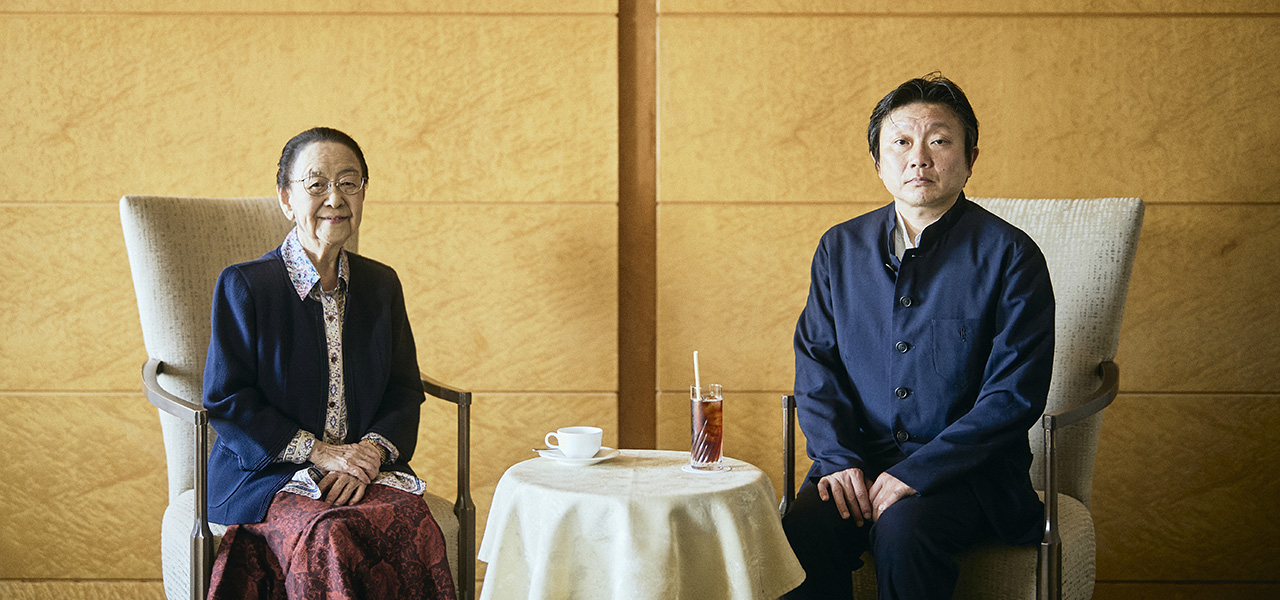
A Special Conversation: Poet Akiko Baba x Shinya Tomoeda, Kita School Kita-ryu Shite Master
In Noh, there are beings called "kishin" who possess both divine and demonic aspects. In contrast, modern demons often appear as part of expressions for horrific events beyond human comprehension, such as "the work of a demon," or are depicted as the ultimate transformation of humanity, as in popular animations. What, then, is a demon? We asked poet Akiko Baba, who engages with Noh, and Shinya Tomoeda, a Kita-ryu Kita-ryu shite master, to discuss "demons" as a special addendum to their conversation, alongside the widely known book "A Study of Demons."
※The first special conversation can beviewedhere.
※The first special conversation can beviewedhere.
Text by AMARI Mio|Photographs by TAKAYANAGI Ken
TomoedaTomoeda: It might be a bit late to bring this up, but Ms. Baba, in the final part of your book "A Study of Demons," you discussed "Yamauba."
BabaBaba: The demon depicted in "Yamauba" is special. It's different from the demons in other plays, and only one Noh mask is used. I wonder if it's a demon that became particularly beloved by common people in the medieval period.
Baba: Speaking of demons, it's fascinating that in the world of Noh, there exist "kishin" (demon-gods) who embody both divine and demonic aspects. Prince Shōtoku, who created the Seventeen-Article Constitution, was a highly virtuous figure. However, Zeami's "Fūshikaden" states that Prince Shōtoku possessed both the outward appearance of an elder and the inner nature of a demon. Also, I believe it was Kurokawa Noh (a traditional performing art passed down in the Shōnai region of Yamagata Prefecture) where, when performing "Okina," they also present a demon mask. In essence, one can become a demon at any moment. Humans have both an outward and an inner self.
TomoedaTomoeda: A readily understandable play featuring a kishin would be "Nomori."
BabaBaba: I love it. It has a very striking line: "Omōi omowazu..."
TomoedaTomoeda: "...yosonagara min."
BabaBaba: Yes. Although a kishin, it has been pacified and transformed into a "nomori" (guardian of the fields). Yet, through the mirror, it is a fearsome being that watches everything from the heavens to hell from afar. "Hyōri" also features a demon.
TomoedaTomoeda: Yes. The mask is "Kobeshimi." Its mouth is tightly shut, primarily representing a terrestrial kishin.
BabaBaba: In the height of summer, the old guardian of the ice house brings ice from the ice house in Tanba Province to present to the Emperor. As depicted in "The Tale of Genji," in the past, high-ranking nobles would cool their hands and cheeks with ice for refreshment, but this was only possible with the support of demons. The demons, sweating profusely, never complain.
TomoedaTomoeda: Precisely because the mouth is so tightly shut, it's all the more terrifying.
BabaBaba: With masks, I'm also drawn to "Akujō." In terms of plays, there's "Tamanoi," which is based on the legend of the brothers Hikohōhodemi no Mikoto and Hikoitsuse no Mikoto. Hikohōhodemi no Mikoto, seeking his lost fishing hook, enters the sea and meets Toyotama-hime and Tamayori-hime, daughters of the sea god. He then makes a pact with Toyotama-hime and receives the Tide-Full Jewel and the Tide-Ebb Jewel. What does this signify? It means he has handed over all authority over the sea, along with the daughter, so they can do as they please, whether it be to cause floods or ebb the tides. I believe it requires considerable courage to perform this sea god with an "Akujō" mask.
TomoedaTomoeda: I have performed it as a tsure in the past.
BabaBaba: Please perform it as a shite someday. Like "Nomori," I will be watching intently, "thinking, not thinking, from afar." The "Akujō" mask, which silently conveys the terrifying words of how one will treat this sea country. This is a mask that expresses the human heart, which is both demon and god. I love Akujō music, so I've seen "Ōyashiro," "Shirahi ge," "Aya no Tsuzumi," and "Dōmyōji."
BabaBaba: In Noh, there are many demons who don't appear with a demon's face. "Tobide" is one of them, isn't it? The "Ōtobide," which represents a divine manifestation, is truly a great demon.
TomoedaTomoeda: Of course, in plays like "Takasago" and "Enma," where Amaterasu Ōmikami appears, they are gods.
BabaBaba: While Amaterasu Ōmikami in the Noh play "Enma" is generally recognized as a goddess, in the Kita school, she is portrayed as male. This is an important testament, making us consider the unresolved nature of Amaterasu's identity up to that point.
TomoedaTomoeda: There is also a variation called "Jotai," but many Noh plays do not clearly distinguish between demons and gods.
BabaBaba: The performers of old were called "kawaramono" (riverbed dwellers), but they must have understood that demons and gods are one and the same.
TomoedaTomoeda: From the perspective of a performer, I feel that Noh fundamentally lacks the intention to be understood by the general populace.
BabaBaba: It was enough if the noble court understood; the rest was about appreciating the beautiful costumes, masks, and movements.
Baba: Returning to the topic of demons, after the Edo period, demons became less recognized, and the existence of ninjas emerged. Aren't they also manifestations of demons? Furthermore, the late Edo period was filled with chaos and many bandits appeared; bandits are also demons, aren't they? That's why Hasegawa Heizo, the head of the Arson and Bandit Suppression Bureau, was called "Onihei" in Shotaro Ikenami's novels. Even now, this world is full of demons. Anything can happen at any time. We often see the "work of demons" in the news. Ultimately, something triggers a surge of passion, leading to a loss of reason and becoming a demon. This has been happening ceaselessly, both in the past and present.
Akiko Baba
Poet and literary critic. Born in 1928 in Tokyo. After graduating from the Department of Japanese Literature at Tokyo Women's Higher Normal School (now Showa Women's University), she joined the poetry magazine "Mahiruno" and studied under Shoichiro Kubota. In 1972, she founded the tanka literary magazine "Karin" with her husband, Tadashi Iwata. She is a selector for the Asahi Shimbun tanka column, and will retire from this position at the end of March 2025 after 47 years. Member of the Japan Art Academy. Person of Cultural Merit. In 1947, she entered the Kita school under the 15th head family master, Minoru Kita, and has been involved in creating new Noh plays and writing Noh criticism. In addition to poetry collections, she has numerous works on tanka, Noh, folklore, and classical literature.
Poet and literary critic. Born in 1928 in Tokyo. After graduating from the Department of Japanese Literature at Tokyo Women's Higher Normal School (now Showa Women's University), she joined the poetry magazine "Mahiruno" and studied under Shoichiro Kubota. In 1972, she founded the tanka literary magazine "Karin" with her husband, Tadashi Iwata. She is a selector for the Asahi Shimbun tanka column, and will retire from this position at the end of March 2025 after 47 years. Member of the Japan Art Academy. Person of Cultural Merit. In 1947, she entered the Kita school under the 15th head family master, Minoru Kita, and has been involved in creating new Noh plays and writing Noh criticism. In addition to poetry collections, she has numerous works on tanka, Noh, folklore, and classical literature.
Shinya Tomoeda
Kita school Kita-ryu shite master and official. Member of the Noh Association. Designated as a holder of Important Intangible Cultural Property. Born in 1969 in Tokyo. Grandson of the late Kikuo Tomoeda, a Kita-ryu Kita-ryu official. Made his stage debut at the age of three with the dance "Tsukimiyadono." Studied under the late Minoru Kita, the 15th head family master of the Kita school Kita-ryu shite. After training as an in-house disciple of the Kita school head family, he currently studies under his uncle, Akimitsu Tomoeda. He has performed "Shōjō Ran" in 2004, "Dōjōji" in 2008, and "Ishibashi (Red Lion)" in 2011. Member of "San no Kai." Representative of "Morioka no Noh." His schedule for 2025 includes the Kita school independent performance on September 28th,Kita school independent performanceand other annual events can be foundhere.
Kita school Kita-ryu shite master and official. Member of the Noh Association. Designated as a holder of Important Intangible Cultural Property. Born in 1969 in Tokyo. Grandson of the late Kikuo Tomoeda, a Kita-ryu Kita-ryu official. Made his stage debut at the age of three with the dance "Tsukimiyadono." Studied under the late Minoru Kita, the 15th head family master of the Kita school Kita-ryu shite. After training as an in-house disciple of the Kita school head family, he currently studies under his uncle, Akimitsu Tomoeda. He has performed "Shōjō Ran" in 2004, "Dōjōji" in 2008, and "Ishibashi (Red Lion)" in 2011. Member of "San no Kai." Representative of "Morioka no Noh." His schedule for 2025 includes the Kita school independent performance on September 28th,Kita school independent performanceand other annual events can be foundhere.