Panasonic | Expressing "Sceneries of Energy" with Architect Akihisa Hirata at Milan Salone 2013
Panasonic
Concept: "Energetic Energies"
Expressing "Scenes of Energy" with Architect Akihisa Hirata
Proposing "scenes of energy" for the city, newly installed with "energy creation" through solar panels, "energy storage" via batteries, "energy saving" with LED lighting, and the energy management that controls them.──At the Interni venue within the University of Milan, the same location as last year, Panasonic presented an installation exhibition with the concept of "Energetic Energies / Scenes of Energy."
Text by KAJII Makoto (OPENERS)Photographs by Satoshi Shigeta
Explaining "Closing and Expanding"
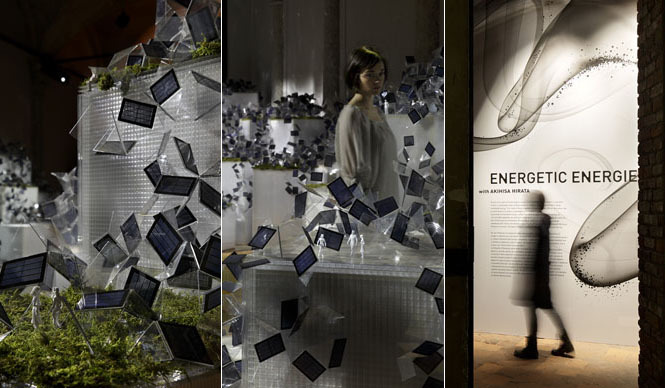
Milan Salone 2013 opened on April 9th. A report from the venue stated: "This exhibition does not depict a sterile world with uniformly arranged solar panels solely for power generation efficiency. Instead, it expresses a future urban landscape where solar panels are arranged three-dimensionally like plants, seamlessly integrating artificial structures and nature, brimming with vitality. The aim is to switch on visitors' imagination."
Last year, Panasonic's installation exhibition attracted approximately 33,000 visitors (according to Panasonic) during the Milan Salone period. This year, the sixth iteration, continues the theme from last year.Architect Akihisa HirataThe venue design, by , presents an exhibition with the concept of "Energetic Energies / Scenes of Energy."
Regarding this exhibition, Hirata described it as "closing and expanding." He explained, "This time, within a closed indoor space, we are presenting a small-scale expression, but the content represents a much larger urban expansion. It builds upon last year'sPhotosynthesisexhibition while inheriting its concept."
A Miniature City Spanning 30 Meters
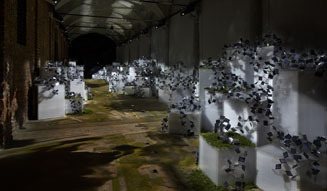
The main presentation, located in the colonnade to the right of the main entrance of the University of Milan, is a 30-meter-long miniature city. Approximately 6,000 solar panels are scattered across the cityscape, creating hills atop the urban structures. Clouds cast slow-moving shadows over these hills, as if moving across natural terrain, reminding visitors of their often-forgotten connection to the sky. Dynamic natural movements are expressed through 16 projectors and ambient soundscapes from scattered speakers. Visitors can experience a new vision of integrated urban and natural environments as they walk through the hills.
Regarding the solar panels, Hirata commented, "In the near future, it's highly probable that urban rooftops will be covered with solar panels. These panels will shape the landscape of our cities. It is meaningful to consider what kind of scenery this will create, together with a major company like Panasonic. We hope visitors realize that there are ways of thinking about this beyond mere mechanical arrangements – as elements that shape our environment. This will change their perspective on solar panels and activate their imagination."
When asked why he finds solar panels interesting, Hirata explained, "Solar panels are both familiar in our daily lives and susceptible to weather. When considering their connection to the sun, sky, and climate, it should evoke imagination extending at least to the solar system. There's an element of reclaiming a primitive relationship with the sky and nature through cutting-edge technology. This time, we wanted to spatially demonstrate how the space interacts with clouds and the rhythms of natural change."
Activities Merging "Products," "Art," and "Education"
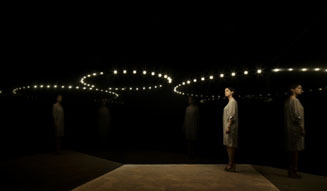
Further exploration beyond the miniature world leads to a mirrored space. Here, visitors can experience installations of Panasonic products that form the basis of energy management, including "solar panels" from the main presentation, "storage battery systems," and "LED lighting."
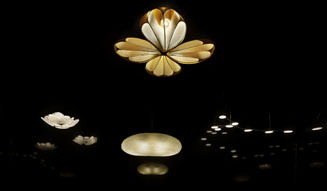
The LED lighting features four types of chandeliers, created in collaboration with Milanese designers based on Panasonic's proprietary "Panelina" and "Synchro-Color" technologies. Within the fantastical mirrored space, where light layers upon light, visitors can appreciate the diversity of LED illumination.
Additionally, as part of Panasonic's socio-cultural activities, an "Eco-Classroom of Light" is scheduled to be held at a Milanese elementary school in conjunction with the installation exhibition at Milan Salone. The class will use three types of light sources (incandescent, fluorescent, and LED) and hand-crank generators for experiments, allowing children to "discover and realize" the importance of energy saving. Through crafting LED lanterns, they will also experience the joy of making things.
We will be watching Panasonic as they tackle major themes: expanding their LED product line, pursuing the design potential of light, and promoting lighting culture, all based on "creation, storage, and saving of energy."
Exhibition Concept | Energetic Energies
Dates | April 9 (Tue) - 14 (Sun), 2013, 9:00 - 24:00
Venue | INTERNI: HYBRID ARCHITECTURE & DESIGN
Università degli Studi di Milano: Portico Richini
Within the University of Milan, Portico Richini
(via Festa del Perdono, 7 - Milano)
Venue Design | Akihisa Hirata (Hirata Architects)
Exhibited Products | Solar panels, storage battery systems, HEMS, LED bulbs (clear type), LED chandeliers
Milan Salone Special Site
http://panasonic.net/milanosalone
Inquiries
Customer Consultation Center
0120-878-365 (Reception 9:00 - 20:00)

Akihisa HIRATA
Architect. Born in Osaka in 1971. Completed graduate studies at Kyoto University's Graduate School of Engineering in 1997. After working at Toyo Ito & Associates, Architects, he established Hirata Architects in 2005. He has received numerous awards, including the JIA Newcomer's Award in 2008, ELLE DECO Young Japanese Design Talent for "animated knot" in 2009, the Elita Award for Panasonic's venue design at Milan Salone in 2012, the Golden Lion award for the Japanese Pavilion exhibition at the 13th Venice Architecture Biennale, and the Grand Prize for the Kamaishi City Reconstruction Housing Public Housing and Children's Garden proposal.