People and Companies Building a New Era — Panasonic Electric Works Edition | SHIFT JAPAN
People and Companies Building a New Era – Panasonic Electric Works Edition
A New Form of Energy Utilization Proposed Through Housing (1)
The smallest unit of the smart grid isSmart House. Efficiently using electricitySmart Grid. With the importance of the smart grid gaining attention, the first step is to use electricity efficiently at home. To what extent has the smart house, which can be called the next-generation home, progressed as a starting point for this? We interviewed Mr. Yasuhiro Fujii, Deputy General Manager of the Marugoto Business Promotion Department at Panasonic Electric Works, a company that handles a wide range of housing equipment and building materials.
Text by Fumio OgawaPortrait photos by Kenta Yoshizawa
The Social Environment Surrounding Housing is Changing
—Since the earthquake and the accident at the Fukushima Daiichi Nuclear Power Plant, public awareness of electricity has shifted due to concerns about power supply. For Panasonic Electric Works, which considers everything from housing to electricity and communication infrastructure, what do you think has changed significantly?
Simply put, it's the awareness of society as a whole. Ideas to promote efficient electricity use have existed for a long time. For example, smart meters that visualize household electricity consumption, and the use of home battery storage were also considered for introduction in the near future.Smart MeterInitially, the introduction timing was said to be 'after 2015,' but I think it's happening sooner.
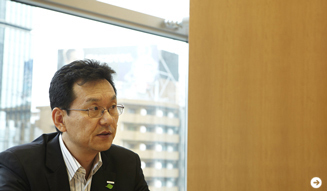
Yasuhiro Fujii, Deputy General Manager, Marugoto Business Promotion Department, Panasonic Electric Works
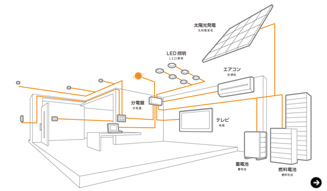
Connecting all home appliances to efficiently consume electricity.
—Based on the idea of not relying on nuclear power, we have two tasks. One is to reduce electricity consumption. The other is to deal with power generation using new energy sources, which includes renewable energy. Both of these can be started from individual homes.
We are already proposing systems to visualize electricity usage within the home. The next step is digitalization. This involves using ICT (Information and Communication Technology) to reduce power consumption and effectively incorporate solar power generation and battery storage. Power demand consists of general households and businesses; simply put, businesses consume electricity during the day, and general households consume it from the evening. Therefore, it would be ideal if we could use computers connected to the community to efficiently utilize power sources, for example, by having general households rely on self-generated solar power during the day when businesses consume large amounts of electricity, although this cannot be achieved by our company alone.
—Is HEMS (Home Energy Management System), which combines smart meters with computers, the next step?HEMSWhat is the progress on this?
HEMS's role is to control the power of devices within the home, such as electrical appliances. With this, it is limited to functions like stopping power supply to certain devices due to high consumption. Considering usability, it's necessary to supply electricity efficiently according to the usage patterns of each household. The software aspect is crucial here.
—Could you explain in a little more detail?
It's the concept of understanding the usage patterns of home appliances for each household and controlling consumption in relation to the overall electricity consumption of the community. We are focusing our efforts on creating the algorithms for this. We have a sense of pride in being a top runner in the industry.
—When is the target for realization?
We envision that most of the system will be in place between 2018 and 2020, with continuous evolution each year. We feel it has to be that way.
People and Companies Building a New Era – Panasonic Electric Works Edition
A New Form of Energy Utilization Proposed Through Housing (2)
Housing is Moving Towards a New Form
—How will homes interact with natural energy?
Amidst calls for planned power outages and energy conservation, we believe that housing manufacturers must also provide solutions. As mentioned earlier, plans to incorporate new energy and efficient energy saving into general households were already underway before the earthquake, but what has been newly added is a system that provides peace of mind even during power outages.
—What kind of model cases can be considered?
In addition to energy saving through HEMS, which we've discussed, we believe that future homes will combine distributed power sources through the installation of solar panels and preparedness for power outages through battery storage. We call these new-generation homes smart houses. Since we have Sanyo Electric within the same group, which commercializes residential solar power generation systems, we can cooperate to develop homes that incorporate new energy.
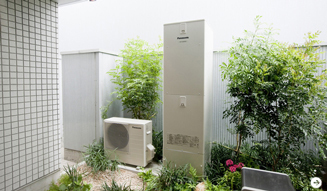
Home fuel cells are also a promising energy source.
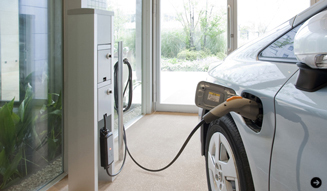
The "Eco Idea House" also allows for power supply to electric vehicles.
—What is the future potential of solar power generation in housing?
There are no construction method issues as solar panels can be installed on the roofs of houses. However, it also involves significant costs, so there are several hurdles, such as the government providing sufficient subsidies and revising laws to allow for electricity sales, and how much consumers can feel the return on investment. However, at our "Eco Idea House" in Ariake, Tokyo, we aim for near-zero CO2 emissions by using electricity wisely, and we hope to achieve a balance where the cost of buying and selling electricity becomes zero.
—It is very beneficial to use natural energy to generate secondary energy like electricity. On the other hand, LNG (liquefied natural gas) is also being considered as a promising primary energy source.
I believe gas-fired power generation is promising in terms of cost. LNG is mainly used in large-scale power plants, but in homes, power generation using city gas is possible. At the Eco Idea House, we have also introduced a gas reformer type home fuel cell. This system extracts hydrogen from city gas, reacts it with oxygen, and generates electricity through a special process that captures electrons. This is a system that generates electricity at home using gas.
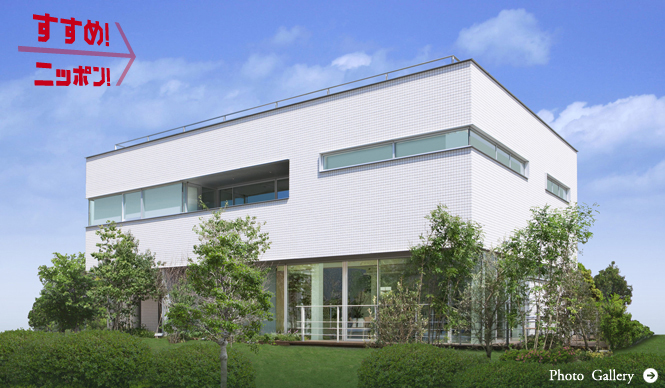
eco idea HOUSE
Experience a next-generation home that aims for "CO2 ± 0 (Zero)" proposed by Panasonic. By enhancing the energy efficiency of home appliances and utilizing highly insulated building materials, CO2 emissions are drastically reduced. The energy that is still needed is generated and stored through solar power generation, fuel cells, and battery storage. The Home Energy Management System connects these and intelligently controls energy to achieve CO2 ± 0 (Zero). Furthermore, it proposes a comfortable lifestyle that effectively incorporates the blessings of nature such as "wind, light, water, and heat." Available for experience on Saturdays, Sundays, and public holidays, excluding Mondays.
3-5-1 Ariake, Koto-ku, Tokyo (Inside Panasonic Center Tokyo)
Public Viewing | Saturdays, Sundays, Public Holidays (Closed Mondays) 10:00–18:00
Free Admission
http://panasonic.co.jp/ecohouse/