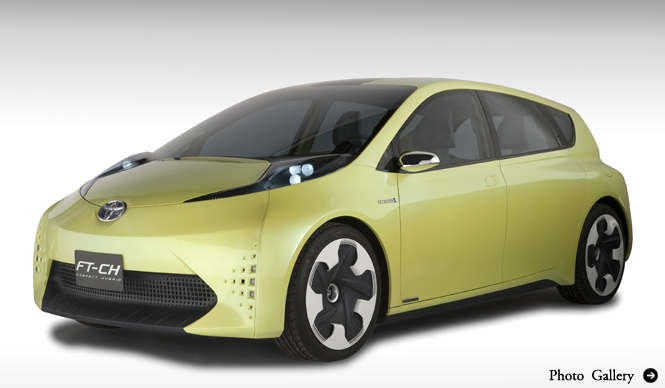
Toyota FT-CH | An Entry-Level Model in the Prius Family
TOYOTA FT-CH | TOYOTA FT-CH
The Entry Model of the Prius Family
Toyota unveiled the concept car "FT-CH" at the Detroit Motor Show. This model is a hybrid-exclusive vehicle with a compact, five-door hatchback body.
Text by Giraffe
A Body Under Four Meters in Length
The FT-CH measures 3900mm long and 1720mm wide. It's 560mm shorter and 25mm slimmer than the Prius, giving you an idea of its compact size. Yet, it's said to offer enough space for four adults to ride comfortably, drawing attention for its practicality.
The exterior was designed by Toyota's European design division, "ED2." Its innovative and colorful design clearly targets a younger demographic.
As a Member of the Prius Series
While details of the engine and hybrid system have not been disclosed, the secondary battery is expected to be a lithium-ion battery manufactured by Panasonic EV Energy, similar to the "Prius Plug-in Hybrid."
Toyota is proceeding with plans to establish "Prius" as an independent brand in the United States. This FT-CH is slated for commercial release as a derivative model under the Prius brand. Naturally, its price is expected to be lower than that of the Prius.
Toyota's offensive in hybrid vehicles has only just begun.
BRAND HISTORY
Toyota's founding as an automobile manufacturer dates back to 1936. The initial offerings were a six-cylinder model with the then-popular streamlined body and a model aimed at the upper market. In the late 1950s, the Corona with a 1-liter engine and the Crown with a 1.5-liter engine were added to the lineup. In the 1960s, as part of a corporate strategy to expand sales in the US market, the company developed a range of vehicles from compact models to V8-powered cars, embarking on the path of a full-line manufacturer.
The key to Toyota's growth lies in its thorough market-centric approach. In the 1960s, it succeeded in the US market by introducing models targeting small cars from Britain and Italy. Subsequently, its product strategy of offering appropriate performance at appropriate prices was applied across a wide range of vehicles, from large sedans to sports cars. Later, by building factories in the US, the company began producing many vehicles specifically for the American market, such as large pickup trucks.
Domestically, the high-growth period of the 1960s marked a peak, and with contributions from sales and marketing, Toyota secured a solid position through diverse product development. In its main market, the US, the two oil crises of the 1970s proved to be a tailwind, driving rapid growth with small, fuel-efficient vehicles as its strength. A significant leap occurred in the late 1980s when, in response to a growing demand for luxury cars in the US, Toyota launched Lexus as a separate brand. Adopting a philosophy of "genryu" (source principle) with meticulous quality control from the smallest component, it emphasized a high level of quality.
Another major leap was the launch of the Prius in 1997. Although the hybrid powertrain was unfamiliar to the general public and criticized by the automotive industry at the time as "meaningless in the technological progression from internal combustion engines to fuel cells," its foresight is evident in its current success. Manufacturers worldwide are now promoting hybridization, albeit with slight variations in methodology. Furthermore, other automakers have had to acknowledge that the battery technology essential for hybrid vehicles is also necessary for electric vehicles and, ultimately, for fuel cell vehicles.
Since the so-called Lehman Shock in September 2008, which originated in the US, luxury car sales have slowed. Around the same time, product recalls became a major topic in the US Congress, suggesting that Toyota is currently facing headwinds. The early withdrawal from F1 in 2009, after entering in 2002, also disappointed fans. However, the company has announced its intention to resume international racing activities, with an eye on the World Rally Championship, raising expectations for the future. (Updated August 2010)