Toyota Launches Wireless Charging Demonstration Test | Toyota
TOYOTA│Toyota
Toyota Begins Verification Testing of Wireless Charging
Toyota Motor Corporation has developed a contactless charging system that allows charging without cables. Verification testing will begin in late February 2013, with the aim of practical application.
Text by YANAKA Tomomi
Adopting Magnetic Resonance for Minimal Transmission Efficiency Loss
Toyota is developing a wireless charging system in anticipation of the increasing number of Plug-in Hybrids (PHVs) and EVs. Wireless charging is already in practical use for various low-power devices such as mobile phones and electric toothbrushes, and momentum is building for its adoption in automobiles.Volvo is conducting researchAs we reported the other day, this is a field that various companies are diligently researching.
The charging system developed by Toyota utilizes the magnetic resonance method, which transmits power by leveraging the resonance phenomenon of the magnetic field between two coils: one installed on the ground (transmitting side) and one installed on the vehicle (receiving side).
This method is said to reduce losses in transmission efficiency caused by misalignment or height differences between the transmitting and receiving coils.
The experimental vehicle used for this test is a "Prius PHV." Charging takes approximately 90 minutes with an output of 2kW.
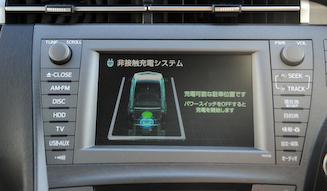
Additionally, a new parking assist function has been developed to align the vehicle optimally for charging. By coordinating with the "Intelligent Parking Assist" function, which automatically performs garage parking and parallel parking, it has become possible to align the charging position more easily and accurately.
The verification experiment will be conducted over one year using three vehicles at the homes of PHV owners in Aichi Prefecture. Moving forward, various aspects will be examined for practical application, including the distribution of parking position deviations in daily use, charging frequency, and the use of timer charging.