Peugeot | Peugeot Announces New 508
Peugeot 508
The Refined 508
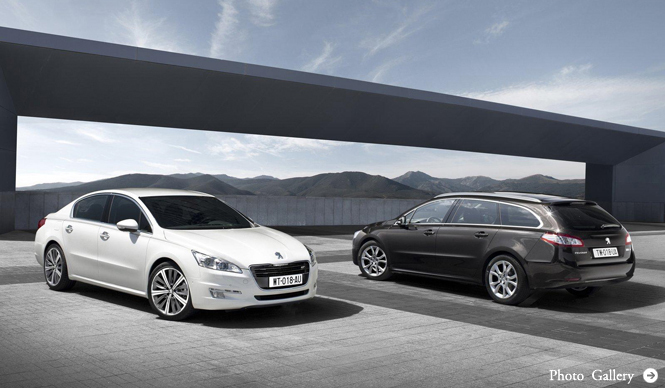
Peugeot unveiled the new "508" and "508 SW" at the Paris Motor Show in September 2010.
By Giraffe
New High-Efficiency, High-Torque "2.2HDi" Engine Adopted
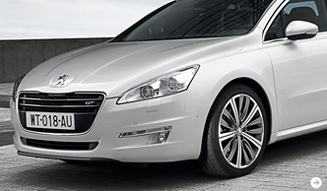
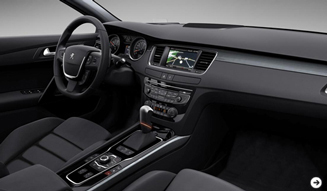
The 508 series, announced this time, features sharp styling that embodies Peugeot's new generation identity, and a luxurious, high-quality interior. With a body length of approximately 4.8 meters, it is a model that exudes a higher class of vehicle.
The engine lineup includes two gasoline engines: a 1.6-liter naturally aspirated (120ps) and a 1.6-liter turbo (156ps). There are also three diesel engines: 1.6, 2.0, and 2.2-liter, as well as the "Hybrid4" diesel hybrid system, offering a rich variety similar to the Citroën DS series.
Particularly noteworthy is the newly developed 2.2-liter diesel engine, the "2.2HDi," which boasts a maximum output of 204ps and achieves high-efficiency, powerful driving with a maximum torque of 45.9kgm delivered at just 2000rpm.
The standard model features a strut front suspension and a multi-link rear suspension.
Meanwhile, the top-of-the-line "508 GT" model is equipped with a special front suspension called "drop link dual wishbone," offering a supple ride and sporty handling.
As of this writing, there are no plans for the 508 series to be released in Japan. However, it is undoubtedly a model that deserves to be introduced.
BRAND HISTORY
Peugeot, one of France's leading brands, also owns Citroën. It is a full-line manufacturer that produces everything from mass-market cars to presidential limousines, and is also actively involved in the 24 Hours of Le Mans and the World Rally Championship.
Peugeot began manufacturing automobiles in 1890. Ten years after Gottlieb Daimler developed the world's first internal combustion engine automobile (the precursor to the Mercedes-Benz), Peugeot was already actively involved in car manufacturing, receiving engines from Daimler.
Peugeot is also characterized by its steady product development, consistently creating orthodox models without resorting to gimmicks. Its deep relationship with Italian coachbuilder Pininfarina also contributes to the elegant design of Peugeot cars.
In Japan, due to a small dealer network and its relatively understated, orthodox design, Peugeot was once a brand known only to enthusiasts. However, the sporty hatchback 205 GTI, introduced in 1986, ignited its popularity. Subsequently, the 306 and 307, targeted at the VW Golf market, significantly expanded its market share. It gained particular attention as an urban vehicle popular among women.
Peugeot's product planning prowess is another key characteristic; it was also an early adopter of open-top models with retractable hardtops, a segment now known as CC (Coupe Cabriolet).
Another factor behind Peugeot's growing market presence is its active involvement in motorsports and its consistent success. Peugeot secured titles in the World Rally Championship in 1985, 1986, and again in 2000, 2001, and 2002. It achieved overall victory at the 24 Hours of Le Mans twice in the 1990s and once in 2009. Notably, the 2009 victory was with a diesel-powered machine.
As of June 2010, the lineup in Japan included the 207 (hatchback, station wagon, coupe cabriolet), 308 (hatchback, station wagon, coupe cabriolet), and 407 (sedan, station wagon, coupe). In June, the crossover concept 3008 was added, followed by the sporty compact coupe RCZ in the fall.