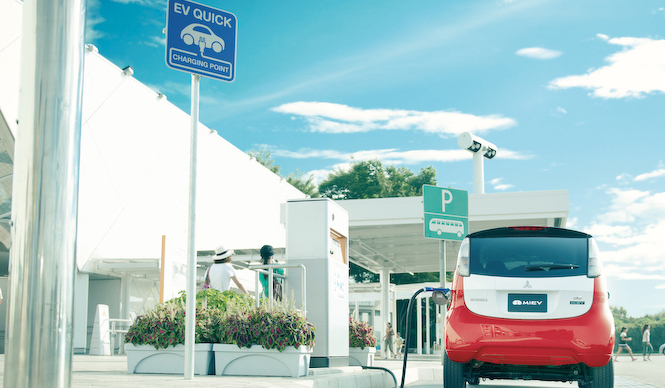
Four Japanese Automakers Launch Joint Project for Major Expansion of EV Charging Infrastructure
Toyota & Nissan & Honda & Mitsubishi
Four Japanese Automakers Launch Joint Project to Dramatically Expand EV Charging Infrastructure
Toyota, Nissan, Honda, and Mitsubishi, automakers that have previously developed their charging infrastructure independently, have announced the launch of a joint project to expand charging facilities, aiming to promote the widespread adoption of electric vehicles (EVs).
Text by HORIGUCHI Yoshihiro(OPENERS)
A Project Bolstered by Policy
One of the crucial challenges in promoting electric vehicles is the expansion of charging infrastructure. To accelerate this, four Japanese automakers have agreed to a project that will jointly advance the infrastructure and services they have each built independently.
Currently, the charging facilities for electric vehicles nationwide, installed by these four companies alone, comprise over 1,700 rapid chargers and more than 3,000 standard chargers. Furthermore, each installation entity offers its own unique services. While charging may be physically possible, differences in membership cards or the need for new registrations can create significant inconvenience for users.
This project aims to leverage government subsidy policies as a catalyst to accelerate the expansion of charging infrastructure, considered key to EV adoption. The project categorizes charging station locations into 'bases (homes),' 'destinations,' and 'transit points.' Standard chargers will be installed at destinations, where longer parking times are expected, while rapid chargers will be placed at transit points.
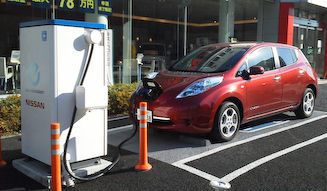
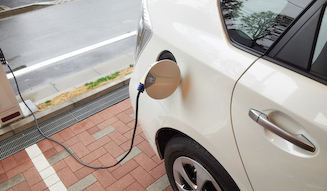
'Transit points' are envisioned as locations like convenience stores, parking areas, and gas stations, where stays are typically short or where people stop specifically for charging. Since drivers will be waiting during charging at these locations, rapid chargers will be the primary installation.
Conversely, large commercial facilities, home centers, restaurants, and tourist attractions are classified as 'destinations.' Here, with longer parking durations and drivers engaged in other activities, numerous standard chargers will be installed. Highway service areas and roadside stations, considered 'transit points' with longer stays, will also feature standard chargers.
The goal is to more than double the current number of charging facilities nationwide, aiming for 4,000 rapid chargers and 8,000 standard chargers.
Furthermore, usability will be enhanced by ensuring compatibility between the cards currently issued separately by each company, allowing members of any service to use the charging facilities.