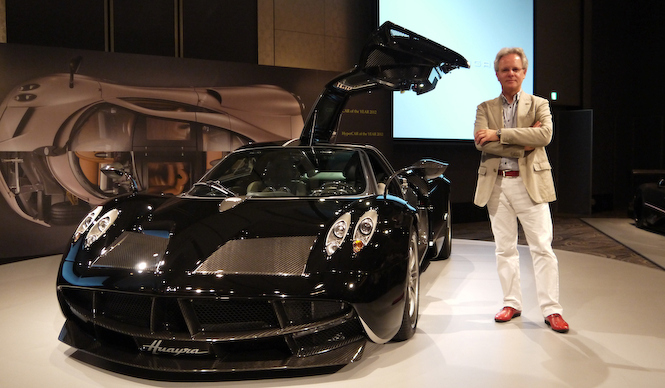
The Ultra-Luxury Supercar Pagani Huayra Arrives in Japan | Pagani
Pagani Huayra
Pagani Arrives in Japan
Bingo Sports has launched Pagani Japan, the official importer of Pagani Automobili, and held a press unveiling of Pagani's latest supercar, the Huayra.
Text & Event Photographs by SUZUKI Fumihiko (OPENERS)
Supercar Brand Pagani Officially Lands in Japan
Founded in 1991 by designer Horacio Pagani, who hails from Argentina and spent nine yearsat LamborghiniPagani Automobili is a small car manufacturer of about 70 employees, based in San Cesario sul Panaro, near Modena. Yet, it is from here that supercars claiming to be the world's fastest are born.
Pagani possesses superior carbon molding technology, a technique that has been consistently employed since the debut of Pagani's first car, the Zonda C12, in 1999.
Until now, only parallel imported Pagani cars existed in Japan. However, with the establishment of Pagani Japan, based on Bingo Sports, the brand will now be officially available in Japan. The showroom has also been renovated, with a new Pagani Japan showroom set to open along Sotobori-dori in Tokyo.
The Huayra, unveiled to the Japanese press alongside the launch of Pagani Japan, is Pagani's latest model, first presented at the 2011 Geneva Motor Show.
It is powered by a 6-liter V12 engine, codenamed 'M158', developed by AMG for this car based on the Mercedes AMG 'M275 AMG' engine. This unit is mounted mid-ship behind the driver and delivers a maximum output of 545kW (730ps) at 5,800rpm and a peak torque of 1,000Nm at 4,500rpm to the rear wheels via a lightweight 7-speed twin-plate clutch sequential gearbox weighing just 96kg.
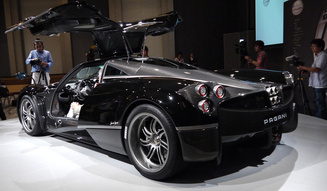
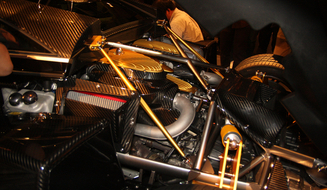
While incorporating technology from the Zonda Revolution, which shaved 11 seconds off the Zonda R's 2009 Nürburgring Nordschleife record of 6:47 for production cars, the Huayra enhances performance in everyday driving conditions compared to its track-focused predecessors.
Nevertheless, its carbon-titanium central monocoque and chrome-molybdenum steel front and rear subframes create a highly rigid body that weighs just 1,350kg. The car is equipped with four independently controlled 'control flaps' at the front and rear, which adjust aerodynamic drag during cornering to achieve exceptional stability. This allows for a 0-100km/h acceleration in under 3.5 seconds and a top speed of 370km/h.
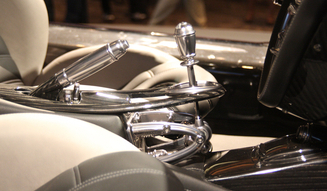
Beyond its performance, the Huayra is characterized by its exquisite interior and exterior, filled with homage to mechanical objects such as classic cars, luxury watches, and musical instruments. Every component is pursued not only for its functional excellence but also for its aesthetic beauty. For example, the gear lever, reminiscent of a manual gearshift knob, is crafted from aluminum and resembles a piece of art.
Pagani cars are built-to-order, handcrafted by artisans. Currently, production is around 20 units per year, and the total number of cars produced to date, including prototypes and test vehicles, is approximately 150.
A new factory is under construction with the aim of producing 40 units per year. However, Japan's allocation will initially be around two units per year, meaning a considerable wait may be necessary for those wishing to acquire one.
The price is based on the Euro retail price plus taxes, starting at approximately 130 million yen.

Pagani Huayra
Body Dimensions | Length 4,605 x Width 2,036 (2,356mm with mirrors) x Height 1,169mm
Wheelbase | 2,795 mm
Weight | 1,350 kg
Engine | 5,980cc V12 Direct Injection DOHC Twin-Turbo
Max Output | 545kW (730ps) / 5,800rpm
Max Torque | 1,000Nm / 4,500rpm
Transmission | 7-speed Sequential
Drivetrain | MR
Tires Front/Rear | 255/35ZR19 / 335/30ZR20
0-100km/h Acceleration | Under 3.5 seconds
Top Speed | 370km/h