A Tribute to the Renault 5: A Genuine Sports Concept Car Appears | Renault
Renault Twin'Run Concept
An Evolution of the Renault 5 and Clio V6
A True Sports Concept with a Midship V6
Renault unveiled the "Twin'Run" concept car at the 71st Monaco Grand Prix.
Text by HORIGUCHI Yoshihiro (OPENERS)
A Serious Sports Concept
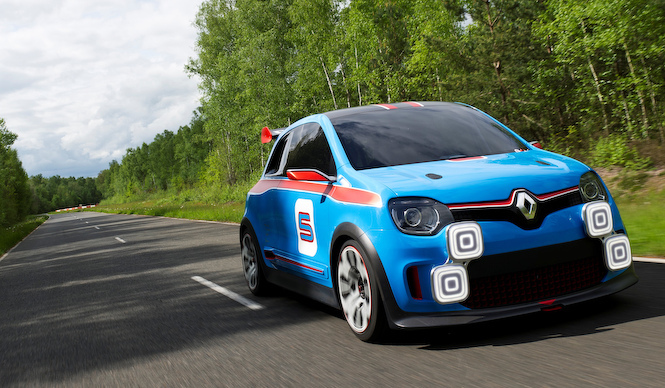
The concept car revealed in Monaco is named "Twin'Run." As the name suggests, it is the twin model of the "Twin'Z" Twin'Z," announced in Milan in April.
It shares many common features with its sibling, including a structure with a tubular frame covered by a body shell made of glass fiber polyester composite, wheels positioned at the extreme corners, resulting in minimal overhangs, and a high beltline.
However, while the Twin'Z was a pure EV, the Twin'Run is a genuine sports car, housing a 3.5-liter V6 engine midship within its compact 3,680mm body.
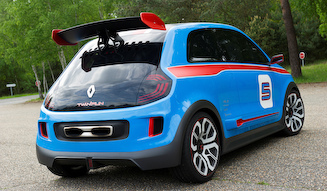
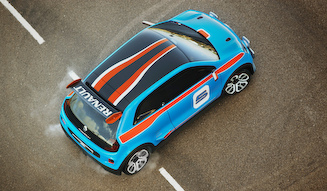
This V6 engine, mounted longitudinally in front of the rear axle and separated from the cockpit by acrylic glass, is the V4Y model, producing a maximum output of 320ps, also found in the "Megane Trophy" one-make race car. In Japan, it is known as the VQ35 and is used in models like the "Skyline" and "Fuga." Drive is sent to the rear wheels, the same layout as its twin, the Twin'Z. It is paired with a SADEV 6-speed sequential gearbox with an LSD.
Due to the MR layout, other components such as the fuel tank, radiator, and hydraulic systems are housed under the bonnet to optimize weight distribution, achieving a front-to-rear weight ratio of 43:57.
Both the front and rear suspension are independent double wishbone systems. These are complemented by 22mm front and 25mm rear anti-roll bars, contributing to agility and improved control. The shock absorbers utilize springs from OHLINS.
The development involved full cooperation from French competition vehicle specialists Tork Engineering and Poclain Vehicules, with numerous feedbacks from the racing field incorporated into everything from the body to the clutch.
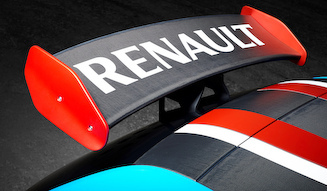
The two-box Twin'Run design inherently generates lift at high speeds. To counteract this, particular attention was paid to the large rear wing and the slits carved into the underside of the car.
A Tribute to the Legendary Rally Car, the Renault 5
The Twin'Run expresses the fifth theme, "Play," within Renault's "Lifecycle Concept" design strategy. The Lifecycle Concept defines six keywords representing important aspects of life, which then guide car design. Each theme is assigned a color, and "Play" is represented by blue. Therefore, both the Twin'Run and the previous Twin'Z embody "Play."

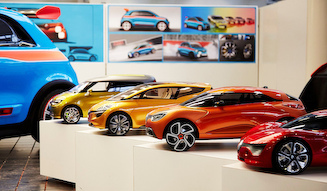
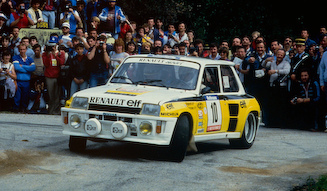
The Twin'Run's body color features sporty red accents on the side lines, front grille, intakes, and wheel rims. The "5" painted on the side of the body originates from the "Renault 5," a car that excelled in rallies in the 1980s and to which this vehicle pays homage. The other car honored is the "Clio V6 (Lutecia RS V6)."
The headlights, including the distinctive square auxiliary lights, also inherit design cues from the Renault 5. However, the Twin'Run's auxiliary lights are ultra-slim, 25mm LED units, and their development was crucial to making this vehicle possible.
Jean Ragnotti, the driver who won the Monte Carlo Rally with the "Renault 5," also participated in the Twin'Run's development. After his first test drive, he reportedly commented, "It's more powerful and easier to handle than the Renault 5. The balance and ride remind me of the Renault 5. It would be a worthy successor to the Maxi 5 Turbo."
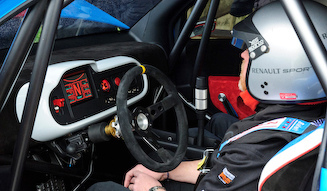
The interior evokes the atmosphere of a competition car, with its exposed tubular frame structure and unadorned sports steering wheel. However, the use of red and black Alcantara-style suede on the door panels and dashboard, and the three-stage gradient Alcantara on the Sparco bucket seats, demonstrate a thoughtful, French design sensibility.
The interior evokes the atmosphere of a competition car, with its exposed tubular frame structure and unadorned sports steering wheel. However, the use of red and black Alcantara-style suede on the door panels and dashboard, and the three-stage gradient Alcantara on the Sparco bucket seats, demonstrate a thoughtful, French design sensibility.
Behind the steering wheel, a vibrant white console houses a 5.5-inch LCD. Switching between red and blue pages displays speed, gear speed, engine RPM, fuel pressure, clutch pressure, and oil pressure. The analog meters to the left and right are oil and water temperature gauges.
To facilitate quick gear changes, the shift lever is positioned immediately next to the steering wheel, at the same height, alongside the handbrake. This arrangement is reportedly intended to allow spectators to view the car from all angles during demonstrations, implying a design that anticipates spin turns and drifts.
While the Twin'Run Concept is a serious sports car concept with racing in mind, the two twin concept cars offer a glimpse into the future design direction of Renault's compact cars, including the next-generation Twingo.

Renault Twin'Run Concept
Body Dimensions | Length 3,680 x Width 1,750 x Height 1,493 mm
Tread Front/Rear | 1,522 / 1,497 mm
Engine | 3,498 cc 60° V6 24-valve, longitudinal
Bore x Stroke | 95.5 x 81.4 mm
Max Output | 320 ps / 6,800 rpm
Max Torque | 380 Nm / 4,850 rpm
Transmission | 6-speed sequential (with LSD)
Weight | 950 7kg
Suspension (Front) | Double wishbone
Suspension (Rear) | Double wishbone
Brakes (Front) | Ventilated discs (φ356 x 32 mm, 6-piston calipers)
Brakes (Rear) | Ventilated discs (φ328 x 30 mm, 4-piston calipers)
Tires (Front) | 205 / 40 R 18
Tires (Rear) | 245 / 35 R 18
Drive | MR
0-100 km/h Acceleration | 4.5 seconds
Top Speed | 250 km/h