Volkswagen Unveils Latest Environmental Technology | Volkswagen
Volkswagen | VOLKSWAGEN
10-Speed DSG, Latest Diesel, Natural Gas, Plug-in Hybrid, etc.
Volkswagen Unveils Latest Environmental Technologies
The Volkswagen Group announced its future plans at the 34th Vienna International Motor Symposium.
Text by HORIGUCHI Yoshihiro (OPENERS)
Multiple Powertrains in Parallel
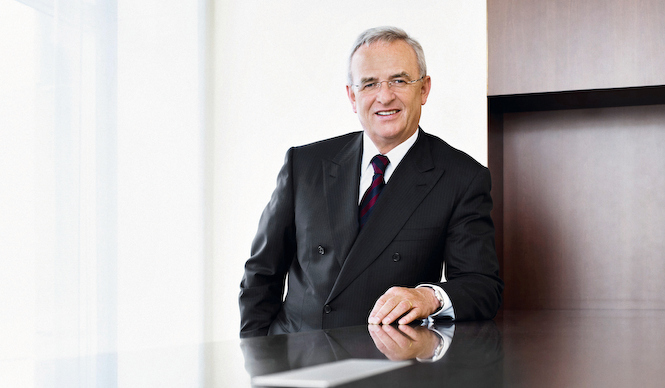
At the 34th Vienna International Motor Symposium, Dr. Martin Winterkorn, CEO of the Volkswagen Group, presented his vision for future technologies, outlining the Group's future direction.
According to Dr. Winterkorn, the Volkswagen Group plans to develop highly efficient gasoline and diesel engines in parallel with natural gas, hybrid, and electric vehicles in the medium to long term. With these multiple powertrains, the Group expects to meet the European standard of reducing new car CO2 emissions to 95g/km by 2020.
Dr. Winterkorn emphasized that conventional gasoline and diesel engines still hold significant potential. Citing a 30 percent improvement in fuel efficiency compared to the year 2000, he stated that a further reduction of approximately 15 percent is achievable by 2020. This is based on the fact that there is still room for improvement in combustion processes, lightweight design, engine management, friction reduction, and thermal management.
Furthermore, he reiterated that the Volkswagen Group sees great potential in natural gas. For natural gas vehicles, the technology is already established and a market exists, offering not only environmental benefits but also the advantages of lower fuel costs and ready availability.
As evidence, he cited the "ECO up!", the world's most affordable natural gas vehicle, which achieves CO2 emissions of just 79g/km. Additionally,Geneva Motor Showat the, the "Golf TGI BlueMotion" and "Audi A3 g-tron" were announced, demonstrating that the development of future natural gas vehicles is already progressing realistically. For further insight into the Volkswagen Group's approach to natural gas utilization, please refer to Mr. Tatsuya Otani's report "Audi's Future Energy".
"We want more people to recognize the advantages of natural gas engines. The wider adoption of natural gas vehicles requires the cooperation of many parties, including automotive manufacturers, politicians, and energy companies."
said Dr. Winterkorn.
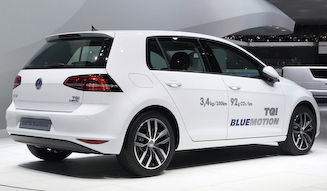
Volkswagen Golf TGI Blue Motion
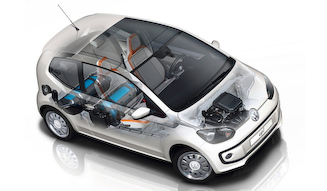
Volkswagen eco up!
Modular Platform Facilitates Post-Development Implementation
The modular platform, known as "MQB", is instrumental in integrating these diverse powertrains and energy sources into actual models. Thanks to the benefits of modularization, new models can be introduced more flexibly and rapidly within the existing model lineup.
Starting with Plug-in Hybrids
Among non-internal combustion powertrains, the company is advancing vehicle electrification. According to Dr. Winterkorn, the Volkswagen Group plans to hybridize or electrify all vehicle classes.
The initial focus will be on plug-in hybrid systems.
The Volkswagen Group's approach to plug-in hybrids involves vehicles with a pure electric range of approximately 50 km, allowing daily commutes to be powered by home charging. For longer journeys, they offer the flexibility of an efficient internal combustion engine.
Leading the charge will be the upcoming market introductions of the "Porsche Panamera" and "Audi A3 e-tron", followed by the "Volkswagen Golf", "Volkswagen Passat", and "Audi A6", and the Porsche Cayenne.
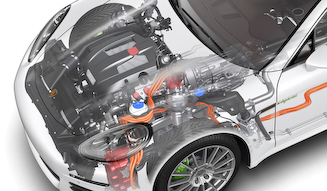
Further technological advancements announced include a more sophisticated dual-clutch transmission, the 10-speed DSG, and the development of next-generation diesel engines. The latter are being developed with high-pressure injection at 3,000 bar and electric turbocharger technology, aiming for a maximum output of 100 kW per liter of displacement.
The Volkswagen Group has achieved fuel efficiency improvements without compromising driving pleasure through the combination of downsizing turbo engines (TSI/TDI) and DSG. It appears that new technologies to accelerate this trend will continue to become a reality.