Finally Revived! The Honda NSX Officially Announced in Japan | Honda
Honda NSX | The Honda NSX
Finally Revived! The Honda NSX Officially Announced in Japan
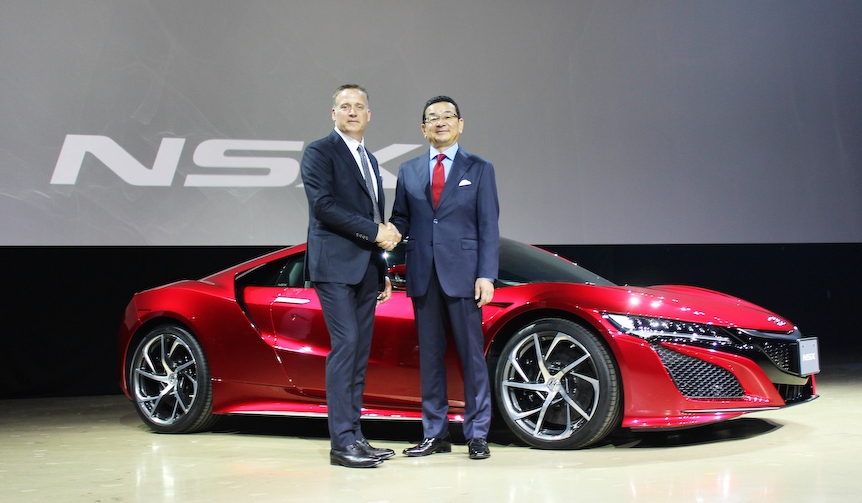
On August 25th, the Honda NSX was fully redesigned for the first time in 26 years and announced in Japan. Sales will begin on the 27th. The price is 23.7 million yen.
Text & Photographs by Shunichi Uchida
A New Era of Super Sports Experience: "New Sports Experience"
Ted Klaus, the development lead for the new NSX, who joined Honda R&D Americas, Inc. inspired by the first-generation "NSX," stated, "I felt the original NSX was Honda's declaration of how a sports car should be. Compact, low center of gravity, high-rigidity chassis, excellent visibility, simple and ergonomic interface. And a car built to directly connect with the driver. This is precisely what we aimed for with the new NSX. In other words, while inheriting the original NSX's concept of a 'human-centered super sports car,' we have realized a 'New Sports Experience' for a new era." He emphasized that the new model is positioned as an extension of the original.
Furthermore, he revealed, "When we started development with a joint Japanese-American team, we began by meeting with the original NSX development members and numerous owners in Japan to deeply understand the tradition NSX had built – what constitutes 'NSX-ness.' We made all development decisions based on this 'NSX-ness.'"
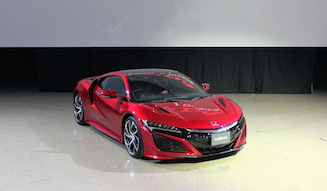
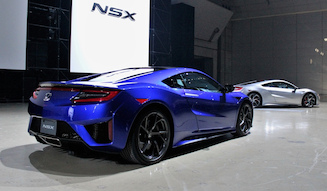
We then established three core concepts for the new NSX. The first is "instantaneous acceleration performance." This aims for an acceleration feel that is agile and linear in response to throttle input.
The second is "handling performance that responds to the driver." It precisely responds to driver inputs such as throttle, braking, and steering, creating an intuitive connection between human and machine.
Finally, there is "human fit." In addition to ergonomic considerations in the cabin, the goal was to create a sports car that anyone can enjoy, regardless of their individual style or skill. Klaus stated, "By realizing these concepts using the latest technology, we are providing a new era of super sports car experience."
Honda NSX | The Honda NSX
Finally Revived! The Honda NSX Officially Announced in Japan (Part 2)
Honda's Unique Electrification Technology Integrated
The new NSX's powertrain utilizes the "SPORT HYBRID SH-AWD (Super Handling-All Wheel Drive)" three-motor hybrid system, known for its high efficiency and output. A newly developed twin-turbo V6 engine is mounted midship, paired with a 9-speed DCT. Two motors are positioned at the front, and one is connected to the engine's crankshaft, transmitting power freely to all four wheels with immediate response to throttle input.
The front twin motors produce a maximum output of 27 kW (37 hp) at 4,000 rpm and a maximum torque of 73 Nm (7.4 kgm). They precisely control positive and negative torque to the left and right front wheels, achieving an "on-rail" sensation through torque vectoring.
The rear direct-drive motor delivers 35 kW (48 hp) at 3,000 rpm and 148 Nm (15.1 kgm) between 500-2,000 rpm. This motor is directly connected to the engine, assisting it with its characteristic quick response and eliminating turbo lag. It also functions for power generation.
The 3.5-liter V6 DOHC twin-turbo engine, mounted midship at the rear, achieves high output and flat torque characteristics of 373 kW (507 hp) at 6,500-7,500 rpm and 550 Nm (56.1 kgm) at 2,000-6,000 rpm. Its compact size and low center of gravity significantly contribute to improved dynamic performance. The total system output is 427 kW (581 hp) and 646 Nm (65.8 kgm).
The body employs a multi-material space frame. As a result, it achieves a modern body that is lightweight, highly rigid, and boasts excellent crash safety, all while maintaining a compact size. The dimensions are 4,490 mm in length, 1,940 mm in width, and 1,215 mm in height, with a curb weight of 1,780 kg.
Furthermore, the new NSX is equipped with the newly developed "Integrated Dynamics System." This system integrates chassis settings and the SPORT HYBRID SH-AWD powertrain to control dynamics and feel according to the driver's needs, offering four modes ranging from "QUIET mode" for silence to "TRACK mode" for maximum performance on the circuit. This allows for enjoyment of a super sports car in a wider range of scenarios without compromise.
Honda NSX | The Honda NSX
Finally Revived! The Honda NSX Officially Announced in Japan (Part 3)
Exterior Design Concept: "INTERWOVEN DYNAMIC"
The basic design was conceived in Japan and then refined for production through joint development with the United States. This approach also inherits the philosophy of the original NSX, centered on a "human-centric" package, with the premise of achieving excellent visibility and manageable body size.
The term "INTERWOVEN" can be interpreted as embodying seemingly contradictory elements. It represents the new NSX's direction: achieving both sporty performance at low to medium speeds and unwavering stability at high speeds, as well as fusing the high performance of a super sports car with environmental consciousness and a gentle driving feel suitable for the modern era. This has culminated in an advanced exterior design that weaves together the contrasting aspects of power and lightness.
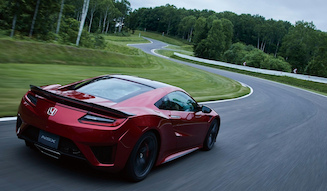
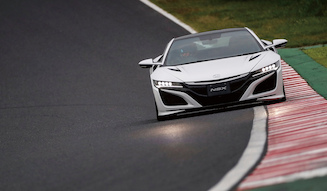
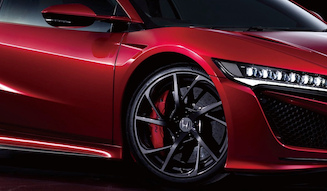
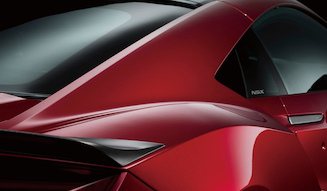
Specifically, the body's underside is lowered to the extreme, and flared fenders that emphasize the presence of the staggered-size tires are integrated into a wedge-shaped body line. The roofline, housing the forward cabin with excellent visibility, gently lifts towards the rear, visually expressing aerodynamic efficiency.
This powerful structure, contrasted with lightness, is expressed through thin external panels and components like the floating rear pillars, giving the impression of a body constructed from feather-light structural elements. Overall, it aims for the solid framework of a powerful sports car.
Functionality has also been pursued. One aspect is aerodynamics: the "floating rear pillars," which function as C-pillars, efficiently guide airflow along the body sides to the side intakes. Negative pressure zones are created around the rear heat exhaust vents and near the trailing edge of the rear window, enhancing heat exhaust efficiency and contributing to engine cooling.
Additionally, design elements like the door mirrors extending from the A-pillars contribute to both aerodynamics and visibility, embodying beauty derived from function.
Honda NSX | The Honda NSX
Finally Revived! The Honda NSX Officially Announced in Japan (Part 4)
Interior Also Inherits the Philosophy of the Original NSX
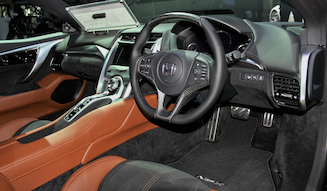
This philosophy extends to the interior. Inheriting the excellent visibility, a key element of the original, the "human-centric" development concept guided the design to deeply appeal to the senses in areas of sight (seeing), operation (controlling), and comfort (touching).
Even in a sports car, visibility is crucial. Better visibility makes driving easier and allows for more precise control. Inheriting this philosophy from the original NSX, meticulous attention was paid to ensuring superior visibility. The front pillars, with their reduced cross-section thanks to the use of 3DQ high-tensile steel tubes, combined with the offset door mirrors, a flattened upper section of the steering wheel, and a low dashboard, ensure excellent forward and lateral visibility during cornering. Furthermore, the visible bulges of the front fenders make it easier to perceive the tire positions, aiding in targeting clipping points during cornering.
The NSX Comes from America
The second-generation NSX is manufactured at the Performance Manufacturing Center, a dedicated facility adjacent to the Marysville Auto Plant in Ohio, USA. Approximately 100 skilled employees are responsible for everything from body construction and painting to final assembly.
Specifically, the 3.5-liter V6 twin-turbo engine is handled by master technicians at the Anna engine plant, who spend six hours on each unit for assembly and balancing.
Furthermore, each component of the powertrain – the engine, 9-speed DCT, direct-drive motor, and front twin motor units – undergoes bench testing and break-in. They are run for five minutes at 2,000 rpm, then for 20 minutes at 3,000 rpm, followed by another 20 minutes at 4,000 rpm. Following this, thorough data collection and quality inspections are performed to ensure the car is ready for optimal performance immediately after delivery.
Ted Klaus, the development lead for the new NSX, said, "25 years ago, when I was stationed in Japan, I told my colleagues, 'I hope the US research center will become as strong as, or even stronger than, Japan in the future.' However, in reality, we are 'One Team' who share the same values beyond language and borders. This new NSX, created by us, is a super sports car that only Honda can build."
Takahiro Hachigo, President, added, "The Honda spirit of pursuing technology with high aspirations and a determination to do it ourselves, in order to delight our customers and provide new value, is a universal spirit that transcends borders and languages. The new NSX is a car into which the Japanese and American teams, sharing such aspirations, have poured their passion, and it is truly the crystallization of the 'Team HONDA' spirit."

Honda NSX | The Honda NSX
Body Dimensions | Length 4,490 x Width 1,940 x Height 1,215 mm
Wheelbase | 2,630 mm
Weight | 1,780 kg
Engine | 3,492cc V6 DOHC Twin-Turbo + Electric Motors (Front x2, Rear x1)
Bore x Stroke | 91.0 x 89.5 mm
Compression Ratio | 10.0
Engine Max. Output | 373 kW (507 ps) / 6,500 – 7,500 rpm
Engine Max. Torque | 550 Nm (56.1 kgm) / 2,000 – 6,000 rpm
Motor (Front) Max. Output | 27 kW (37 ps) / 4,000 rpm (per motor)
Motor (Front) Max. Torque | 73 Nm (7.4 kgm) / 0-2,000 rpm (per motor)
Motor (Rear) Max. Output | 35 kW (48 ps) / 3,000 rpm
Motor (Rear) Max. Torque | 148 Nm (15.1 kgm) / 500-2,000 rpm
System Integrated Max. Output | 427 kW (581 ps)
System Integrated Max. Torque | 646 Nm (65.9 kgm)
Transmission | 9-speed Dual Clutch
Drivetrain | 4WD (SPORT HYBRID SH-AWD)
Suspension Front/Rear | Double Wishbone / Wishbone
Brakes Front/Rear | Ventilated Disc / Ventilated Disc
Fuel Economy (JC08 Mode) | 12.4 km/ℓ
Drive Battery | Lithium-ion Battery (72 cells)
Steering | Right
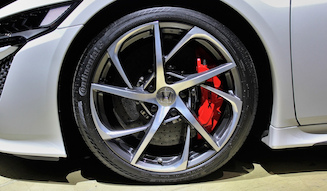
Tires | 245/35ZR19 93Y / 305/30ZR20 103Y
Minimum Turning Radius | 5.9 meters
Minimum Ground Clearance | 110 mm
Price | 23.7 million yen