
The Successor to the FF, the Ferrari GTC4 Lusso, Debuts in Japan | Ferrari
Ferrari GTC4 Lusso | Ferrari GTC4 Lusso
Successor to the FF, Debuts in Japan
The new four-seater model, the "GTC4 Lusso," which had its world premiere at the 2016 Geneva Motor Show, has already been announced in Japan. It is the successor to the "Ferrari Four (FF)," Ferrari's first four-wheel-drive model, and its highly anticipated price is 34.7 million yen. Deliveries in Japan are scheduled to begin after December of this year.
Text by SAKURAI Kenichi
Revival of a Big Name
Ferrari's first four-wheel-drive model,Ferrari Four (FF)" was unveiled at theGeneva Motor Showin 2011. This model was the latest in Ferrari's traditional lineup of four-seater models, and was the de facto successor to the612 Scaglietti. True to its position at the top of Ferrari's range, it featured the exquisite, traditional V12 engine mounted in the front. It debuted as a model employing innovative mechanisms, including this engine, a novel hatchback design that Ferrari calls a shooting brake, and the aforementioned four-wheel-drive system.
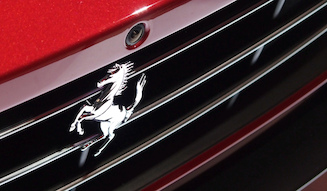
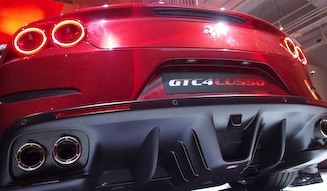
Put simply, theGTC4Lussois a major minor change of the FF. The newly given name "GTC4Lusso" is a revival of the "GTC" designation given to luxury GTs produced by Ferrari in the 1960s and 70s, and Ferrari fans will surely recall the "365GTC4" that debuted in 1971.
As its name suggests, the "GT" in GTC4Lusso stands for Gran Turismo. In the past, the "C" in "365GTC4" meant Coupe and "4" meant four-seater, but in GTC4Lusso, in addition to those meanings, it is interpreted as signifying "Gran Turismo" + "Coupe" + "Four-wheel Drive." Incidentally, "Lusso" means luxury in Italian. Therefore, the GTC4Lusso is Ferrari's top-of-the-line four-seater GT.
Ferrari GTC4 Lusso | Ferrari GTC4 Lusso
Successor to the FF, Debuts in Japan (2)
V12 Engine Delivers 690 hp, a 30 hp Increase
At the venue for the commemorative Japan premiere, Dieter, Head of the Far East and Middle East region for Ferrari,Knechtl, General Managertook the stage and provided a vehicle explanation of the GTC4Lusso. "The GTC4Lusso is the latest four-seater Ferrari, inheriting its name from the legendary models 330GTC and 250GT Berlinetta Lusso. In 1966, the year the 330GTC was born, Ferrari established its first sales base in Japan. Coincidentally, this year marks the 50th anniversary since then. For the past 50 years, Ferrari has delivered a succession of top-tier automobiles to Japanese customers without compromising on design or performance," said Knechtl in his opening remarks.
He further introduced the GTC4Lusso, stating, "The GTC4Lusso launched in Japan today delivers exceptional performance in all situations, from deserts to snow-covered mountain roads and urban environments. At the same time, it generously offers sporty elegance and luxurious comfort to both driver and passengers." He then elaborated on the three key features of the GTC4Lusso: performance, versatility, and sport luxury.
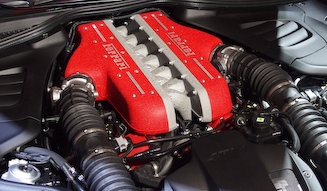
"Although it is a high-revving naturally aspirated V12 engine, approximately 80 percent of its maximum torque is available from just 1,750 rpm, ensuring ease of use and excellent response. Furthermore, the engine sound, a key characteristic of the GT segment and one that clearly defines this model's character, is also a highlight of the GTC4Lusso. It produces a satisfyingly powerful sound during high-speed driving and harmonizes into a more subdued tone in urban settings. The sound's ability to change according to the situation is a captivating feature," he explained, emphasizing Ferrari's distinctive sound.
The engine installed in the GTC4Lusso is a naturally aspirated, direct-injection V12 DOHC 48-valve with a total displacement of 6,262cc. While these specifications are the same as the predecessor FF, the GTC4Lusso boasts an increase of 30 hp, delivering a maximum output of 690 hp at 8,000 rpm, compared to the FF's 660 hp at 8,000 rpm. Simultaneously, the maximum torque has also increased by 14 Nm (1.5 kgm) to 697 Nm (71.1 kgm) from the FF's 683 Nm (69.6 kgm).
For reference, the GTC4Lusso's top speed is stated to be the same as the FF's at 335 km/h, but its 0-100 km/h acceleration is 3.4 seconds, an improvement of 0.3 seconds over the FF's 3.7 seconds. This performance is in no way inferior to its mid-engined rivals. It seems that even a four-seater from Ferrari deserves to be called a supercar.
Ferrari GTC4 Lusso | Ferrari GTC4 Lusso
Successor to the FF, Debuts in Japan (3)
Advanced Four-Wheel Drive System
On the chassis front, the news is the further evolution of the four-wheel-drive system, which was first introduced by Ferrari in the FF. Based on the fourth-generation Slip Side Control System (SSSC4), the "4RM-S (Four-wheel Drive, Four-wheel Steering)" system has been developed and integrated into the advanced four-wheel-drive system "4RM Evo." The adoption of a rear-wheel steering system is, of course, a first for Ferrari. This is the core of what Mr. Knechtl referred to as versatility.
This rear-wheel steering system controls the angle of the rear wheels in accordance with the vehicle's speed and the steering angle of the front wheels. A dynamic response control model is incorporated to assist with corner exits, for example. Ferrari explains that the intention behind its development is to minimize steering corrections by the driver and provide a cornering experience with an "on-rails" feel, but it should also be expected to improve control at the limit and increase cornering speeds.
The "4RM-S (Four-wheel Drive, Four-wheel Steering)" also integrates control of the "E-Diff (Electronic Differential)" and the "SCM-E (an evolution of Magnetic Ride Control suspension)" found in the "458 Speciale." Furthermore, a significant evolutionary point is the substantial weight reduction achieved by reducing the total weight of the hardware by approximately 50 percent compared to the previous system. It exhibits grip performance exceeding that of the FF on low-grip surfaces such as wet roads and snow.
To borrow Mr. Knechtl's words, "The GTC4Lusso's other appeal is its ability to deliver maximum performance on any road surface at any time."
The third characteristic, sport luxury, primarily refers to the styling and equipment. Mr. Knechtl stated, "With the GTC4Lusso, we have achieved a low, sporty form and beautiful proportions to deliver driving pleasure and unprecedented luxury. At the same time, we have actively worked to improve aerodynamics."
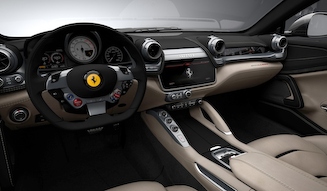
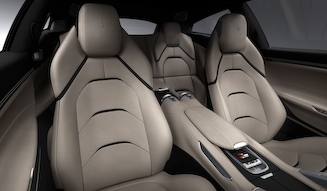
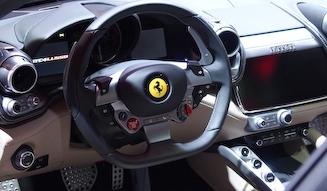
"Over 90 percent of the interior has been redesigned (compared to the FF) to enhance its luxurious feel. We also dedicated significant development time to functionality and UI, resulting in a new steering wheel design that is more compact due to a smaller airbag, and a state-of-the-art infotainment system with a 10.25-inch full HD panel that supports touch sensors," he explained, introducing the exterior and interior features.
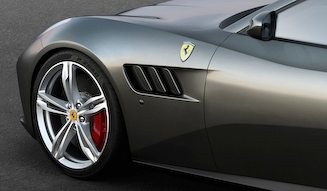
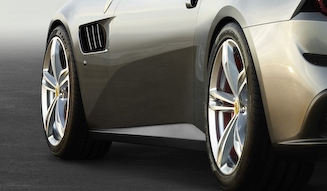
The exterior design, which Ferrari itself calls a shooting brake, features a redesigned front bumper, grille, and headlights, clearly differentiating it from the previous FF. Looking at the rear, the round taillights have changed from a single unit per side to a dual-unit design. The roof spoiler and the diffuser below the bumper are also new designs. The air outlet on the front fender has a three-louver design, inspired by the air outlets of the 330GTC.
Ferrari GTC4 Lusso | Ferrari GTC4 Lusso
Successor to the FF, Debuts in Japan (4)
New Device Allows Sharing the Driving Experience with the Front Passenger
Beyond these detailed changes, improved aerodynamics is another highlight of the GTC4Lusso. Compared to the FF, the drag coefficient has improved by 6 percent, contributing to vehicle stability and fuel efficiency at high speeds. Furthermore, airflow during driving is actively utilized for cooling, significantly enhancing cooling efficiency. Ferrari's official statement is, "The design not only focuses on appearance but also on improving aerodynamics, achieving top-level performance."
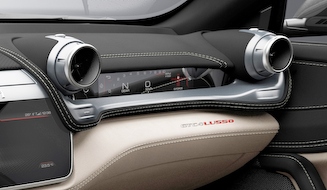
In the interior, which Mr. Knechtl described as over 90 percent renewed, the new "Dual Cockpit" feature, a passenger-side display showing engine speed, gear, and speed, is particularly noteworthy.
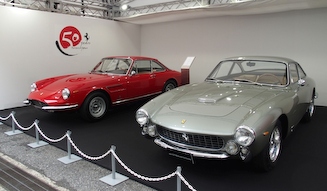
330GTC (left) and 250GT Berlinetta Lusso (right)
The "Dual Cockpit" is a new idea that allows the front passenger to share the GTC4Lusso's driving experience. Along with the adoption of such new devices, the cabin has undergone significant changes throughout, including a three-dimensional and high-quality dashboard, a bridge-design center console, a steering wheel, and seats with integrated headrests.
The enlarged, horizontal 10.25-inch touch-screen monitor located in the center of the console features the latest infotainment system. Various functions, such as audio and air conditioning temperature control, can be easily accessed with a single touch, and the UI is designed for intuitive control. As Ferrari claims, anyone would feel that it combines the luxury befitting the name "Lusso" with a modern and advanced image.
At this announcement event, along with the GTC4Lusso, a logo commemorating the 50th anniversary of Ferrari's establishment in Japan was also displayed. The "330GTC" and "250GT Berlinetta Lusso" were also exhibited, adding to the splendor of the GTC4Lusso's Japan premiere. Ferrari has several events planned in Japan this year to celebrate its 50th anniversary. One of these, the "Ferrari International Cavalcade," scheduled to be held in Kyoto from November 10th to 14th, has already been announced.

Ferrari GTC4Lusso | Ferrari GTC4Lusso
Body Dimensions | Length 4,922 x Width 1,980 x Height 1,383 mm
Vehicle Weight | 1,790 kg
Engine | 6,262 cc 65-degree V12
Bore x Stroke | 94 x 75.2 mm
Compression Ratio | 13.5
Maximum Output | 507 kW (690 hp) / 8,000 rpm
Maximum Torque | 697 Nm / 5,750 rpm
Transmission | 7-speed Dual Clutch (F1 DCT)
Drivetrain | 4WD
Brakes Front | φ398 x 38 mm Ventilated Discs
Brakes Rear | φ360 x 32 mm Ventilated Discs
Tires Front/Rear | 245/35R20 / 295/35R20
0-100 km/h Acceleration | 3.4 seconds
0-200 km/h Acceleration | 10.5 seconds
100-0 km/h Braking | 34 meters
200-0 km/h Braking | 138 meters
Top Speed | 335 km/h
Weight Distribution | Front 47 : Rear 53
Fuel Consumption | 15 L/100 km (approx. 6.67 km/L)
CO2 Emissions | 150 g/km