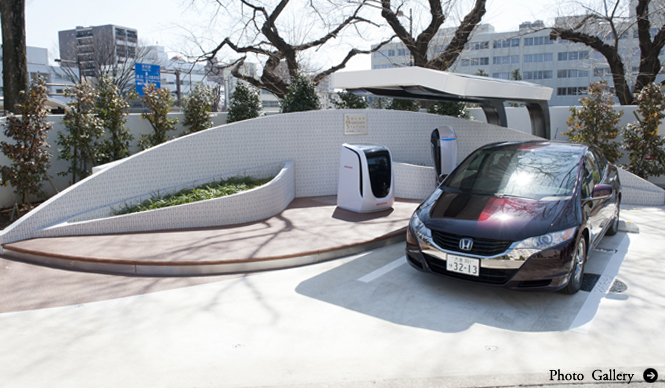
Honda Unveils Solar Hydrogen Station with Zero CO2 Emissions
Honda
Could this be a step forward for the "ultimate eco-car"?
Solar Hydrogen Station Emitting No CO2 is Born
Enjoy a long drive with a car fueled by clean energy──This event hints at a future to come. On March 27th, Japan's first "Solar Hydrogen Station" was installed on the grounds of the Saitama Prefectural Government.
Text by TANAKA Junko(OPENERS)
Fuel Cell Vehicles: The "Ultimate Eco-Car" Expected to Become Practical
The "FCX Clarity," a fuel cell vehicle actively developed by Honda, is hailed as the "ultimate clean-performance car." It's a next-generation vehicle that runs on hydrogen, generating its own electricity to power the motor. Since its lease sales began in 2008, practical application has been anticipated. Its greatest appeal, like that of EVs (electric vehicles), is that it emits no carbon dioxide while driving. Furthermore, unlike the lengthy charging time for EVs, hydrogen can be refueled in about five minutes. Additionally, a single refueling provides a driving range comparable to gasoline cars (620km).
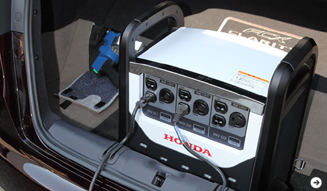
Fuel cell vehicles are primarily composed of a "fuel cell stack" that generates electricity from hydrogen, a "high-pressure hydrogen tank" to store hydrogen, a "lithium-ion battery" to store electricity, a "drive motor" that converts electricity into motive force to move the car, and a "PDU (Power Drive Unit)" that controls the flow of electricity. The synergy of these components not only allows for electricity generation as needed but also utilizes the ability to store generated electricity to supply power to external electrical equipment. The maximum output is 9kW, which is equivalent to the electricity consumption of an average household for approximately six days.
Hydrogen does not exist independently on Earth but is contained within various substances from which it can be extracted. Currently, it is mainly extracted from natural gas, but theoretically, it can be produced using only natural energies like solar, wind, and hydropower, along with water. This process involves using electricity generated from natural energies to electrolyze water and extract hydrogen. If this method becomes feasible, it would lead to the creation of a truly "ultimate eco-car" powered by clean energy, independent of fossil fuels.
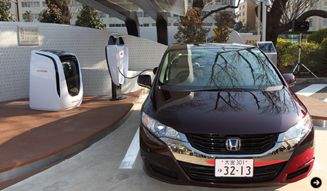
A hydrogen station is the equivalent of a gas station for gasoline cars, where hydrogen is manufactured. Honda has now succeeded in installing Japan's first Solar Hydrogen Station, which emits no carbon dioxide throughout all processes from hydrogen production to storage and supply. This means that using this station, both the fuel and the car will be CO2-emission-free.
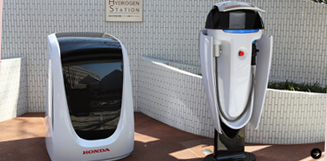
Honda has been working with Saitama Prefecture in a public-private initiative towards realizing a low-carbon society. Alongside the FCX Clarity delivered as an official vehicle, they will verify its practicality under actual environmental conditions, aiming to popularize the "Home Energy Station" for domestic use in the future.
This Solar Hydrogen Station utilizes both solar power and commercial power, and can produce 1.5kg of hydrogen in 24 hours – enough for the FCX Clarity to travel approximately 150km. By adopting Honda's proprietary "High-Pressure Water Electrolysis System," the equipment has been made more compact and quieter. While challenges such as construction costs, estimated in the hundreds of millions of yen, and the price of hydrogen remain for practical implementation, the Solar Hydrogen Station, which has been in experimental operation since 2001, has finally taken shape. We will be watching the verification results to see if this becomes a catalyst for the practical use of fuel cell vehicles.
Inquiries
HONDA Customer Relations Center
0120-11-2010