Nissan Conducts Demonstration Test of EV Charging System
NISSAN
EV Charging System Demonstration
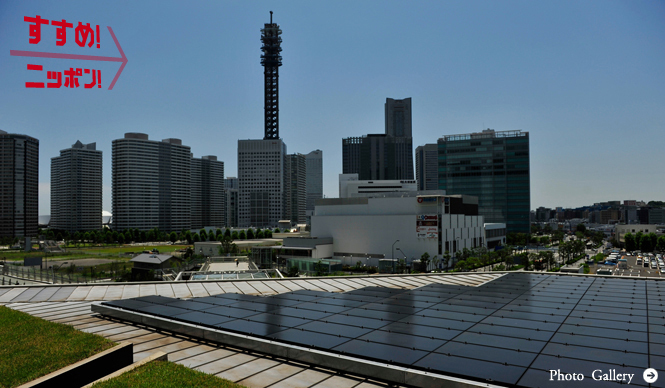
Nissan, together with 4R Energy, has developed an EV charging system combining solar power generation and Leaf lithium-ion batteries.lithium-ion batteryA demonstration experiment has begun at Nissan Motor Global Headquarters in Yokohama.
By Tomomi Yanaka
Charging for 1,800 Leafs Possible Annually
4R Energy, which collaborated with Nissan Motor on this development, is a joint venture established in September 2010 by Nissan Motor and Sumitomo Corporation with the aim of commercializing the secondary use of batteries that have been used in EVs. They are already engaged in demonstration experiments for small-scale residential storage systems.
The charging system developed this time is installed at Nissan Motor Global Headquarters. Solar panels with a maximum output of 40 kW have been installed, and the generated electricity is sent to lithium-ion batteries with a maximum storage capacity of 96 kWh (equivalent to four batteries used in the Nissan Leaf), also located within the headquarters, for EV charging. This power can charge EVs through three rapid chargers and 14 standard charging sockets within the headquarters. For a Leaf with a completely depleted battery, this system can provide enough charge for 1,800 vehicles annually (assuming 40 kW of power is generated by the solar panels for approximately 3 hours a day, a simple calculation multiplying this by 365 days yields an annual capacity of 43,800 kWh). Incidentally, 488 solar panels have been installed, covering a total area of approximately 3,500 square meters.
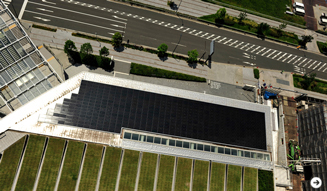
Solar Frontier solar panels
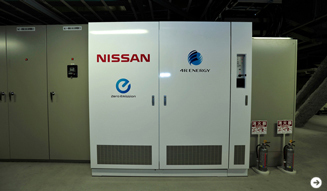
Battery and grid management system
Stationary Lithium-ion Batteries Enable Charging Even at Night
The development of this system makes it possible to achieve zero CO2 emissions during power generation, bringing us closer to the zero-emission society that Nissan Motor advocates.
Nissan Motor and others plan to operate the charging system by reusing lithium-ion batteries, which have a longer service life than the EV lifecycle. In other words, by using lithium-ion batteries as stationary storage, charging becomes possible even at night or during rainy weather when solar power generation is not feasible, allowing for efficient utilization of renewable energy.
Following the demonstration experiment, Nissan Motor intends to pursue market development for medium-scale storage systems targeting commercial and public facilities in the future.