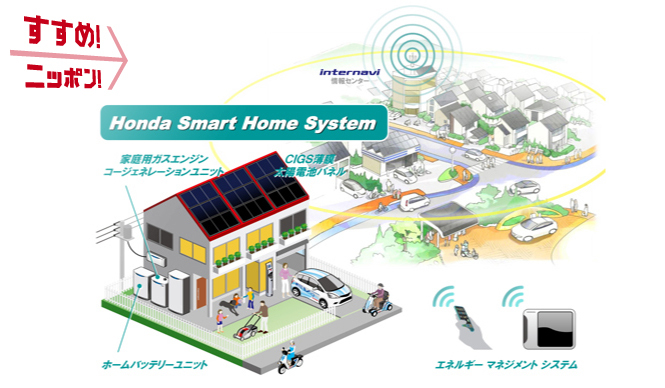
HONDA | Honda Smart Home System Demonstration Outline
HONDA
Honda and Saitama City Sign Agreement to Reduce CO2 Emissions
Honda has agreed to jointly promote Saitama City's "E-KIZUNA Project," which aims to reduce CO2 emissions in households, and has signed an agreement to that effect.
By Tomomi Yanaka
Autonomous Power Supply with Smart Home System
The E-KIZUNA Project is an initiative by Saitama City that aims to reduce CO2 emissions through the promotion of electric vehicles and other measures.
The experiment will verify the practicality of using a Fit-based EV, a plug-in hybrid, and electric motorcycles. Furthermore, Honda will construct a house equipped with its independently developed "Honda Smart Home System"—which combines a natural gas-powered cogeneration unit with a solar power generation system—aiming for completion in the spring of 2012. This will be a demonstration experiment for a low-carbon society through a comprehensive approach.
Aiming to Halve CO2 Emissions by 2015 Compared to 2000 Levels
In the experiment, electricity and thermal energy generated by this system, in addition to externally supplied power, will be used within the household, for EVs, and electric motorcycles. By efficiently managing these resources, the aim is to reduce daily CO2 emissions. The experiment will also assess the feasibility of autonomous household power supply during disasters. While the Fit-based EV used in the experiment cannot currently function as a battery, it is expected to be capable of energy storage in the future, with development anticipated.
Through this demonstration experiment, Honda aims to reduce household CO2 emissions by half by 2015, compared to 2000 levels.
The energy issues brought into sharp focus by the Great East Japan Earthquake and the accident at the Fukushima Daiichi Nuclear Power Plant underscore the urgent need for comprehensive energy management systems like the "E-KIZUNA Project" to build a sustainable society.