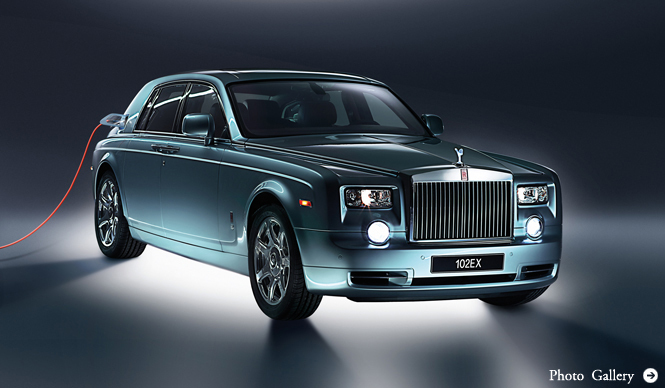
ROLLS-ROYCE 102EX | Details of the Rolls-Royce 102EX "Phantom EE"
ROLLS-ROYCE 102EX | Rolls-Royce 102EX
Rolls-Royce Announces Details of Phantom EE
Rolls-RoyceMotor Cars has announced details of its Phantom EV model, codenamed "102EX," which was unveiled at the Geneva Motor Show.
By Dai Matsuo
See our report from the test drive event held at The Capitol Hotel Tokyo for the 102EX!
Phantom-Based EV
Rolls-Royce unveiled the electric concept car 102EX, also referred to as the "Phantom Experimental Electric = Phantom EE," at the Geneva Motor Show. Its details, however, are surprisingly practical.
In recent years, models like the 100EX and 101EX have become production models. Following the tradition that began with the 1EX in 1919, Rolls-Royce's experimental models aim to evaluate and consider new technologies and their applications, always leading to future product development. These are not mere concept cars. They are built using materials such as wood, leather, and metal, with all functions fully operational and capable of being driven.
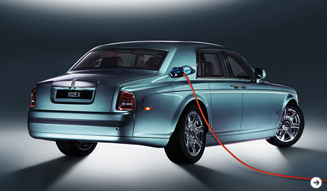
The latest project in this tradition, the "102EX," is built upon the Phantom's aluminum spaceframe. In place of the conventional 6.75-liter V12 engine and 6-speed gearbox, it features a single lithium-ion battery pack and two electric motors mounted on the rear subframe. The motors are connected to a single-speed transmission via an integrated differential. Notably, the 102EX is the first instance of an electric motor being fitted to a car in the GKL++ segment (ultra-luxury cars over €200,000), and its battery pack is the largest for a passenger car.
With motors producing 145kW each, the Phantom EE generates a total maximum output of 290kW and a peak torque of 800Nm. For comparison, the standard Phantom boasts a maximum output of 338kW (460ps) / 5,350rpm and a peak torque of 720Nm (73.4kgm) / 3,500rpm, making the powertrain quite substantial. The driving range on a single charge is stated as 200km, suggesting practicality on par with the Nissan Leaf, although the specific driving conditions are not detailed. Performance figures include 0-60 mph in under 8 seconds (compared to 5.7 seconds for the standard Phantom) and a top speed of 160 km/h (compared to 240 km/h for the Phantom).
The Future Vision of the "Best Car in the World"?
The design remains largely consistent with the Phantom. The primary exterior difference is the illuminated Spirit of Ecstasy at the tip of the radiator grille, featuring the double R emblem signifying experimental models in red. Made of polycarbonate resin instead of stainless steel, it is illuminated by blue LEDs.
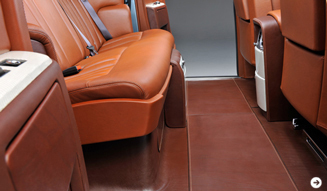
The interior showcases innovative touches that challenge conventional Rolls-Royce interiors. The leather used for the seats and armrests is "Seton Corium," which exhibits more natural markings than the leather found in standard Phantoms. This leather is tanned using a Corium process with natural plant-based agents, dyed by tumbling in a mixture of chestnut extract from Southern Europe and tara powder from crushed tara fruit from South America. Furthermore, it departs from traditional wood pairings, featuring aluminum materials instead.
The objective of the test program utilizing this 102EX is to understand the future aspirations of Rolls-Royce owners, including driving range per charge, performance, and charging infrastructure. By assessing the feedback received through the dedicated website (www.electricluxury.com) from customers, media, stakeholders, and enthusiasts, Rolls-Royce will determine whether a 100% electric drivetrain or other alternative drivetrain technologies are suitable for the future of the "Best Car in the World."