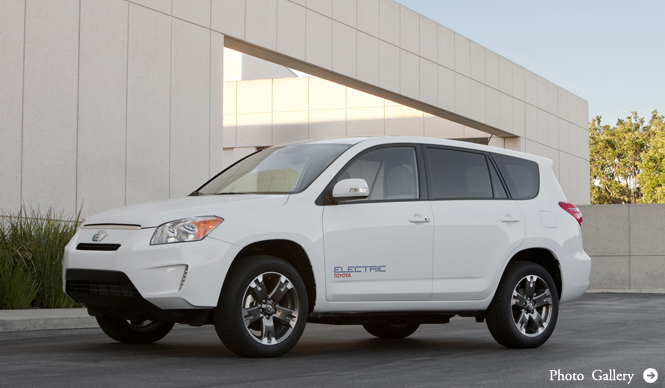
TOYOTA RAV4 EV Concept | Toyota RAV4 EV Concept
TOYOTA RAV4 EV Concept
An EV Based on the RAV4 Appears
Toyota Motor Corporation has unveiled the "RAV4 EV," an electric vehicle concept model equipped with Tesla's EV system, at the Los Angeles Auto Show. The partnership between the two companies has also been a topic of discussion.
By Dai Matsuo
Equipped with Tesla's EV System
Toyota made a significant investment in Tesla Motors in the spring of 2010. It was rumored at the time that a RAV4 would be provided, and now it has been reborn as an EV.
Tesla and Toyota have reached a basic agreement on a business alliance concerning the development, production systems, and production technology of electric vehicles and their components. Toyota aims to learn from the venture company Tesla about EV technology, its spirit of challenge, decision-making speed, and flexibility. Meanwhile, Tesla's objective is not only to receive funding but also to absorb Toyota's expertise in vehicle development and production.
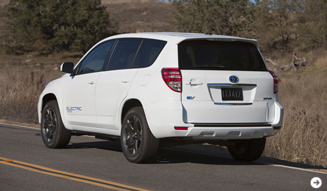
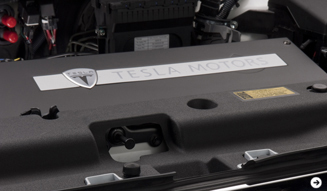
This RAV4 EV, jointly developed by both companies, is a concept model based on the highly utilitarian RAV4 body, incorporating Tesla's EV system. It aims for a cruising range of approximately 100 miles (about 160 km) in real-world driving conditions. With commercialization planned to begin in the U.S. in 2012, an American research team will lead the acceleration of vehicle development.
Toyota launched the world's first mass-produced hybrid passenger car, the "Prius," in 1997, surpassing a cumulative total of 2 million units sold. Furthermore, in 1996, it released the "RAV4 EV" (first generation), the world's first production vehicle to feature a nickel-metal hydride battery, selling approximately 1,900 units by 2003.
Toyota continues to announce a wide range of environmentally friendly vehicles, not just hybrids. While the RAV4 EV is reportedly for sale only in the U.S., the introduction of EVs into the Japanese domestic market may not be far off.
BRAND HISTORY
Toyota's origins as an automobile manufacturer date back to 1936. Its initial offerings were a six-cylinder model with a streamlined body, popular at the time, and a model targeting the upper market. In the late 1950s, its lineup included the 1-liter Corona and the 1.5-liter Crown. In the 1960s, adopting a corporate strategy aimed at expanding sales in the U.S. market, Toyota developed a range of vehicles from compact models to V8-powered cars, embarking on a path as a full-line manufacturer.
Toyota's growth has been driven by its unwavering market-centric approach. In the 1960s, it succeeded in the U.S. market by introducing models that targeted small cars from Britain and Italy. Subsequently, its product strategy of offering appropriate performance at reasonable prices was applied across a wide spectrum, from large sedans to sports cars. Later, by establishing factories in the U.S., Toyota began producing many vehicles specifically for the American market, such as large pickup trucks.
In Japan, the period of high economic growth in the 1960s marked a peak, and with contributions from sales and marketing, Toyota secured a solid position through its diverse product lineup. In its main market, the U.S., the two oil crises of the 1970s proved to be a catalyst, driving rapid growth with small, fuel-efficient vehicles as its strength. A significant leap forward in recent times occurred in the late 1980s with the launch of Lexus, a separate brand from Toyota, in response to the growing demand for luxury cars in the U.S. Adopting a philosophy of "genryu shugi"—thorough quality control from the smallest component—Lexus established itself by emphasizing high quality.
Another major leap was the launch of the Prius in 1997. While the hybrid powertrain was unfamiliar to the general public and criticized by the automotive industry at the time as "meaningless in the technological progression from internal combustion engines (like gasoline and diesel) towards fuel cells," its foresight is evident in its current success. Manufacturers worldwide are now promoting hybridization, albeit with slight variations in approach. Other automakers have had to acknowledge that the battery technology essential for hybrid vehicles is also crucial for electric vehicles and the fuel cell vehicles that lie beyond.
Since the Lehman Shock in the U.S. in September 2008, luxury car sales have slowed, and around the same time, product recalls became a major issue in the U.S. Congress. It can be said that Toyota is currently facing headwinds. The early withdrawal from F1 racing in 2009, after entering in 2002, also disappointed fans. However, Toyota has announced its intention to resume international racing activities, with an eye on the World Rally Championship, raising expectations for the future.
(Updated August 2010)