December 16, 2014
Renault Unveils Compact PHV Achieving 100km/L | Renault
Renault EOLAB Concept
Renault Unveils Compact Plug-in Hybrid Achieving 100 km/L in Paris
Renault has unveiled the compact plug-in hybrid concept car, the EOLAB, at the Paris Motor Show. This is a highly realistic vehicle, designed with mass production in mind.
Text by HORIGUCHI Yoshihiro (OPENERS)
Fuel Efficiency Achieved Through Aerodynamics, Lightweighting, and Hybrid Technology
Renault's Paris Motor Show reveal was the compact hybrid car, the EOLAB Concept. While packed with the latest technology, it's a realistic model designed with production costs in consideration.
The EOLAB Concept was created with the aim of being a "100 km/L car," and it achieves an impressive fuel economy of approximately 100 km/L with CO2 emissions of 22g/km.
To achieve this, compared to the "Renault Clio (Lutecia)" in the same segment, it features a 30% improvement in aerodynamic performance, a vehicle weight reduction of up to 400kg, and the adoption of a compact hybrid engine named "Z.E. Hybrid Technology."Clio (Lutecia in Japan)"Clio (known as Lutecia in Japan)", a 30% improvement in aerodynamic performance, a vehicle weight reduction of up to 400kg, and the adoption of a compact hybrid engine named "Z.E. Hybrid Technology."
High Aerodynamic Performance Achieved Through Innovative Technology
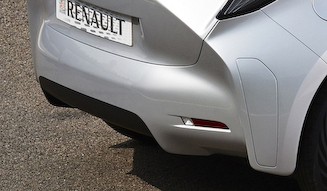
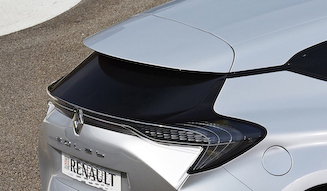
The active spoiler on the front bumper lowers by 10cm at speeds above 70 km/h to manage airflow around the vehicle. Additionally, the rear bumper features a 40x10cm aerodynamic flap that extends 6cm at speeds above 70 km/h, suppressing the tendency for airflow along the sides of the car to detach too early from the body at high speeds.
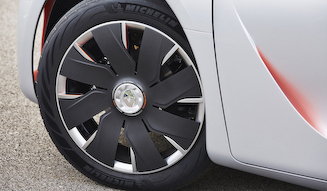
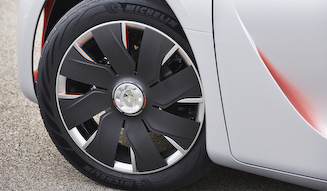
To reduce air resistance, a flat wheel surface would be beneficial for fuel economy. However, from a design and brake cooling perspective, completely covering the wheels is difficult. Renault's solution is an active wheel system that incorporates temperature sensors; when brake cooling is needed, the cover shifts to allow outside air in.
The tires are also a dedicated 145mm wide design, co-developed with Michelin. Design elements emphasize width in the tread pattern and a sense of lightness in the sidewalls. Renault has also improved the wheel bearings, reportedly reducing CO2 emissions by 1g/km alone.
Renault EOLAB Concept
Renault Unveils Compact Plug-in Hybrid Achieving 100 km/L in Paris (2)
Material Selection Considering Future Sales Price
Thanks to meticulous weight reduction efforts, the EOLAB weighs 955kg, which is 400kg lighter than the benchmark Clio.
For this, the body shell utilizes a variety of materials—steel, aluminum, magnesium, and composite plastics—optimized for weight, cost, and material properties.
While lightweighting the body is essential for improving fuel efficiency, the use of all-aluminum bodies or composites of aluminum and carbon is already common in sports and luxury cars. However, these methods require significant investment in materials and skilled labor, making them unsuitable for mass-produced compact cars.
As the project leader emphasized, "If you have unlimited funds, lightweighting is easy. But that goes against Renault's philosophy. We designed it with production costs in mind to make it an affordable car." The EOLAB Concept is not just a showcase of future technology, but a "concept model" grounded in the reality of near-future mass production.
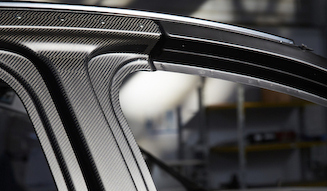
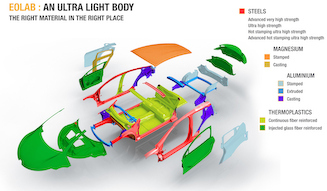
The front half of the cabin uses ultra-high-strength steel plates with tensile strength ranging from 1,200MPa to 1,500MPa. The rear section uses aluminum, employing three different manufacturing methods based on cost and performance requirements, contributing to reduced body weight and driving inertia without compromising strength.
While a conventional steel roof would weigh 10kg, this magnesium alloy roof weighs just 4.5kg. This groundbreaking technology for producing magnesium in sheet form, rather than blocks, was provided by supplier POSCO.
Additionally, fiber-reinforced plastics, including glass fiber and long fibers, are used for the hood and cabin floor. The windshield is also thinner and 30-50% lighter than current standard products. Polycarbonate replaces glass for the rear and rear-side windows.
Renault EOLAB Concept
Renault Unveils Compact Plug-in Hybrid Achieving 100 km/L in Paris (3)
Lightweighting Applied to Drivetrain Components
Various drivetrain components have been made lighter through the use of aluminum. Compared to the Clio, the subframe is 5.3kg lighter, suspension arms 1.8kg, the axle assembly 5kg, and the rear arms 9kg lighter.
The braking system, developed by Continental, is 14.5kg lighter. While the front brake discs are steel, the hubs and other components are aluminum. Furthermore, the brake pads are kept completely separate from the discs during normal driving, eliminating frictional resistance. In conjunction with this, a control system detects situations where the driver is likely to brake and lightly touches the pads to the discs as a preliminary action, ensuring braking force remains unchanged or responds even faster.
The rear drum brakes incorporate an electric automatic parking brake, eliminating the need for a conventional brake lever and cables, contributing to a weight reduction of 1.3kg.
Lightweighting has also been applied to the interior without compromising functionality. The front seats have been redesigned and are newly developed thin and lightweight units created with a partner company. Interior plastics are also thinner and utilize a special manufacturing process that incorporates air bubbles for weight reduction.
Beyond these, weight reduction measures are implemented throughout the vehicle, even in less visible areas. For example, the air intake ducts use polyethylene, which has a very low specific gravity of 0.09 compared to the usual 0.96. Although the thickness is five times greater, the weight is only 700g, a reduction of 2.3kg from conventional ducts.
Renault EOLAB Concept
Renault Unveils Compact Plug-in Hybrid Achieving 100 km/L in Paris (4)
An Affordable, Compact Plug-in Hybrid
The EOLAB Concept's powertrain features Renault's original plug-in hybrid system, protected by 30 patents. Equipped with a 6.7 kWh lithium-ion battery, it achieves a range of 60 km and a top speed of 120 km/h on electric power alone. These figures cover a significant portion of daily driving needs for most users.
The power source combines a 999cc, 3-cylinder gasoline engine producing 57 kW (75 hp) and 95 Nm of torque with a compact permanent magnet motor delivering 50 kW and 200 Nm.
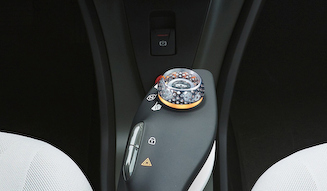
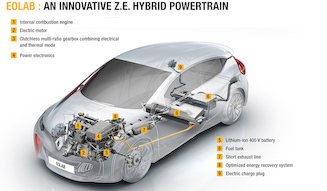
This plug-in hybrid system is designed to be cost-effective and compact enough for small cars, not an expensive, large-scale system. Renault aims to introduce it in production vehicles by 2020, aligning with their philosophy of "ultra-fuel-efficient cars within reach."
The transmission is a 3-speed semi-automatic (single clutch). Renault explains that for the typical speed ranges of a car this size, a 3-speed transmission is sufficient when combined with the torque-rich motor. It also offers advantages in weight and cost compared to CVTs or dual-clutch transmissions when used in compact cars.
Renault EOLAB Concept
Renault Unveils Compact Plug-in Hybrid Achieving 100 km/L in Paris (5)
EV for Daily Commutes, Hybrid for Weekend Getaways
The behavior of the transmission and powertrain varies depending on the driving mode.
The "Weekday" mode, designed for daily commutes and errands, prioritizes electric power for zero emissions. The transmission operates in first gear up to 60-70 km/h, then automatically shifts to second gear to cover speeds up to 120 km/h, primarily using electric power. Above this speed, it shifts to third gear, and the engine engages to transition to hybrid driving.
In "Weekend" mode, intended for longer journeys, the engine starts from the outset for powerful hybrid driving. During coasting or braking, the system actively generates electricity to power the electric motor assist.
The Joy of Owning an Eco-Friendly Car
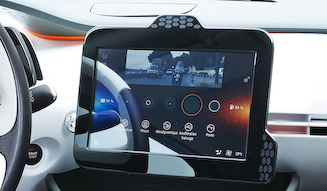
To enhance the value of driving an eco-car, Renault has equipped the EOLAB with an infotainment display showing real-time eco-driving information. Furthermore, unique systems that operate above 70 km/h—such as the spoilers, flaps, and wheels—can be activated via tablet buttons even when the car is stationary, allowing the driver to appreciate their function. This is another way Renault aims to provide the satisfaction of ownership, akin to sports cars, but in an eco-car context.
The EOLAB Concept embodies Renault's philosophy of "ultra-fuel-efficient cars at an affordable price," incorporating thorough measures for fuel efficiency in materials, design, and powertrain, while also considering mass-production costs. It is a grounded model that builds anticipation for Renault's future production "affordable eco-cars."