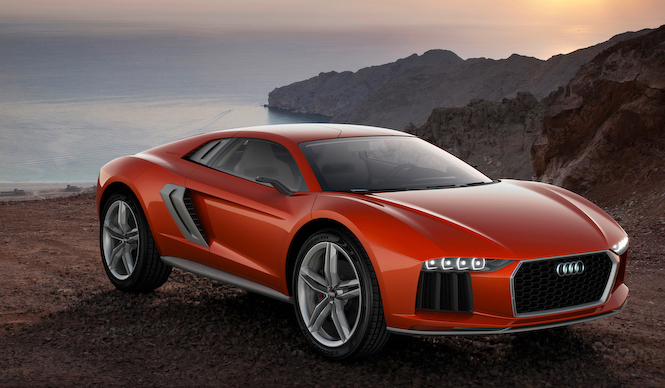
Audi's Crossover Sport Concept | Audi
Audi Nanuk Quattro Concept
Designed by Giugiaro
Audi's Crossover Sports Concept "nanuk quattro"
The "Nanuk Quattro Concept," penned by Italdesign Giugiaro after its acquisition by Volkswagen, proposes a new all-weather supercar that is not bound by roads. With a maximum output exceeding 400 kW (544 ps) and off-road capability akin to an SUV, this is truly the ultimate supercar.
Text by SAKURAI Kenichi
Merging Sports Car and Off-Roader
Audiunveiled theFrankfurt Motor Show"Nanuk Quattro Concept" at the Frankfurt Motor Show. The announcement was made the day before the show, during the "Volkswagen Group Night," an event where the Volkswagen Group unveils its new creations. The "Nanuk Quattro Concept" made its entrance by driving itself onto the stage. "Nanuk" is an Inuit word for polar bear, a name that also appeared in a unique commercial previously produced by Audi.
The design, which appears to place the body of Audi's mid-engine supercar, theR8, onto the chassis of an SUV from the Q series, can be seen as a proposal for a new category of sports model. The design was handled by the renowned "Italdesign Giugiaro," now under the "Volkswagen" umbrella.
At the Geneva Motor Show earlier, "Italdesign Giugiaro" had already presentedLamborghinian SUV concept car based on theGallardo, theParcour. As this suggests, the concept of this category itself is not entirely new, having been proposed by various designers over the years. However, the novelty lies in Audi's collaboration with "Italdesign Giugiaro" to propose the potential of a mid-engine supercar, making it a point of particular interest.
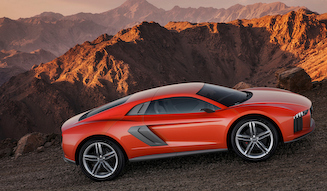
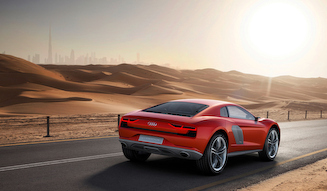
The "Nanuk Quattro Concept" is a study that evolves the crossover concept, combining the dynamics of a high-performance mid-engine sports car with the off-road capability of an RV. Audi describes it as a "sports car that can fully demonstrate its performance on the racetrack, on the highway, and even off-road in sand or snow."
The body dimensions are 4,541 mm in length, 1,990 mm in width, and 1,337 mm in height, with a wheelbase of 2,710 mm. The main frame is a lightweight Audi Space Frame (ASF) made of aluminum, combined with exterior panels made of carbon fiber reinforced polymer (CFRP).
Unlike the "Sport Quattro Concept," the hexagonal single-frame grille incorporates the emblem, suggesting that this concept car represents a different model series from Audi's mainstream design language. On the other hand, the "side blades" on the body sides, a signature element of the Audi R8, have been evolved with "Italdesign Giugiaro's" interpretation.
Audi Nanuk Quattro Concept
Designed by Giugiaro
Audi's Crossover Sports Concept "nanuk quattro" (2)
A Supercar for Any Terrain
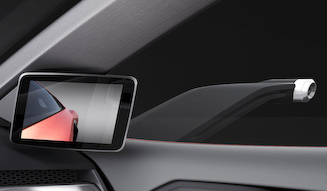
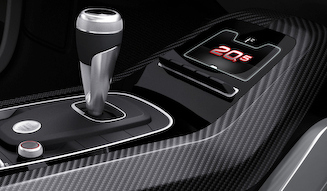
The interior extensively uses carbon, aluminum, and genuine leather. The vehicle is a two-seater, featuring a distinctive floating-design instrument cluster. Instead of a rearview mirror, it employs a combination of small cameras and monitors. A luggage space capable of holding two suitcases is provided under the bonnet at the front of the vehicle, demonstrating consideration for practicality.
Positioned longitudinally in front of the rear axle is a newly developed 5-liter V10 TDI. This powerful twin-turbo diesel engine boasts a maximum output of over 400 kW (544 ps) and generates 1,000 Nm (102 kgm) of torque from just 1,500 rpm. A reinforced 7-speed S tronic, mounted behind the engine, transmits torque to the quattro drivetrain, utilizing Audi's signature full-time all-wheel-drive system.
Despite a vehicle weight of 1,900 kg, this powertrain propels the "Nanuk Quattro Concept" to 100 km/h in just 3.8 seconds, with a top speed of 305 km/h. On the other hand, it achieves a fuel efficiency of 13.7 km per liter, a key advantage of diesel engines.
The "Nanuk Quattro Concept" features double-wishbone suspension on both front and rear axles, paired with tires sized 235/50R22 at the front and 295/45R22 at the rear. Carbon-ceramic brakes are employed. The ride height can be set in three stages by the driver using an adaptive air suspension with electronically controlled dampers. Additionally, the system automatically adjusts the vehicle's ride height based on driving speed and predictive route data from the navigation system.
At low speeds, a four-wheel steering system (4WS) operates to assist with tight turns. The rear wheels turn up to 9 degrees in the opposite direction to the front wheels, resulting in a minimum turning radius of approximately 5 meters. This is effectively equivalent to a 1,000 mm reduction in wheelbase. At high speeds, the rear wheels steer 2.5 degrees in the same direction as the front wheels, which is said to provide the effect of extending the wheelbase by approximately 1,400 mm, contributing to excellent stability during high-speed cornering.
The proposal of a mid-engine supercar capable of off-road driving is an old yet fresh theme. The unveiling of the "Nanuk Quattro Concept," following Italdesign Giugiaro's "Parcour," suggests the potential to evolve the supercar from a highway king into a ruler of all terrains.