April 6, 2015
A Hybrid Sports Car Inspired by Racing Machines Arrives | Toyota
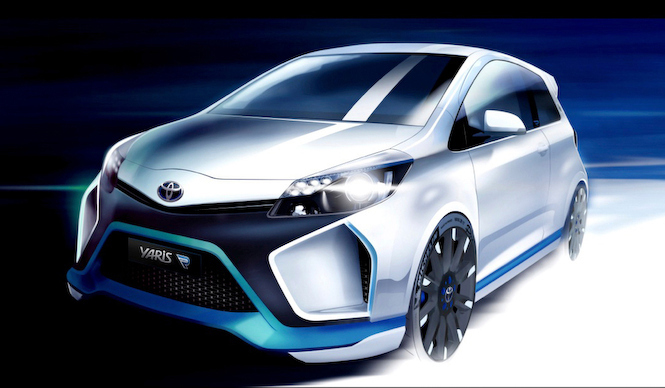
Toyota Yaris Hybrid-R Concept
Hybrid Sports Debut, Inheriting Racing Machine DNA
Details have emerged of Toyota's hybrid sports concept, said to be derived from the racing machine "TS030."
Text by HORIGUCHI Yoshihiro (OPENERS)
A Sports Powertrain Featuring a High-Output Engine, High-Power Motors, and Capacitors
Recently,Toyota's next-generation hybrid sports, the "Hybrid-R Concept"had its details revealed.
This sports car is based on a three-door hatchback Yaris (Vitz in Japan) hybrid, and incorporates sports hybrid technology from the "TS030 HYBRID" racing machine that Toyota developed for 24-hour endurance races like Le Mans.
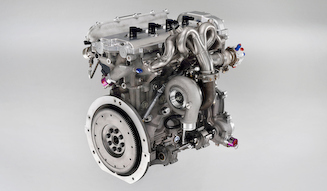
The 1.6-liter direct-injection turbocharged engine, which drives the front wheels, boasts a maximum output of 300 ps. This engine, developed by TMG (Toyota Motorsport GmbH) for participation in various FIA-regulated races, is named GRE (Global Race Engine). Furthermore, the rear wheels are equipped with motors, each delivering a maximum output of 60 ps. The total system output reaches an impressive 420 ps.
Replacing the conventional Yaris Hybrid's battery pack is a super capacitor, inherited from the TS030 HYBRID. Toyota explains that super capacitors, which allow for more efficient and rapid charging and discharging compared to nickel-hydrogen batteries, are ideal for race tracks due to their high reliability and responsiveness.
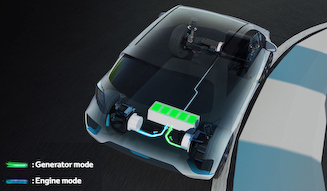
Regarding its hybrid behavior, in "Road" mode, the output is limited to a maximum of 40 ps for the combined rear motors, utilizing energy charged from a single braking event for up to 10 seconds. In contrast, the "Track" mode is designed to release a maximum of 120 ps from the combined rear motors for five seconds per braking event, considering the frequent hard braking and momentary acceleration characteristic of circuit driving.
The Yaris Hybrid-R Concept is also equipped with another motor, boasting a maximum output of 60 ps. This motor is positioned between the engine and the six-speed sequential transmission and serves two functions. One is to charge the capacitor during deceleration. The other is to act as a generator, receiving rotational force from the engine when the front tires exceed their grip limit, and directly driving the rear motors. This latter function acts as traction control, utilizing the engine's excess power converted to electricity to temporarily drive the rear wheels, thereby enhancing acceleration and handling performance.
The independent nature of the motors is also leveraged in other scenarios. During cornering, by driving only the outer wheel motor, generating braking force on the inner wheel, or employing both simultaneously, the system generates the necessary yaw moment (rotational inertia) according to the corner's angle, enhancing cornering performance through what is known as torque vectoring.
The unveiling of the Yaris Hybrid-R Concept, which incorporates TS030 HYBRID technology into a production car, is scheduled for theFrankfurt Motor Show, starting September 10th.