January 28, 2015
The 7th Generation Golf Unveiled | Volkswagen
Volkswagen Golf
The 7th Generation Golf Unveiled!
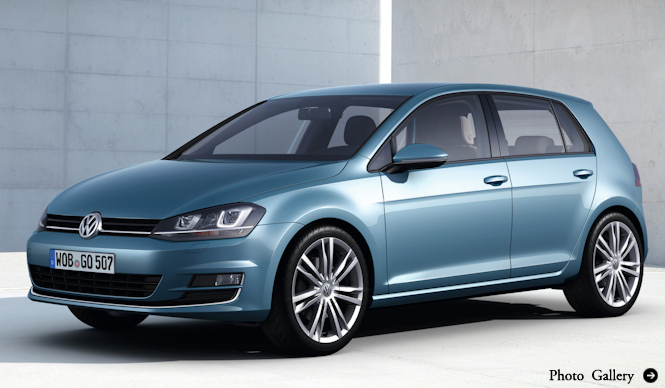
Volkswagen AG has announced the new Golf, the 7th generation model, ahead of its debut at the Paris Motor Show.
Text by HORIGUCHI Yoshihiro (OPENERS)
A Fusion of Traditional Aesthetics and Advanced Engineering
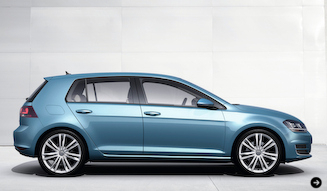
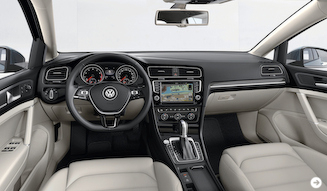
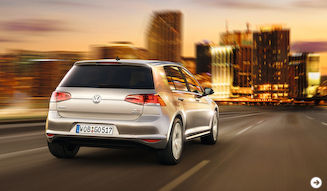
The new Volkswagen Golf, also known as the Golf 7 due to it being the seventh generation, appears to maintain a consistent design concept overall, featuring the iconic thick C-pillars (the section from the rear door to the back), a long roofline, and horizontal front and rear designs. However, with the adoption of the production technologyModular Transverse Matrix (MQB)and the introduction of newly developed engines, the interior is entirely new. The vehicle's weight has been reduced by 100kg, and various high-efficiency technologies have been implemented, resulting in a reduction of CO2 emissions by up to 23 percent, according to European environmental performance indicators.
The body dimensions are 4,255mm in length, 1,799mm in width, and 1,452mm in height, making it 56mm longer, 13mm wider, and 28mm lower than its predecessor. The wheelbase has been extended by 59mm to 2,637mm. Furthermore, the front overhang has been shortened as the front axle has been moved forward by 43mm. This gives the car a longer bonnet and a more rearward cabin, creating "a sportier and more premium silhouette," according to Volkswagen's designers.
Along with the increased body size, the cabin space has also been expanded. Rear legroom has increased by 15mm, and the space around the elbows and shoulders for both front and rear occupants has grown by 20-30mm. The luggage capacity has also increased by 30 liters to 380 liters. The rear seats are split-folding 60:40, allowing for expansion as needed, as before.
Newly Developed Powertrains
Both gasoline and diesel powertrains are available. Both are newly developed. The gasoline engines are 16-valve, direct-injection, turbocharged inline-4 DOHC (TSI) units. At launch, two versions with different power outputs will be offered: the entry-level model with a maximum output of 85ps (63kW) and a fuel consumption of 4.9ℓ/100km (approximately 20.4km/ℓ), with CO2 emissions of 113g/km. This is a 0.6ℓ/100km improvement over the predecessor with equivalent performance. The higher-output version has a maximum output of 140ps (103kW), with a fuel consumption of 4.8ℓ/100km and CO2 emissions of 112g/km.
The 1.4-liter TSI engine features thePolo BlueGTcylinder deactivation technology, "ACT (Active Cylinder Technology)" also installed. Specifically, when the engine speed is between 1,400 and 4,000 rpm and the torque is below 85Nm under low load conditions, two cylinders are deactivated to improve fuel efficiency. This is said to contribute to a 0.4ℓ/km improvement in the European driving cycle value.
The diesel engines are also newly developed 16-valve, turbocharged inline-4 DOHC (TDI) units. Initially, versions with 105ps (77kW) and 150ps (110kW) will be released. The 105ps version has a fuel consumption of 3.8ℓ/100km (approximately 26.3km/ℓ) and CO2 emissions of 99g/km, falling below 100g/km. Even the 150ps version boasts high environmental performance with a fuel consumption of 4.1ℓ/100km (approximately 24.4km/ℓ) and CO2 emissions of 106g/km.
This environmental performance is supported not only by engine efficiency but also by weight reduction. Specifically, the engine has been lightened by 40kg, the transmission system by 26kg, the electrical system by 6kg, and the body and interior by 37kg. The breakdown for the body and interior is further detailed: the body alone is 23kg lighter, the dashboard 0.4kg, the frame around the dashboard 1.4kg, the seats 7kg, and other components 2.5kg. While the sum of these weight reductions is 109kg, the actual vehicle weight reduction is 100kg due to increases in safety equipment and other factors.
Additionally, it is equipped with a "Start/Stop" system (idling stop function) that contributes to a 4 percent improvement in fuel efficiency, and a "Brake Energy Recovery System" that reduces CO2 emissions by 4 percent.
Numerous Safety Features
The safety features are also enhanced with the latest systems and those previously adopted in theTouaregandPassatmodels.
The "Multi Collision Brake System," introduced for the first time here, automatically applies the brakes in the event of a collision, significantly reducing the kinetic energy that determines the severity of the impact. The system operates by electronically controlling deceleration to below 0.6G, while ensuring driver control. For example, if the driver presses the accelerator pedal, the automatic braking is released, not hindering the driver's evasive maneuvers. The background for adopting this "post-accident" system is research indicating that a quarter of personal injury accidents involve secondary collisions, meaning multiple impacts.
Additionally, a pre-tensioner function that tightens the seatbelts and adjusts the seating position of front occupants to ensure effective deployment of airbags in response to pre-collision signs such as hard braking, strong understeer, or oversteer has been introduced. This is complemented by a pre-crash function that automatically closes windows and the sunroof to ensure side and curtain airbags function as intended.
Other features include "Adaptive Cruise Control," which provides automatic driving between 0-160km/h (30-160km/h for manual transmission) based on radar detection; "Front Assist," which warns if the vehicle gets too close to the car ahead and automatically applies the brakes if the distance remains too short, either avoiding a collision or minimizing its impact; "City Emergency Braking," which automatically provides the necessary braking force if the braking applied during a Front Assist warning is insufficient; "Driver Alert System," which monitors the driver's steering inputs and prompts them to take a break if fatigue is detected; and "Lane Assist," which uses a camera to prevent lane departure and supports steering along the lane. Many of these are enhancements of existing functions or safety technologies previously found only in luxury vehicles.
The unveiling of this new Golf, packed with the latest technology, will take place at the Paris Motor Show (Paris Salon), starting on the 29th.