TOYOTA | Prius | The 2nd Installment of the Long-Term Test
TOYOTA PRIUS | TOYOTA PRIUS Part 2
Driving a Next-Generation Hybrid Car on the Circuit (1)
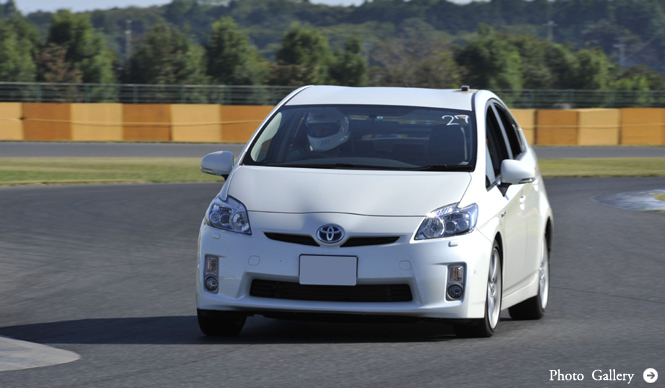
Following the Nissan GT-R Spec V, OPENERS has introduced the Toyota Prius as its second long-term test car. It's been quite some time since this "next-generation hybrid car," which recorded unprecedented backorders, arrived at our editorial department. Although it may seem sudden for the second report, we had the opportunity to drive it on the Tsukuba Circuit Course 1000, just like the first car, the GT-R. Two car journalists share their impressions.
Text by OPENERSPhotos by Satoshi Kaminura
The Evolved Third-Generation Prius
—First, what are your impressions of the new Prius, our second long-term test car?
Car Journalist A: The conventional wisdom was that hybrid cars, with their engines, two motors, and large batteries, prioritized efficiency over driving performance. Past eco-cars seemed to sacrifice driving enjoyment for environmental considerations. However, actually driving this third-generation Prius on the Tsukuba Circuit 1000 completely dispelled that notion.
Car Journalist B: Yes, my initial expectations were low, but I felt it had sufficient maneuverability as a "city commuter." Moreover, despite being about 50kg heavier than the previous model, it achieves an astonishing fuel efficiency of 36 km/l. The first Prius appeared 13 years ago, and I believe this third generation has significantly evolved as a hybrid car.
A Hybrid Car That's Also Fun to Drive
—Testing a Prius on a circuit is an interesting endeavor.
Car Journalist A: We wanted to see what would happen driving a hybrid car on the circuit, the polar opposite of our other long-term test car, the GT-R. So, just as we did with the GT-R, we completed four sets of 12 laps around the 1000m course, followed by a break.
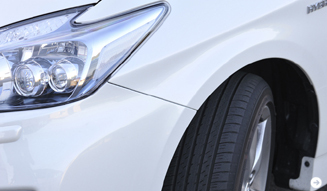
Car Journalist B: The result confirmed that it possesses fundamental performance capable of withstanding such extraordinary driving conditions. Perhaps due to the hard compound eco-tires, the tires showed no signs of wear even after continuous driving. The braking performance was also good for this type of car, and its basic "run, turn, stop" dynamics were surprisingly straightforward, responding as intended. It drives as you imagine, with no abruptness in its behavior. Surprisingly, it's a car that's "fun to drive." It's clearly different from previous Priuses.
TOYOTA PRIUS | TOYOTA PRIUS Part 2
Driving a Next-Generation Hybrid Car on the Circuit (2)
Car Journalist A: Looking at the driving dynamics, for instance, when lifting off the accelerator, regenerative braking engages, preventing the car from coasting. This meant it decelerated more than I expected on the circuit, which was something to be mindful of. Also, if you don't press the pedal gently, the brake assist engages and applies more braking than necessary, so that required attention too.
Car Journalist B: As a side note, brake assist is a system that helps even with full braking, which can be difficult for beginners or women, by supplementing pedal input. However, once you get used to its "quirks," you can manage with smooth brake operation, and the braking itself felt more natural than expected. The Prius uses a "drive-by-wire" system, converting brake and accelerator inputs into electrical signals for output. Considering that feel, it gives the impression that "Toyota has become adept at building hybrids by the third generation." You can feel Toyota's confidence, having pioneered hybrid cars.
TOYOTA PRIUS | TOYOTA PRIUS
—What about the car's stability?
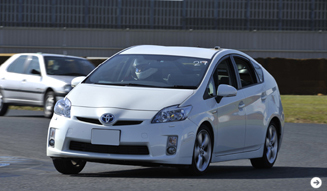
Car Journalist A: Typically, hybrid cars with large battery packs tend to become unstable when pushed hard. However, the Prius is more stable than I imagined in that regard. Even when cornering to the point of losing tire grip, if you drive carefully, you don't get as much understeer as you might expect. The third generation was developed with the European market in mind, where average traffic speeds are higher than in Japan, and it excels in high-speed stability.
The Next Generation of Eco-Cars
—The Prius is an "eco-car," but how does it differ from the first and second generations?
Car Journalist B: With this third-generation Prius, you feel like you're driving a regular FF sedan, and you no longer notice the drawbacks associated with previous eco-cars. Its maneuverability and man-machine interface have evolved to a point comparable to conventional cars, showing its potential for the next generation. It's not just environmentally friendly; it offers something extra and possesses the inherent appeal of a car.
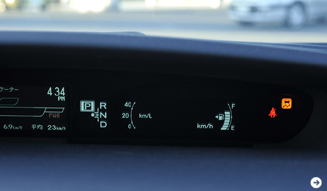
Car Journalist A: Still, its fuel efficiency is truly remarkable for an "eco-car." We refueled near Tsukuba Circuit that morning, and despite driving on the circuit all day, only one fuel level indicator dropped. It's meaningless to compare directly, but the GT-R consumed 70 liters. This is astonishing.
—Finally, what kind of car do you think the Prius will evolve into in the future?
Car Journalist B: It will undoubtedly become a "standard car." In terms of the "future of hybrid cars," hybrids are starting to appear in sports cars, including Porsches. Perhaps the day when Formula 1 becomes a hybrid car is not too far off.