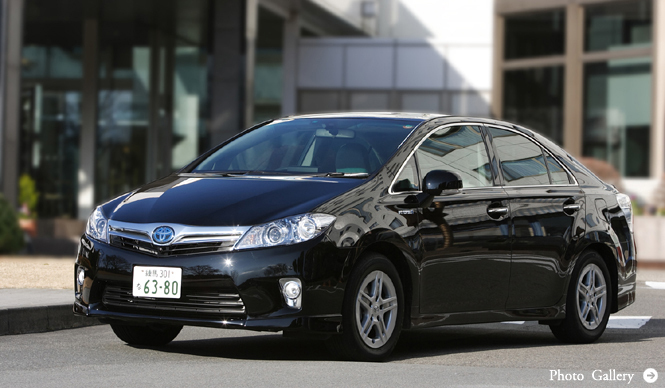
TOYOTA SAI | Toyota Sai (Part 1) | For the discerning customer who wants more than a Prius
TOYOTA SAI | TOYOTA SAI (Part 1)
For the discerning customer unsatisfied with the Prius
The Toyota Prius once achieved unprecedented success, with backorders reaching 180,000 units. However, Toyota also offered a hybrid car positioned above it. Automotive journalist Fumio Ogawa test-drives the SAI, released on December 7th.
By Fumio OgawaPhotos by Masayuki Arakawa
Nimble and Easy to Handle
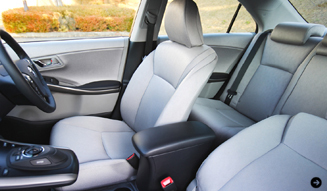
A luxurious hybrid car. That is the SAI, launched by Toyota Motor Corporation on December 7, 2009. Its characteristics are its sedan body style and its luxurious feel.LexusWhile sharing a chassis with the Lexus HS250h, it features Toyota's unique tuning. The interior, for example, adopts an entirely new design.
The name SAI, derived from "advanced intelligence and sophisticated quality that radiates color," reflects its aim to appeal to discerning customers unsatisfied with existing Toyota hybrid models, offering not only environmental performance but also driving pleasure and superior craftsmanship. The engine is a 2.4-liter gasoline unit combined with Toyota's hybrid system, THS II. Two grades are available: the "S" (from 3.38 million yen) with 16-inch tires for ride comfort, and the "G" (from 3.80 million yen) with 18-inch tires for a sportier feel.
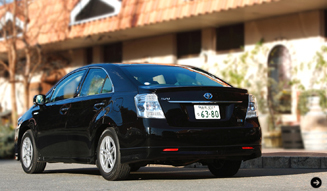
The SAI, released on July 14th, shares its chassis, engine, and transmission with the Lexus hybrid sedan HS250h. However, its suspension settings, styling, and interior design are based on its own unique concept. It is 95mm shorter than the HS250h, measuring 4605mm in length, primarily due to a shorter trunk. Furthermore, developers state that "a major difference is the 'lightness.'" Even the steering feel is lighter than the Lexus HS250h. Toyota explains this was a deliberate choice to achieve "nimbleness and ease of handling."
Eco-Plastic Reduces CO2 Emissions
The SAI's engine is a 2.4-liter inline-four that employs the Atkinson cycle, which optimizes efficiency and fuel economy by delaying the closing of intake valves, similar to the Prius and Lexus HS250h. The electric motor, coupled to the engine via a reduction gear according to Toyota's proprietary system, produces a maximum output of 143 ps on its own and 190 ps as a system. Like the Prius, it is equipped with an "EV Drive Mode" that allows for electric-only operation.
Another notable environmental feature of the SAI is the use of "eco-plastic" for 60% of its interior surface area. This composite material, synthesized from plant-derived raw materials like cornstarch and petroleum-based components, is used in many areas, including the headliner, pillar garnishes, and sun visors. The manufacturer states that the adoption of this new material aims to "reduce CO2 emissions and conserve petroleum resources."
While the SAI emphasizes environmental compatibility in various aspects, it also promotes a sporty driving experience. Engineers focused on lowering the roll center, which tends to be high in hybrid vehicles, to enhance cornering performance. Although Toyota describes it as "lighter," the steering, which feels heavier than in conventional Toyotas, is tuned to maintain a consistent, appropriate resistance from low to high speeds, reminiscent of European cars. This can be seen as an attempt to break down the conventional dichotomy where hybrids excel in fuel efficiency and gasoline cars in handling, and instead, to fuse the best of both worlds.