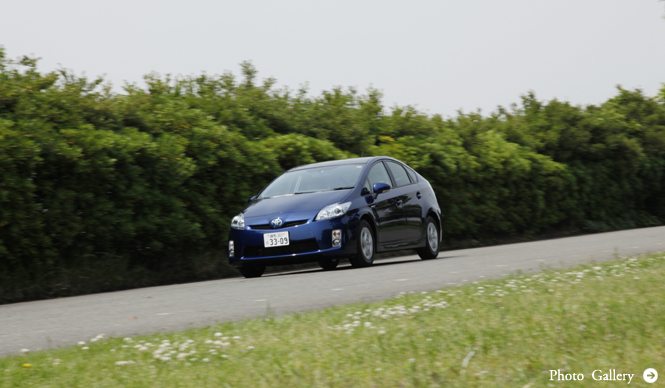
TOYOTA PRIUS | Toyota Prius (Part 2) | Elevated to True Masterpiece
TOYOTA PRIUS | Toyota Prius (Part 2)
Ascended to True Masterpiece Status
As of June 17th, Toyota announced a staggering backlog of 180,000 orders for the Prius. Following our first installment, we delve deeper into the true value of the original hybrid hit's new model.
By Satoshi WatanabePhotos by Atsuki Kono
Success in Improving Highway Fuel Economy, Once a Weak Point
The new Prius features a motor assist that operates across the entire speed range, from startup to its top speed of 180 km/h, and a 1.8-liter Atkinson cycle engine enlarged to reduce engine revolutions during high-speed cruising. In addition to its unparalleled low fuel consumption in urban driving, the new Prius has also succeeded in improving its highway fuel economy, which was previously a weak point.
It's likely that the new Prius was designed with European highway conditions, where cruising at 130 km/h is standard, as a benchmark. The development team probably aimed to achieve fuel efficiency equal to or better than that of the new-generation diesel cars from competitors like Volkswagen, Peugeot, and Fiat, which fiercely compete in this market. In other words, with the success in the Japanese and American markets as a foundation, the new Prius is now poised to make a full-scale entry into the European market.
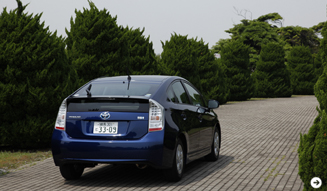
The specification introduced to the European market is the Touring Selection. With its stiffened suspension and precisely tuned steering response, it prioritizes drivability at high speeds while still offering acceptable ride comfort at lower speeds. Personally, I believe it to be the best grade currently available for the Prius.
Will it Replace the Corolla?
Incidentally, other grades are surprisingly differentiated not only in their tires and suspension but also in components like the power steering system, offering a driving experience that is a natural extension of the conventional Prius. If you are considering a purchase, we highly recommend test-driving both grades.
Driving the G Touring Selection on a weekday afternoon in Yokohama, I achieved a fuel economy of 25.7 km/l. With the most affordable L grade, which benefits from reduced rolling resistance, an additional improvement of nearly 10% in fuel economy can be expected. Ultimately, it depends on how dedicated one is to eco-driving. However, for the average driver, the practical fuel economy of the new Prius is likely to settle around 20+ km/l in the city and near 25 km/l on the highway.
Regardless, the sales are phenomenal. At this rate, it won't be long before the Prius replaces the Corolla. Conversely, maintaining its brand image in terms of exclusivity is becoming increasingly difficult. In other words, the Prius can no longer be considered a mere fashion accessory, as it was in the early days of the previous generation.
However, I believe this phenomenon should be viewed very positively. The numbers indicate an increase in people choosing it as a natural part of their daily environmental efforts. Seeing this, I feel that the Prius has truly ascended to the status of a masterpiece. For a product to reach such a level is truly a monumental achievement. The Prius accomplished this in just 12 years.

Toyota Prius S "Touring Selection"
Body | Length 4460 x Width 1745 x Height 1490mm Wheelbase 2700mm
Vehicle Weight | 1380kg
Engine | 1.8L Inline-4 Cylinder + Electric Motor
Maximum Output | Engine: 73kW [99ps]/5200rpm Motor: 60kW [82ps]
Maximum Torque | Engine: 142Nm [14.5kgm]/4000rpm Motor: 207Nm [21.1kgm]
Drivetrain | FF
Transmission | Electronically Controlled Continuously Variable Transmission
Price | 2,450,000 yen
Toyota Motor Corporation Customer Relations Center
0800-700-7700
http://toyota.jp