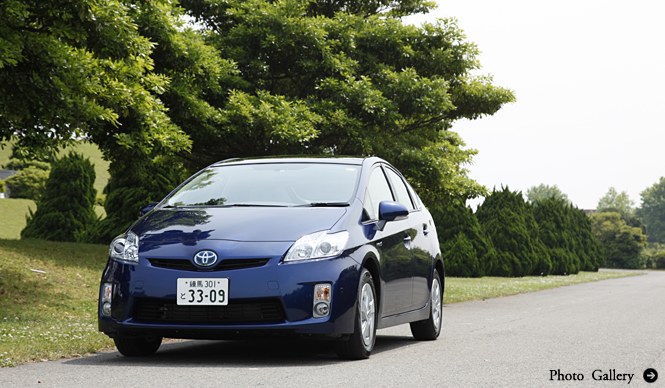
TOYOTA PRIUS | Toyota Prius (Part 1)
TOYOTA PRIUS
A Lifeline for Toyota's Business
The new Toyota Prius, with an unprecedented 140,000 backorders in Japanese automotive history. Arriving four months after the Honda Insight. Esteemed automotive journalist Satoshi Watanabe takes the wheel of the original hybrid car, now making its debut.
By Satoshi WatanabePhotos by Atsuki Kono
Achieving 38km/L Fuel Efficiency
The new Prius, with an unprecedented 140,000 backorders in Japanese automotive history. Its production capacity across two Japanese plants has already been revised upwards, and it is now operating at full capacity, producing 50,000 units per month. Considering this is nearly double the previous generation and it will be exported to 80 countries, this number is extraordinary. It signifies that the Prius has become nothing less than a lifeline for Toyota's business.
The new Prius comes in three grades. The 'S' grade, equivalent to the standard model, and the 'G' grade, which features enhanced interior trim for the upholstery, steering wheel, and other elements. The 'L' grade, priced at the most affordable ¥2.05 million, offers simplified equipment (though still nearly full-featured except for audio) but includes an underbody panel designed for aerodynamic effect, achieving the series' best fuel economy (38km/L) as a true eco-grade. Both the 'S' and 'G' grades are available with an optional Touring Selection specification, which includes 17-inch tires, dedicated suspension, and LED headlights also used in the hybrid versions of the Lexus LS and RX.
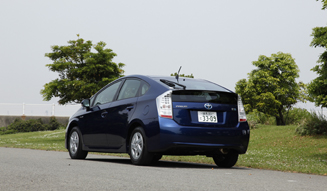
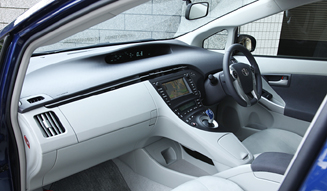
More Elegant Than Any Luxury Car
Twist the ignition key… no, press the button, and the meter illuminates with 'READY,' accompanied by the faint hum of the inverter. This is a familiar moment for Prius owners, but once accustomed to it, the conventional car that runs on burning oil begins to feel rather primitive.
Its silent departure, in a way, appears more elegant than any luxury car. This holds true while driving as well; the quietness in low to mid-speed ranges, where the motor operates extensively and the engine idles almost, can make you feel as though you're in a luxury car three classes above.
With the new Prius, the operational range of the motor has demonstrably increased. The motor, made smaller and capable of higher RPMs compared to the previous model, contributes to cost reduction and was chosen to expand the motor's assistance range into higher speeds. Through a reduction gear, it effectively supports low to mid-speed driving as well.
The planetary gear-based continuously variable transmission, which linearly controls the power distribution between the motor and engine, is the core of Prius technology. The addition of a reduction gear allows for the complete extraction of the motor's benefits. It truly makes one realize that the Prius is a car supported by gears.
Toyota Motor Corporation Customer Relations Center
0800-700-7700
http://toyota.jp