Test Drive the Jaguar I-PACE, the Brand's First Electric Vehicle | Jaguar
Jaguar I-PACE
Test Drive the Jaguar I-PACE, the Brand's First Electric Vehicle
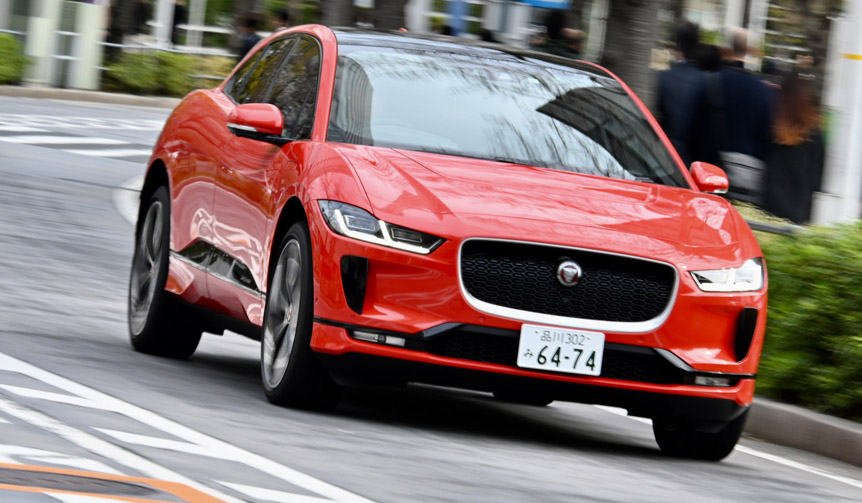
Jaguar, the British marque, developed its mid-size SUV, the “I-PACE” from the ground up as a full battery electric vehicle (BEV). Orders began in Japan last September. It is the latest electric vehicle, launched ahead of its German premium rivals, and the second production BEV SUV after Tesla’s Model X in the US. To ascertain its quality, which earned it the “European Car of the Year 2019” award from European motoring journalists, I participated in a test drive event held in Yokohama.
Text & Photographs by HARA Akira
“Beautiful,” “Fast,” and “Intelligent” Are the Keywords
Globally, there is a growing movement to phase out internal combustion engine vehicles. For example, the UK plans to ban new sales of gasoline and diesel cars by 2040, France has the same goal, Germany aims to ban new sales of internal combustion engines by 2030, China is considering a future ban on the manufacture and sale of gasoline and diesel vehicles, and India aims for 40 percent of new vehicle sales to be electric by 2030.
Furthermore, according to journalists who covered the Geneva Motor Show in March, the venue was dominated by electric vehicles. Against this backdrop, the Jaguar I-PACE, already on sale in Japan, is positioned as a crucial model to propel the EV revolution forward, representing European premium automakers’ early entry into the BEV market. The development keywords are “Beautiful,” “Fast,” and “Intelligent.” Let’s examine each aspect.
A “Beautiful” Exterior
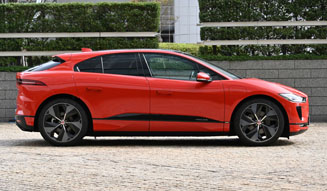
Jaguar is typically associated with long-nose, short-deck sports cars. The I-PACE, however, is the opposite. The long nose, which emphasizes the housing of a powerful, large engine, is unnecessary in an electric vehicle, leading to the adoption of a short-nosed, cab-forward design.
With dimensions of 4,695mm (length) x 1,895mm (width) x 1,563mm (height), it has a body comparable to theF-PACE, but boasts a long wheelbase of 2,990mm. The cabin, with its flowing, one-motion lines, is centered, and large 22-inch wheels are positioned at the four corners of the body, creating a fresh and beautiful style befitting an EV. Jaguar states that this design was inspired by the supercar concept model,C-X75.
The front fascia, on the other hand, is pure modern Jaguar. The familiar Jaguar mascot adorns the center of the large front grille, flanked by Jaguar’s signature “Double J” graphic matrix LED headlights.
A large air scoop is integrated into the bonnet. This not only creates a smooth airflow from the windscreen across the roofline to the rear end but also optimizes the air intake needed to cool components like the battery, motors, and control units. This airflow also prevents raindrops from accumulating on the rear window, eliminating the need for a rear wiper. The door handles are deployable, sitting flush with the body when the vehicle is in motion, contributing to an overall drag coefficient (Cd) of 0.29.
Jaguar I-PACE
Test Drive the Jaguar I-PACE, the Brand's First Electric Vehicle (2)
“Fast” Performance
The I-PACE is equipped with lightweight, compact Jaguar-made permanent magnet electric motors integrated with the axles, one for the front and one for the rear wheels, providing instantaneous torque distribution for all-wheel drive. The combined maximum output is 400ps (294kW) with a maximum torque of 696Nm. Its energy efficiency is 95 percent (compared to about 35 percent for internal combustion engines), enabling it to accelerate its 2,250kg (test vehicle) body to a top speed of 200 km/h and reach 100 km/h in just 4.8 seconds.
The 90kWh lithium-ion battery offers a substantial capacity, providing a maximum range of 438km (Japanese Ministry of Land, Infrastructure, Transport and Tourism certified value) in WLTC mode. For everyday use, drivers can likely travel without worrying about the remaining charge. The 36 battery modules are laid out flat across the floor, low in the vehicle, ensuring a low center of gravity and an optimal 50:50 front-rear weight distribution. Combined with the dedicated aluminum architecture body (94 percent aluminum) that boasts torsional rigidity of 36 kNm/deg, comparable to the F-TYPE sports car, the driving experience promises to be exceptional.
As soon as I drove onto public roads, the acceleration brought a smile to my face. Being an EV, there is no engine noise, and the cabin is remarkably quiet. However, pressing the accelerator instantly shrinks the cars in the rearview mirror, and the speed limit is reached in no time. Releasing the accelerator pedal engages strong regenerative braking, allowing for one-pedal driving where the car can come to a complete stop without using the brake pedal.
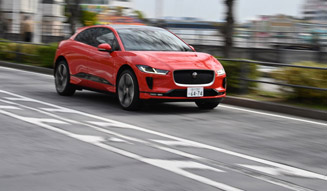
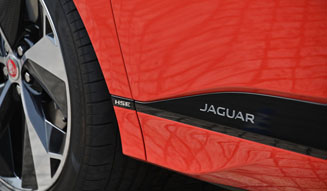
I have driven various EVs before, but the way this heavy vehicle accelerates and decelerates so smoothly and powerfully is undoubtedly top-class performance. Mode selection allows for high (high regeneration) and low (low regeneration) settings. In high mode, deceleration force reaches 0.2G, and when combined with the brake pedal, a total braking and energy generation force of 0.4G is achieved.
The test vehicle (FIRST EDITION) was equipped with optional adaptive dampers. Despite the 22-inch low-profile tires, the ride comfort was not compromised, a testament to its Jaguar heritage. Cornering exhibited minimal body roll, and the steering response, which allowed the car to change direction nimbly, surpassed the typical SUV experience.
It features an Active Sound Design function, allowing the driver to select the driving sound. Selecting “Dynamic” produces a low “Gwooo” sound during acceleration. When I inquired with the PR representative after the drive, they explained that this sound is within the EV range and does not replicate the sound of Jaguar’s high-performance engines, such as those in the classic E-Type.
Creep, which is standard in gasoline cars, can also be turned on or off.
Jaguar I-PACE
Test Drive the Jaguar I-PACE, the Brand's First Electric Vehicle (3)
“Intelligent” Features
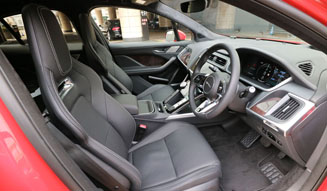
The interior, illuminated by a large UV-cut glass sunroof without a sunshade, feels spacious. The generous rear seating, thanks to the long wheelbase, ensures all occupants enjoy a comfortable ride.
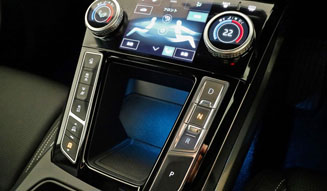
The interior is characterized by the “Touch Pro Duo” infotainment system, featuring 10-inch and 5-inch high-resolution dual touchscreens. The dashboard, with these two screens alongside the digital instrument cluster displaying speed, navigation, and adaptive cruise control status, offers a fresh look. The shift buttons, allowing selection of Drive (D), Neutral (N), Reverse (R), and Park (P) via buttons, are also a novel touch.
The “Smart Settings” feature, incorporating AI learning, is a new technology for Jaguar. It recognizes the driver via the remote key and smartphone. Upon entering the vehicle, the infotainment system and seat position are automatically adjusted. Over time, it further customizes settings based on location, time, weather, and driving patterns.
Additionally, the I-PACE supports over-the-air software updates for the first time in a Jaguar model, delivered wirelessly via the onboard communication module.
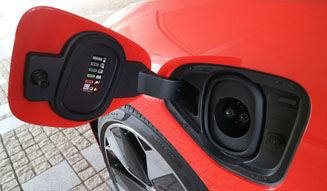
Charging is done via ports located on both front fenders. It supports standard AC charging up to 7kW and DC fast charging via the CHAdeMO standard (50kW in Japan). Jaguar states that charging from 0 to 80 percent takes 85 minutes at 50kW, and a full 100 percent charge takes 12.6 hours at 7kW.
Prices start at ¥9,590,000 for the “S” model, ¥10,640,000 for the “SE,” and ¥11,620,000 for the “HSE.” The “FIRST EDITION,” featuring limited color options like Photon Red, larger wheels, and a panoramic roof, is priced at ¥13,120,000.

Jaguar I-PACE
Body | Length 4,695 x Width 1,895 x Height 1,565 mm
Wheelbase | 2,990 mm
Tread Front/Rear | 1,624-1,641 / 1,647-1,661 mm
Vehicle Weight | 2,208 kg
Motor | 2 units (front axle, rear axle)
Maximum Output | 294 kW (400 ps)
Maximum Torque | 700 Nm
Battery | 90kWh Lithium-ion
Transmission | 1-speed automatic
Drivetrain | 4WD
Brakes Front | Ventilated discs
Brakes Rear | Ventilated discs
Top Speed | 200 km/h
0-100km/h Acceleration | 4.8 seconds
Energy Consumption (WLTP) | 22.0-24.8 kWh/100km
CO2 Emissions | 0 g/km
Range (WLTP) | 415-470 km
Minimum Turning Radius | 5.99 meters
Trunk Capacity | 505 - 1,163 liters
Price (incl. tax) | (S) ¥9,590,000 (SE) ¥10,640,000 (HSE) ¥11,620,000 (FIRST EDITION) ¥13,120,000
*Some specifications are reference values from the home market.
Jaguar Call
0120-050-689 (9:00-18:00, excluding Saturdays, Sundays, and holidays)