A Japanese Car for Japan: Test Drive of the Toyota Crown | Toyota
Toyota Crown
A Japanese Car, Made by Japanese
Test Drive the Crown
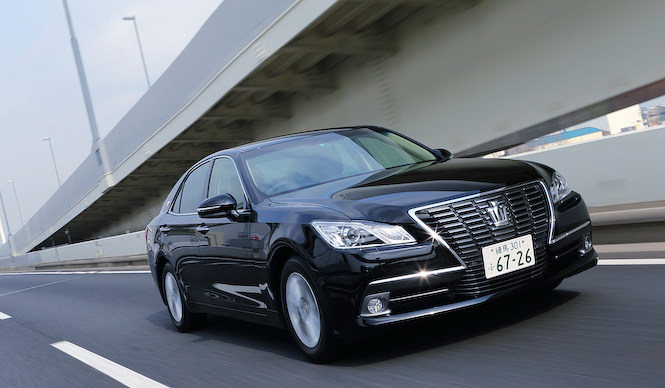
With the slogan, "What this country lacks now is the power to change," the new Crown boldly embraces transformation. This car possesses a unique Japanese worldview, distinct from imported vehicles. The Crown, which once brought about significant change in Japanese motorization, is now the focus of OPENERS as a representative of Japanese cars.
Text by OGAWA Fumio
Photographs by ARAKAWA Masayuki
The Hybrid is a Big Hit
The best-selling model of Toyota's new "Crown" is the hybrid. While hybrids are now common in European luxury cars, the Crown, Toyota's flagship model, which has long embraced hybrid technology, left a lasting impression with its agile driving performance.
The new Crown is selling exceptionally well. According to Toyota's announcement, orders received from its launch on December 25, 2012, to January 29, 2013, totaled 25,000 units, more than six times the monthly sales target of 4,000 units. The hybrid model forms the core of these sales, accounting for approximately 66 percent of all Crown models.
Large sedans are a forte of German manufacturers, but the development team states, "We want people in Japan to understand that the Crown is the most user-friendly car in terms of size and handling."
True to their word, the car's width is not excessively large, and the steering, with its wide turning angle, offers a more compact and responsive feel than expected. This remains an advantage over imported cars.
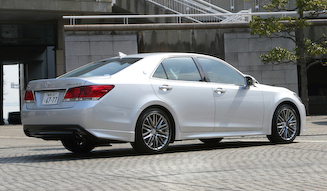
Another significant appeal is the price. The new "Crown Hybrid" is priced from 4.1 million yen.
Comparing this to imported cars, it's comparable to the "C-Class" C-Class, with the most basic grade "C 180 BlueEFFICIENCY" (3.99 million yen), and lower than the "3 Series" basic grade "320i" 6MT model (4.39 million yen). Furthermore, its excellent fuel efficiency, especially in city driving, makes the current situation where the Crown is selling well, with hybrids accounting for about 70 percent of sales, understandable.
Toyota Crown
A Japanese Car, Made by Japanese
Test Drive the Crown (2)
How is the Hybrid Athlete G?
We test drove the hybrid "Athlete G" (5.43 million yen). What's impressive first is the power in EV mode, using only the electric motor. On flat roads, it can travel up to about 50 km/h in EV mode. While the engine starts up after that, which can be seen on the meter, you might not even notice it by feel.
"We had two challenges," says a Toyota development engineer. "First, to achieve the same smoothness as the V6 engine it replaced, using an inline four-cylinder Atkinson cycle engine. Second, to make the transition from EV mode to engine startup as seamless as possible."
As they say, the Crown Hybrid offers an exceptionally natural driving feel. Torque from the electric motor is available from very low RPMs, and as acceleration continues, the driving mode switches seamlessly, as if handing over the baton to the low-vibration 2.5-liter engine. As mentioned earlier, if you operate the accelerator pedal gently on flat roads, you can drive in EV mode up to about 50 km/h, and it functions as an electric vehicle until the battery charge drops below a certain level.
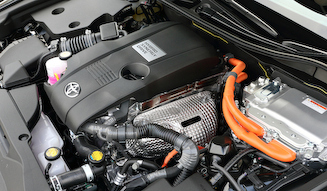
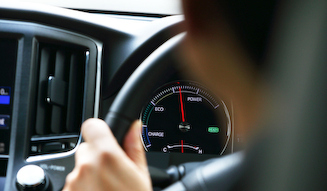
The driving feel is far more natural than the Prius, showcasing the technological advancements of Toyota's unique hybrid system, "THS-II." This makes one wonder if they could evolve it further into a range-extender hybrid, where the engine is smaller and the electric motor covers a wider range.
However, as Toyota engineers state, "One of our objectives was to improve handling performance by minimizing the amount of nickel-cadmium batteries and optimizing their placement," the Crown, with its gasoline engine making up 30 percent of its power, had to strive for excellence in all aspects – driving, handling, and braking – as Toyota's flagship. There must have been immense effort poured into this.
Toyota Crown
A Japanese Car, Made by Japanese
Test Drive the Crown (3)
Handling That Remains Faithful to the Driver
When cornering, despite a somewhat vague feel around the center, the car smoothly tucks its nose inward as you turn the wheel, and with great stability, it powers through to the exit of the curve. The posture remains flat, offering a sense of enjoyment reminiscent of BMW.
I found the driving experience of the Crown series, including the 2.5-liter V6 Royal Saloon and the 3.5-liter V6 Athlete, to be enjoyable. However, the hybrid version exceeded my expectations in terms of driving pleasure.
Acceleration during partial throttle is strong, meaning the car can be driven with considerable fidelity to the driver's intentions.
Some German cars deliberately introduce a larger initial body roll to reduce cornering entry speed or send messages to the driver through their tuning. The Crown, however, remains strictly faithful to the driver.
While some might find this lacking, I believe it allows for good communication.
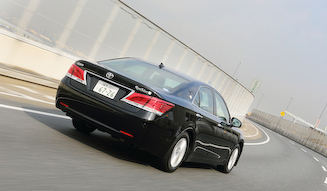
Road noise is relatively quiet while driving. Efforts have been made everywhere, such as intentionally placing air intakes for the electric motor cooling on both sides to reduce intrusive noise, but still, one might feel that the gasoline car is quieter. Nevertheless, it's not "loud" or "obtrusive."
Toyota Crown
A Japanese Car, Made by Japanese
Test Drive the Crown (4)
Beyond the Hybrid: Other Attractive Options
The lineup for the new, 14th-generation Crown is broadly divided into two series: the Royal and the Athlete.
The Royal series includes the "Royal," "Royal Saloon," "Royal Saloon i-FOUR," and the hybrid. Excluding the hybrid, the engines are all 2.5-liter V6.
The Athlete series, on the other hand, consists of the 2.5-liter V6-equipped "Athlete" and "Athlete i-FOUR," as well as the 3.5-liter V6-equipped "Athlete S" and "Athlete S G," and the hybrid.
While the hybrid is exceptionally well-executed, if you truly want to experience the essence of the 14th-generation Crown, I recommend the Athlete with the 3.5-liter engine. In a word, it's exhilarating.
The development engineers confidently state, "We built this for those who want to enjoy driving without worrying about fuel economy." It succeeds in all aspects: the explosive power of the gasoline engine, the vehicle's controllability, and the balance of sportiness and comfort. While priced at 4.97 million yen, whether this is considered high or low is a subtle matter.
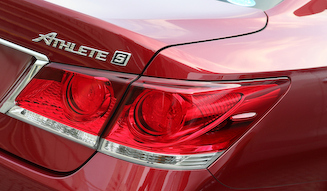
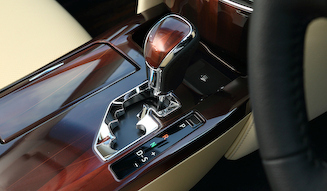
While the previous generation was also well-made, this iteration offers an even more profound sense of driving enjoyment.
The drawbacks, if any, are the somewhat aggressive front grille – leaving one to wonder about Toyota's direction for the Crown – and the fabric seat upholstery, which has a texture reminiscent of a stuffed animal, betraying a lack of international aesthetic sensibility (similarly, the wood paneling evokes the feel of a Nishijin-ori tie). This is a shame. A real shame.
Toyota Crown Hybrid Athlete G
Body Dimensions | Length 4,895 x Width 1,800 x Height 1,450 mm
Wheelbase | 2,850 mm
Tread Front/Rear | 1,545 / 1,545 mm
Minimum Ground Clearance | 135 mm
Weight | 1,680 kg
Engine | 2,493cc Inline 4-cylinder Direct Injection DOHC (D4-S)
Maximum Output | 131kW (178ps) / 6,000 rpm
Maximum Torque | 221Nm (22.5kgm) / 4,200-4,800 rpm
Motor Output | 105kW (143ps)
Motor Torque | 300Nm (30.6kgm)
System Maximum Output | 162kW (220ps)
Transmission | Electronically Controlled Continuously Variable Transmission
Drivetrain | FR
Tires | 215/55R17
Fuel Economy (JC08 mode) | 23.2 km/ℓ
Price | 5.43 million yen