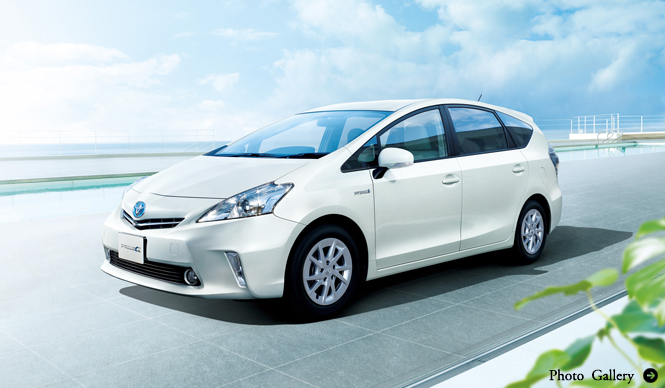
TOYOTA PRIUS α | Toyota Prius α: A Test Drive of the Premium "G" Grade
TOYOTA PRIUS α | TOYOTA PRIUS α
Test Drive: The Wagon Version of the Prius (1)
We test-drove the Prius α (Alpha), Toyota's wagon variant of the Prius hybrid. While it offers a model equipped with a compact, lightweight lithium-ion battery, its refined ride and overall sophistication are particularly impressive.
By Fumio Ogawa
Equipped with a Newly Developed Lightweight, Compact Lithium-Ion Battery
The Prius α is a derivative of the Prius, marketed by Toyota with "spacious interior room" as its key selling point. It was released on May 13, 2011. Like the conventional Prius, it features Toyota's "THS II" hybrid system, combining a 1.8-liter gasoline engine with an electric motor. However, the wheelbase has been extended by 180mm, with overall length increased by 155mm, width by 30mm, and height by 85mm. Notably, it also offers a choice between a 5-seat, 2-row configuration and a 7-seat, 3-row layout. Furthermore, it is equipped with a newly developed, lightweight, and compact lithium-ion battery.
The model I test-drove was the 7-seater "G" grade, the higher trim level of the Prius α, priced at 3 million yen. While the platform, shared with the Mark X GEO, contributes to a larger body and extended roofline, the design's upward kick on the line below the rear quarter windows gives it a stronger family resemblance to the conventional Prius hatchback rather than a typical station wagon. This was my first impression. In reality, careful consideration for its wagon-specific design is evident throughout, such as revised aerodynamic elements on various body parts and the "as far outward as possible" placement of the rear combination lamps.
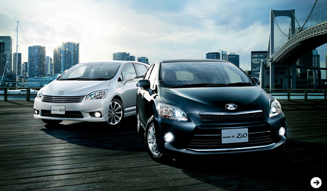
MARK X GEO
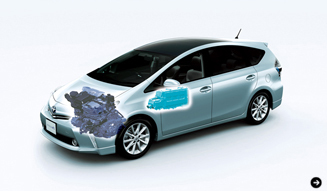
The blue section depicted in the center of the body indicates the location of the lithium-ion battery.
A key feature is the adoption of a compact, lightweight, and high-performance lithium-ion battery. Toyota's experience with this type of battery dates back to the start-stop system in the first-generation Vitz. "So, technically, we've been familiar with batteries for a long time," says an engineer involved with the Prius α. In this full-scale implementation, its compact size allows it to be housed in a box-type unit within the center console between the front seats. However, this battery is exclusively used in the 7-seater "G" model of the Prius α. Chief Engineer Satoru Ogiso explains, "For the 5-seat, 2-row configuration, the conventional nickel-hydrogen battery is installed in the luggage compartment, but with the addition of extra seats, there was no space for the battery."
While lithium-ion batteries are said to offer more than double the performance of nickel-hydrogen batteries of the same size, the Prius α leverages this performance difference by limiting its output to match that of nickel-hydrogen batteries while halving its size. "The potential of lithium-ion batteries is high, but even if we gave it three times the performance, the Prius α couldn't utilize it. So, we used the performance difference to reduce the size," the engineer states. Although the ultimate handling limits are unknown, Toyota asserts that the driving characteristics remain the same regardless of the battery's placement for normal driving.
TOYOTA PRIUS α | TOYOTA PRIUS α
Test Drive: The Wagon Version of the Prius (2)
Newly Adopted System for Improved Ride Comfort by Controlling Body Vibrations
Upon driving, the initial impression is one of nimble acceleration, belying the approximately 140kg increase in vehicle weight. In low-speed driving, the EV mode delivers surprisingly strong acceleration from its 60kW electric motor, a characteristic familiar to existing Prius owners. The engine starts and stops frequently, synchronized with the driving mode. Both the vibration and noise during engine startup are remarkably low, to the point where you wouldn't notice it unless you were looking at the instrument panel. The real-time fuel economy displayed on the hybrid system indicator encourages economical driving, leading one to ponder if the primary reason for hybrid cars being "eco-friendly" is actually the driver's self-restraint.
Another welcome discovery in the Prius α is its exceptionally flat ride, particularly during high-speed driving. The car remains stable, without any jarring vertical movements. This is thanks to a new mechanism called "body vibration control," which uses motor vibrations to manage pitch caused by road inputs. Without any driver input on the accelerator, the vehicle automatically adjusts torque: weakening it when the car's nose lifts and strengthening it when it dips. Toyota claims this not only improves ride comfort but also "enhances tire contact, leading to better steering feel." This control system is being implemented for the first time in the Prius α.
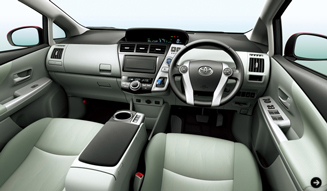
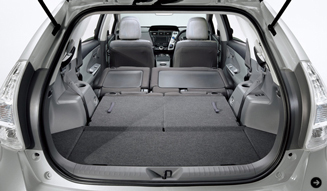
While the drive is quiet in the city, at speeds close to 100 km/h, exhaust noise and other sounds from the engine become noticeable (sound insulation is an ongoing challenge for the Prius). Overall, however, it is undoubtedly a car that provides a sense of contentment. In the 2-row seat configuration, the luggage capacity is increased by 195 liters compared to the Prius, allowing for larger items and improving usability. In the 3-row seat version, surprisingly, there is no feeling of cramped legroom or headroom for passengers. This is likely due to meticulous attention to seat cushion thickness and other factors to maximize space. However, the resulting flat seat cushions might raise concerns about comfort on long journeys, which would require actual long-distance testing to determine.
If there's one issue with the Prius α, it's the delivery time. "Currently, the production capacity for models equipped with lithium-ion batteries is around 1,000 units per month. We expect to fulfill the backlog of over 10,000 orders around April 2012," states Chief Engineer Ogiso.
TOYOTA PRIUS α | TOYOTA PRIUS α
Test Drive: The Wagon Version of the Prius (3)
Lithium-ion Batteries Cannot Be Recycled; What Will Power the Next Generation?
Toyota Motor Corporation has been relatively cautious about adopting lithium-ion batteries, partly due to the difficulty of recycling them. Conventional nickel-hydrogen batteries contained precious metals like nickel, making them profitable to reclaim and sell when nickel prices were high. Recycling companies find lithium-ion batteries less appealing as this economic incentive is absent. Establishing a viable recycling system for these batteries presents a significant challenge. This is a crucial issue that must be addressed for hybrid and electric vehicles.
Another challenge for lithium-ion battery vehicles is the improvement of electric motor performance. As mentioned earlier, even if the performance of lithium-ion batteries is enhanced (current top-tier batteries are reportedly near their potential limits), it is meaningless if the overall system, including the electric motor, cannot fully utilize that power. This necessitates upgrading the entire system. However, the investment required for such upgrades is substantial, especially since hybrid systems themselves can be considered transitional technology. There is a risk that as the market expands, technology will advance further, rendering current products obsolete. Balancing these factors is difficult. While the future may involve smart cities and smart homes integrating electric vehicles with power generation and transmission infrastructure (and private generation), there is no single "correct path" to definitively declare at this moment.
"Naturally, automotive batteries will continue to evolve. In the future, technologies like air batteries, which use oxygen from the air as a cathode, may become practical for car batteries. Our job is to ensure they reach a level of durability and reliability that is fully trustworthy, in addition to their performance," says Satoru Ogiso, Chief Engineer for the Prius α.