The BMW i Incident | BMW
BMW i
A Turning Point in the Company's 100th Year
The BMW i Phenomenon
Aiming to realize sustainable mobility for the next generation, BMW has launched a new sub-brand, BMW iIn the midst of its 100-year history, how is BMW tackling its greatest challenge? With the first i-series model, the compact EV "i3," now available in the Japanese market and its full-scale rollout beginning, we delve into its essence once more.
Text by OTANI Tatsuya
A Beloved Brand on Par with M
Even though I feel like I've seen it countless times, my interest never wanes. Why does BMW i attract so much attention? Frankly, EVs themselves are not exactly rare. Nor are cars made with carbon composite (though the "i3" is likely the first at around 5 million yen with a carbon composite body).
Nevertheless, the reason BMW i has become something of a social phenomenon is likely due not only to the product's advanced technology but also to the abundance of news surrounding this project.
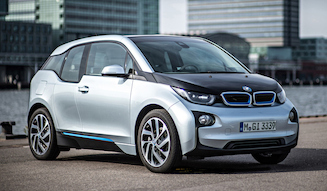
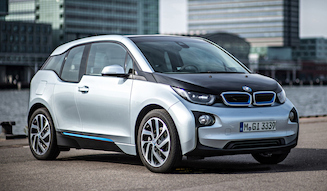
BMW i3
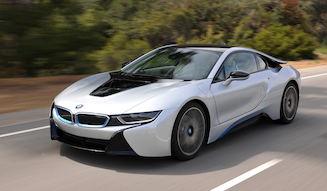
BMW i8
First, it's novel that BMW, which has a strong image of high-performance cars, has created an eco-car using cutting-edge technology. Moreover, they haven't just released a one-off product; they've established a sub-brand, BMW i, comparable to BMW M, and have publicly stated their intention to continuously sell EVs and PHVs.
This is an event that can be called a major turning point for BMW as an automobile manufacturer, and it also serves as a reminder of the significant responsibility manufacturers bear regarding CO2 emission reduction.
However, perhaps it's only Japanese fans, or just me, who struggle to associate BMW with eco-friendliness. The Dow Jones Sustainability Index, selected by the publisher of The Wall Street Journal, has ranked BMW as the top automotive manufacturer in its sector for eight consecutive years, and recognized it as a sustainable company for 15 consecutive years.
This index evaluates not only product sustainability but also corporate governance, compliance, and even working conditions. While it has a broader meaning than the term sustainability commonly used in the automotive industry, there is no doubt that BMW is a company highly conscious of fulfilling its social responsibilities.

Towards connected mobility, BMW's new brand, BMW i, was born in February 2011.
BMW i
A Turning Point in the Company's 100th Year
The BMW i Phenomenon (2)
From Production to Recycling
Another significant characteristic of BMW i is its commitment to reducing environmental impact not only in terms of CO2 emissions during operation but also in the production and disposal stages. For example, the raw material for the carbon fiber used in the "i3" and "i8" (PAN precursor) is produced by Mitsubishi Rayon in Hiroshima Prefecture, Japan, and then fired into carbon fiber at the SGL ACF plant in Moses Lake, Washington, USA.
Firing, in this context, means heating, which normally consumes a large amount of electricity. However, the Moses Lake plant receives its power from a nearby hydroelectric power station, allowing it to fire carbon fiber without any CO2 emissions. The carbon fiber produced here is then transported across the Atlantic to Germany, where it is "woven" into layers for CFRP at another SGL ACF facility in Wackersdorf before being brought to BMW's plant to be finished into a carbon body.
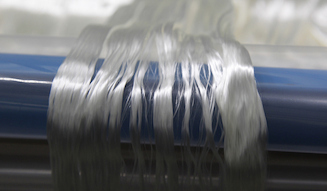
The raw material for carbon fiber (PAN precursor) produced by Mitsubishi Rayon in Hiroshima Prefecture.
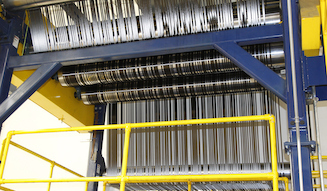
Processing from PAN precursor to carbon fiber.
Incidentally,the BMW i3 production plant in Leipzig, Germany,is entirely powered by four wind turbines (2.5 MW output) located on-site, making CO2 emissions effectively zero here as well.
The automotive industry is typically an equipment-intensive sector where large presses are indispensable. Conversely, profitability has been said to depend on how efficiently in-house facilities are utilized. While there was a demand for reduced CO2 emissions on one hand and the solution of lightweighting vehicles with aluminum and carbon on the other, the slow adoption of these new materials was partly influenced by the automakers' desire to maximize the use of existing facilities.
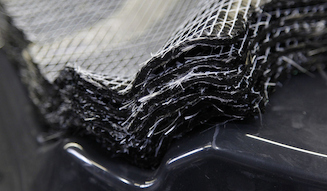
Pre-formed carbon fiber stacks.
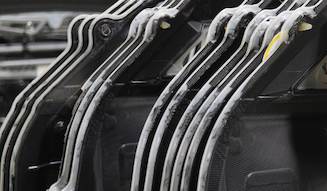
Completed CFRP body components.
However, for BMW i, the entire process from production to recycling was planned from a clean slate. It goes without saying that this almost unlimited discretion greatly contributed to achieving the goal of minimizing CO2 emissions.
BMW i
A Turning Point in the Company's 100th Year
The BMW i Phenomenon (3)
BMW's Japanese Designer
Another distinctive feature of BMW i is how its green image is effectively reflected in its design.
While instantly recognizable as a BMW, the design language of BMW i, which sets it apart from previous BMWs, appears to have involved the participation of Joji Nagashima, a Japanese designer at BMW.
At a BMW design presentation held last June, Nagashima stated, in essence, "BMW has traditionally had a design that clearly shows it's made from hard, cold steel. However, we deliberately attempted a design that breaks from this tradition, and it was adopted as the design for BMW i." Indeed, both the BMW i3 and i8 possess a certain lightness and warmth in their design, seemingly imbued with Nagashima's intentions.
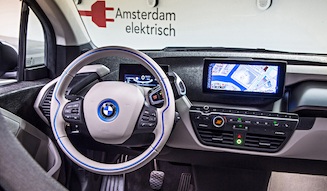
The interior of the i3, enveloped in an organic atmosphere.

Kenaf, a plant, used for interior materials.
The interior, in contrast, is enveloped in an organic atmosphere. The wood retains its natural texture with minimal lacquer, and the dashboard's upper surface is covered with carpet made from kenaf, a plant that grows rapidly during the monsoon season in Bangladesh. The overall impression is one that immediately conveys, "This car must be environmentally friendly."
Apparently, this design was chosen because preliminary research targeting the general public revealed a desire to "feel like they are driving an environmentally friendly car even when inside it."
BMW i
A Turning Point in the Company's 100th Year
The BMW i Phenomenon (4)
i3 Production Plan
The resulting i3 can travel 130-160 km on a single charge and accelerates from 0 to 100 km/h in 7.2 seconds. Furthermore, it adheres to BMW's traditional car-making principles with a 50:50 front-rear weight distribution and rear-wheel drive. By placing the battery low in the floor, they have also succeeded in lowering the center of gravity. It has achieved the agility befitting the BMW name.
So, will the BMW i3 be a commercial success? SGL ACF, which supplies carbon fiber to BMW, recently announced plans to triple production by early 2015 and has begun constructing the necessary production facilities. Tripling production in just about a year and a half since its inception is surprising, but it can be seen as proof of the i3's strong sales. Incidentally, the i3 is being produced at a pace of about 100 units per day, with approximately 5,000 units having rolled off the line by May 2014.
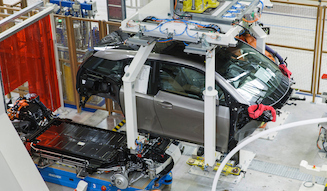
Joining of the Life Module and Drive Module.
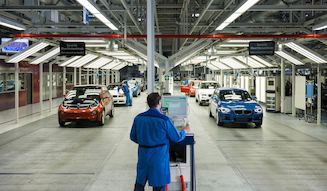
Final inspection before shipment.
Meanwhile, some rival manufacturers have commented, "There's no way the i can be profitable," regarding the i3's price of 4.99 million yen (including 8% consumption tax; the version with a range extender offering a 300 km range is 5.46 million yen). However, BMW's Senior Vice President Klaus Draeger stated the following at the i8 international press event:
"The i3 is generating a solid gross profit. However, if you ask whether we can recoup all the R&D costs invested so far, that might be difficult. Nevertheless, we are pursuing BMW i because we believe it is necessary for the future of mobility." In other words, the i3 and i8 are not just new products; they are cars that embody BMW's philosophy and future direction.

BMW i3
Body Dimensions | Length 4,010 × Width 1,775 × Height 1,550 mm
Wheelbase | 2,570 mm
Tread (Front/Rear) | 1,575mm / 1,560 mm
Minimum Ground Clearance | 110 mm
Weight | 1,260 kg
Drive Battery | 1 Lithium-ion battery (96 cells)
Maximum Output | 125 kW (170 ps) / 5,200 rpm
Maximum Torque | 250 Nm (25.5 kg) / 100-4,800 rpm
Drivetrain | RR
Suspension (Front/Rear) | Strut / Multi-link
Brakes (Front/Rear) | Ventilated discs
Tires (Front/Rear) | 155/70R19
0-100 km/h Acceleration | 7.2 seconds
Minimum Turning Radius | 4.6 meters
Trunk Capacity | 260-1,100 liters
Maximum Speed | 150 km/h
Range per Charge (JC08) | 229 km
Price | 4.99 million yen
BMW i3 (with Range Extender)
Body Dimensions | Length 4,010 × Width 1,775 × Height 1,550 mm
Wheelbase | 2,570 mm
Tread (Front/Rear) | 1,575mm / 1,540 mm
Minimum Ground Clearance | 110 mm
Weight | 1,390 kg
Drive Battery | 1 Lithium-ion battery (96 cells)
Maximum Output (Electric Motor) | 125 kW (170 ps) / 5,200 rpm
Maximum Torque (Electric Motor) | 250 Nm (25.5 kg) / 100-4,800 rpm
Generator Engine | Inline 2-cylinder DOHC 4-valve
Maximum Output (Generator Engine) | 28 kW (38 ps) / 5,000 rpm
Maximum Torque (Generator Engine) | 56 Nm (5.7 kg) / 4,500 rpm
Drivetrain | RR
Suspension (Front/Rear) | Strut / Multi-link
Brakes (Front/Rear) | Ventilated discs
Tires (Front/Rear) | 155/70R19 / 175/60R19
0-100 km/h Acceleration | 7.9 seconds
Minimum Turning Radius | 4.6 meters
Trunk Capacity | 260-1,100 liters
Maximum Speed | 150 km/h
Hybrid Fuel Economy (JC08) | 27.4 km/ℓ
Range on Charged Electricity | 196.1 km
Price | 5.46 million yen
BMW i Customer Interaction Center (Open daily, 9:00 - 20:00)
 0120-201-438