Experience the Future of Audi | Audi
Audi Future Lab tron-experience
Audi Future Lab tron-experience
Audi's Future Experience
This year, too,AudiAt the Future Lab, Audi presented its vision for sustainable mobility. This time, it was an experience. Can emission-free cars become a reality? The various ideas proposed last time are increasingly gaining traction. Here is a report from Tatsuya Otani.
Text & Some photographs by OTANI Tatsuya
Why Both Cars and Energy Must Change
The "Audi Future Lab tron-experience" was held in Berlin.
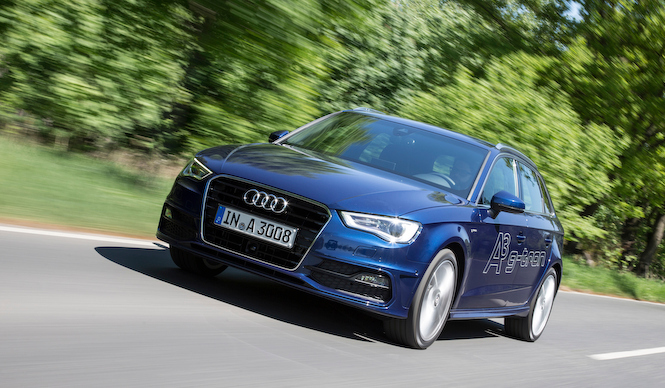
As the name suggests, "experience" implies an event centered around trying out the vehicles. Indeed, this time we were able to test drive three prototype vehicles: theA3 Sportback g-tron, the EV version of theR8called theR8 e-tron, and theA1equipped with a range extender system, theA1 e-tron.
Quite a luxurious lineup.
However, Audi's message at this event was not solely about showcasing the next generation of automobiles or the advanced technology they employ.
As was made clear at the "Audi Future Lab Mobility" held last autumn, Audi considers next-generation vehicles in conjunction with their energy supply methods.Audi Future Lab MobilityAs was made clear at the "Audi Future Lab Mobility" held last autumn, Audi considers next-generation vehicles in conjunction with their energy supply methods.
This is their philosophy: truly environmentally friendly mobility cannot be achieved otherwise.
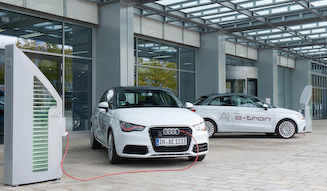
Why must next-generation vehicles be considered alongside their fuel sources?
For example, electric vehicles (EVs), generally considered environmentally friendly, emit no CO2 while driving. However, CO2 is emitted during electricity generation at power plants. In other words, the difference between EVs and conventional cars is merely whether CO2 is emitted at the power plant or during driving.
So, how much CO2 is emitted at power plants? For the 2013 NissanLeaf, CO2 emissions are 84.2g per kilometer driven. The current Audi A3 with a 1.4-liter TFSI engine emits approximately 150g/km of CO2. This means the Leaf emits just over half the CO2. Isn't this figure surprisingly low?
Making EVs Viable
However, the calculation above is based on electricity generated at a thermal power plant. This figure includes CO2 emissions from power plant construction but does not account for losses during electricity transmission from the power plant to homes. Furthermore, since the fuel efficiency data refers to the JC08 mode, it's entirely possible that emissions are higher than 84.2g/km in real-world driving.
But there is a way to dramatically improve this number: generate electricity using renewable energy sources like solar or wind power. In that case, even including CO2 emissions from power plant construction, CO2 emissions can be reduced to 4.3g/km for solar power and 2.9g/km for wind power. At this point, EVs can be considered definitively advantageous.
Therefore, as you can see, even when driving the same EV, the amount of CO2 emissions varies significantly depending on how the electricity is generated and where the energy comes from.
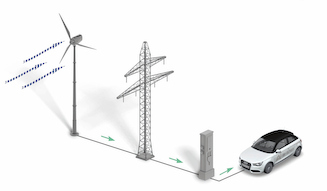
This is precisely why Audi considers next-generation vehicles and their energy supply as a package.
Audi Future Lab tron-experience
Audi Future Lab tron-experience
Audi's Future Experience (2)
Will the g-tron Reduce Global CO2?
Take, for example, the "A3 Sportback g-tron" (hereafter referred to as A3 g-tron) that we test drove this time.
This model, based on the third-generationA3 Sportbackalready released in Germany, is a bi-fuel car that can run on either gasoline or natural gas. Its 1.4 TFSI engine, producing 110ps, runs briskly on natural gas, and of course, it offers the agile handling characteristic of the latestAudimodels. However, the crucial aspect lies in the production process of its fuel, Audi e-gas.
This was explained in detail at the "Audi Future Lab Mobility" held last autumn. What's novel is the generation of e-gas (chemically, methane gas) using surplus electricity from wind power.
Electrolysis of water (H2O) yields hydrogen (H2) and oxygen (O2). Hydrogen obtained here is then combined with the 'C' (carbon) from CO2 captured from the air to form CH4, which is methane. The surplus electricity mentioned earlier is used for water electrolysis.
Furthermore, because CO2 is consumed in the process of generating methane, the production of e-gas not only avoids CO2 emissions but actually consumes CO2. In other words, e-gas is not CO2 neutral but "CO2 negative."
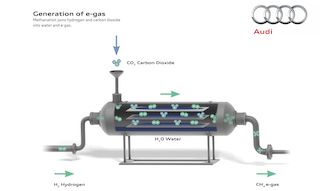
To what extent is it negative? It is said that 95g of CO2 is consumed to produce the methane needed for 1km of driving. However, since the construction of this facility emits 20g of CO2 per kilometer driven, a net of 75g of CO2 is consumed.
On the other hand, the A3 g-tron emits 95g of CO2 per kilometer driven. When the same A3 g-tron runs on gasoline, its CO2 emissions are 113g/km. The difference in figures can be attributed to the properties of the fuel.
In other words, cars running on natural gas (CNG) are more environmentally friendly than those running on gasoline, but they still emit a non-negligible amount of CO2. Even CNG vehicles cannot avoid CO2 emissions, as they extract energy by burning fuel.
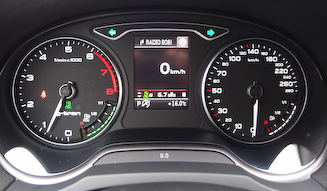
The meter displays the remaining fuel for both gasoline and CNG.
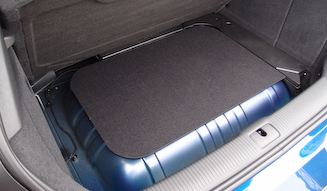
The CNG tank is stored under the luggage floor.
Meanwhile, e-gas consumes 75g of CO2 during its production. This means that even if it emits 95g/km of CO2 while driving, when offset by the CO2 consumed during energy production, only 20g/km of CO2 is generated. While this is not as good as an EV running on renewable electricity, it means significantly lower CO2 emissions than an EV running on electricity from thermal power plants.
Renewable energy accounts for only about 1% of Japan's total electricity generation, with thermal power accounting for nearly 80%. Therefore, it can be argued that the A3 g-tron running on e-gas has lower CO2 emissions than an EV running on Japanese electricity.
Audi Future Lab tron-experience
Audi Future Lab tron-experience
Audi's Future Experience (3)
How to Buy e-gas
Currently, e-gas can only be produced at a pilot plant in Werlte, Germany. The annual production volume there is about 1,000 tons, which is equivalent to the amount needed for approximately 1,500 A3 g-tron vehicles to drive about 15,000 km annually.
This is a negligible amount compared to Germany's total natural gas consumption. This raises the question of where to obtain this precious fuel.
Therefore,Audihas announced plans to feed this e-gas into Germany's nationwide natural gas supply network. They have decided to sell the right to purchase e-gas through a settlement system using a dedicated card (Audi e-gas Fuel Card).
This system, which allows one to virtually purchase renewable energy by bearing the additional cost of its generation, regardless of how the consumed energy was actually produced, is similar in concept to Japan's green electricity certificates. This eliminates the inconvenience and waste of traveling to distant CNG stations in search of e-gas. It is truly an intelligent system.
The Audi e-gas Fuel Card can only be purchased by users of the A3 g-tron. The A3 g-tron itself is scheduled for market release at the end of 2013 (release in Japan is undecided).
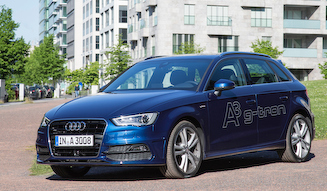
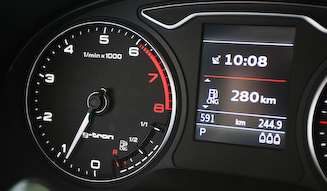
With a range of 400 km on CNG alone and 900 km on gasoline alone, the A3 g-tron's price is said to be "just the cost of the CNG tank and fuel system conversion added to a regular A3," making it potentially an exceptionally affordable price for this type of next-generation vehicle.
Audi Future Lab tron-experience
Audi Future Lab tron-experience
Audi's Future Experience (4)
EVs Aren't Cars!?
Currently, the German government is leading a demonstration project for electric vehicles (EVs) called "Electric Mobility Showcase." A major drawback of EVs highlighted here is their limited range.
While a range of 200 km plus alpha seems acceptable to consumers in Japan, in Europe, where long-distance travel by car is common, especially in Germany, this range is apparently insufficient for a car.The R8 e-tron, which will be introduced in a separate section, has had its release postponed indefinitely, reportedly for this very reason.
Developed based on this philosophy is theA3 Sportback e-tron(hereafter referred to as A3 e-tron). This is also based on the third-generation A3 equipped with a 1.4-liter TFSI engine.
Audi's plug-in hybrids. We have previously introduced theA1 e-tron Dual Mode Hybrid(hereafter referred to as A1 DMH), but the A3 e-tron employs a different type of hybrid system.
The A1 DMH operates on a concept similar to a range extender. Normally, it uses the engine to turn a generator, producing electricity to drive the motor (it also has a separate battery).
However, when the motor alone is insufficient, the generator acts as the motor, and the engine's power is also used to drive the front wheels via a clutch, which was a novel feature.
In essence, it normally drives like an EV using electric power, and when necessary, it can also drive like a hybrid car using the engine's power. The name "Dual Mode Hybrid" likely derives from this.
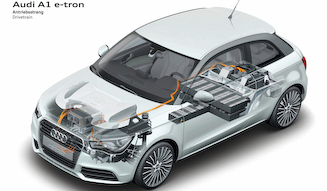
This is the dual-mode hybrid version of the Audi A1 e-tron.
Incidentally, since the A1 DMH is primarily an EV, it lacked a transmission, just like other EVs. It had a simple drivetrain with one forward and one reverse gear.
In comparison, the A3 e-tron is much closer to a conventional hybrid car.
The basic configuration is the same as the AudiA6 Hybridand the latestBMWActive Hybrid: the engine, motor, gearbox, and drive wheels are connected in series. Furthermore, there are clutches between the engine and motor, and between the motor and gearbox. Since this gearbox is a 6-speed dual-clutch automatic, there are two clutches between the motor and the gearbox, resulting in a total of three clutches in the powertrain.
As mentioned earlier, the A3 e-tron's engine is a 1.4 TFSI producing 150ps and 250Nm.
The motor boasts a powerful maximum output of 102ps and a maximum torque of 330Nm. The system as a whole delivers a formidable 204ps and 350Nm of torque.
As a result, it achieves impressive performance figures: a top speed of 222 km/h and 0-100 km/h acceleration in 7.6 seconds. The battery capacity is 8.8 kWh, allowing for approximately 50 km of electric-only driving.
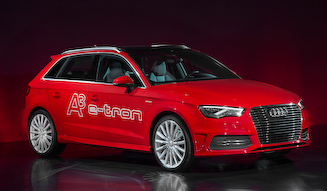
Audi A3 Sportback e-tron
Unfortunately, we couldn't test drive the A3 e-tron, which is expected to be released at the end of this year or early next year. However, we did have the opportunity to drive the A1 e-tron. This is not the DMH, but an evolved version of the model announced in 2010, featuring a single-rotor engine as a range extender. Key enhancements include an increase in the motor's maximum output from 75kW to 85kW and an increase in battery capacity from 12kWh to 13.3kWh. Correspondingly, the engine's displacement has been increased from 254cc to 354cc, with its maximum output raised by 10kW to 25kW, while maintaining the single-rotor configuration.
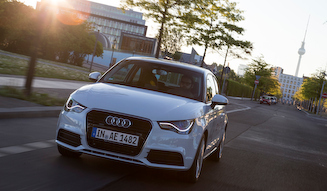
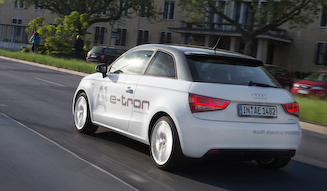
As for the driving experience, the test drive was limited to within the 50 km range of electric-only driving, so the engine never activated. Consequently, it felt exactly like a conventional EV. However, since the smooth-running Wankel engine (rotary engine) operates at a constant speed solely to charge the battery, it's possible we wouldn't have noticed it even if it had started...
Audi Future Lab tron-experience
Audi Future Lab tron-experience
Audi's Future Experience (5)
Not an Unattainable Dream
This event also featured the Le Mans car, the "R18 e-tron quattro." This racing car, powered by a V6 turbo diesel engine producing 510ps and 850Nm, along with an electric motor generating 150kW to drive the front wheels, is both a quattro and a hybrid car.
However, it operates as a quattro only below 120 km/h, and it employs a unique method of regenerative energy storage using a flywheel instead of a battery.won the 2012 24 Hours of Le Mansand earned the distinction of being "the first hybrid car to win Le Mans." This is a testament to Audi's philosophy of viewing racing as a "running laboratory."
While last autumn's "Audi Future Lab Mobility" was somewhat academic, this "Audi Future Lab tron-experience" more clearly demonstrated the feasibility of next-generation vehicles and energy supply methods through test drives of prototype vehicles.
Michael Krieger, in charge of e-fuels, whom we met again after about six months, informed us, "The e-diesel project faced a temporary setback due to issues with the separation of water and diesel fuel, but these have now been resolved, and development is progressing smoothly."
Audi's future may be closer than we think.