Audi's Future Energy | Audi
Audi Future Lab
Audi's Vision for Future Society: Part Two
Audi Future Energy
Regulations on environmental impact caused by automobiles are becoming increasingly strict. The idea of banning engine operation in urban areas, or the prospect of mandatory fuel efficiency of 33 km/L or more by 2025, are now quite realistic. In this context, electric vehicles are not necessarily a panacea, as the environmental impact of electricity generation is also a concern. This report, the second part of Audi Future Lab, which introduces Audi's vision for future mobility, focuses on next-generation clean energy. Are fuels with zero CO2 emissions close to practical application!?
Text & Event Photographs by OTANI Tatsuya
Future Urban Mobility Beyond Cars
The second part of "Audi Future Lab" reports on "Audi Urban Future" and "Audi Future Energy."
"Audi Urban Future" researches the future of urban transportation.Already featured in part on OPENERSbut when considering the future of automobiles, it is undoubtedly important to research the form future urban transportation will take.
In relation to these, Audi is also conducting research on future personal mobility. These are not solely focused on environmental and efficiency aspects, but also on the sportiness that mobility can bring, making them fascinating to observe from a design perspective. In particular, the electric assist bicycle with its carbon frame is so stylish that one might think only Audi could conceive of it; I found myself captivated.
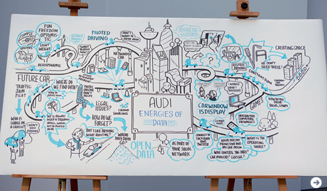
Audi Urban Future|アウディ アーバン フューチャー
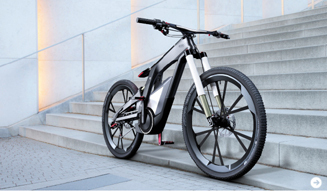
Audi e-bike Wörthersee|アウディ eバイク ヴェルターゼー
Storing Electricity in Gas: The e-gas Concept
Next, let's introduce Audi's research into future energy sources, "Audi Future Energy." This can be broadly divided into the "e-gas Project" and the "e-diesel and e-ethanol Projects."
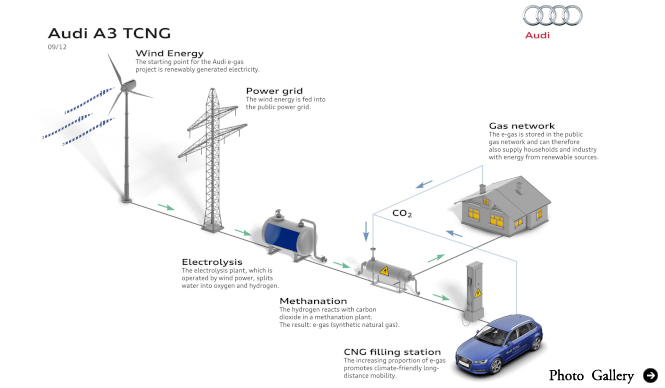
First, the e-gas project. This can be understood as a method of converting surplus electricity generated by renewable energy into hydrogen and methane for storage.
Wind and solar power, which are attracting attention as sustainable energy sources, often generate surplus electricity because their output is determined by natural cycles. However, storing electricity is surprisingly difficult. Attempting to do so with batteries would require enormous "battery plants," making it economically unfeasible.
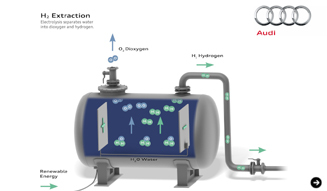
Therefore, Audi's idea is to use surplus electricity to electrolyze water, producing hydrogen and oxygen. The oxygen, having no immediate use, is released into the atmosphere, while the hydrogen can be utilized as an energy source for fuel cell vehicles and hydrogen-powered cars.
Audi Future Lab
Audi's Vision for Future Society: Part Two
Audi Future Energy (2)
Generating Methane Gas from Surplus Energy
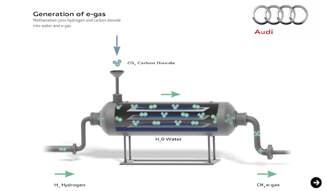
Of course, the widespread adoption of fuel cell and hydrogen vehicles is still some way off. Therefore, the idea was conceived to react this hydrogen (H2) with carbon dioxide (CO2) to produce methane gas (CH4).
Utilizing carbon dioxide as a material for methane gas can help prevent global warming. Meanwhile, methane is the main component of CNG (compressed natural gas), which is already widely used as an energy source in Europe. In other words, the gas produced from surplus electricity is an "immediately usable energy source" in Europe.
Furthermore, existing gasoline engines can be adapted with minor modifications to run on CNG. Thus, Audi is planning to launch a bi-fuel model based on the next-generation " A3" in 2013, which will be capable of using both gasoline and CNG as fuel.
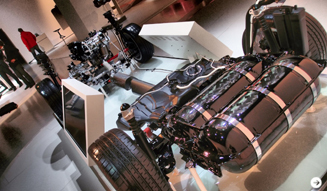
Equipped with both a gasoline tank and a gas tank

Naturally, it has two fuel gauges
While this is a model uniquely suited for Europe, where CNG supply is available in a wide range of regions, this A3, with its easy switching between gasoline and CNG, could potentially be used in Japan, where the CNG supply infrastructure is not yet fully established. Moreover, CNG vehicles are eligible for generous tax incentives in Japan. For instance, automobile tax is generally reduced by 50%, and weight and acquisition taxes are waived. Therefore, it offers significant benefits to users.
Audi Future Lab
Audi's Vision for Future Society: Part Two
Audi Future Energy (3)
Will it Have a Global Impact? e-diesel
However, the e-gas project is limited to utilizing surplus electricity from renewable energy generation. Its impact on global energy matters is by no means significant. In contrast, the e-diesel and e-ethanol projects, which I will introduce next, are research endeavors with such significant societal implications that, if fully realized for mass production, they could render current fossil fuels entirely obsolete.
The key lies in a type of microorganism called cyanobacteria. The American venture company Joule has genetically engineered these cyanobacteria. They have created a system where, when exposed to water, carbon dioxide, and sunlight for photosynthesis, the microorganisms secrete ethanol, a type of alcohol, and diesel fuel.
This is a type of biofuel, but unlike conventional biofuels that extract alcohol through plant fermentation, this method is overwhelmingly more efficient because the microorganisms directly produce the fuel, requiring only one-tenth of the land to produce the same amount of fuel.

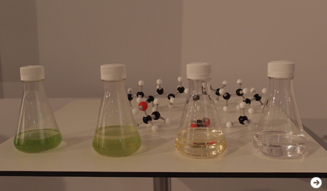
Furthermore, the cost is low; if mass-produced, diesel fuel would cost approximately 33 yen/liter and ethanol around 27 yen/liter. Additionally, the cetane number, which indicates diesel fuel performance, is 100 for e-diesel, compared to around 50 for conventional diesel. In terms of both cost and performance, its feasibility is extremely high.
Audi has partnered with Joule to advance this research and plans to complete a demonstration plant covering 200 square meters next year. Moreover, patents have already been secured in the United States. It appears this is not merely a pipe dream.
Incidentally, if this technology is established, a plant the size of Hiroshima Prefecture could produce enough diesel fuel for 50 million vehicles. This is a scale that could potentially disrupt the existing oil industry. Furthermore, since the microorganisms absorb carbon dioxide to produce fuel, it is completely CO2 neutral, meaning it is also environmentally friendly.
If such fuel were to become practical, might wars break out between oil-producing nations? When I conveyed this concern to an Audi engineer, the person in charge replied with a serious expression, "We pray that it does not."