Tokyo Motor Show 2015 Report | Toyota
Toyota
Tokyo Motor Show 2015 Report
Proposing the Joys of Cars from Various Angles
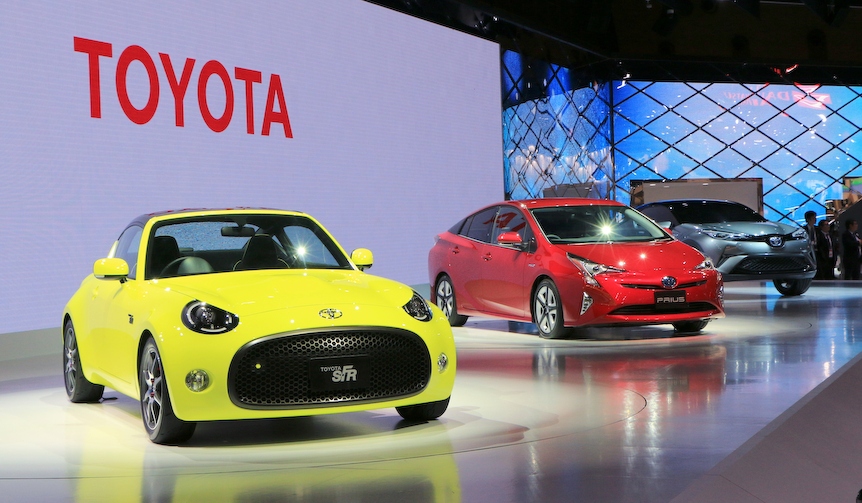
At the Tokyo Motor Show, Toyota's expansive booth offered proposals for enjoying automobiles from many different perspectives, featuring the much-talked-about new Prius, the compact sports concept FR-S, and the KIKAI, which visualizes its mechanics. This report is by Fumio Ogawa, who visited the show.
Text by Fumio OgawaPhotographs by Masayuki Arakawa
The Need for WOW
Toyota's booth was, to put it mildly, understated. Yet, the large exhibition space showcased new models and concept cars that explored the diverse possibilities of automobiles. While the new, fourth-generation Prius was indeed the centerpiece, the display also included a compact sports car concept and, intriguingly, models that conceptually probed the future of automotive design, making it a booth well worth a closer look.
While the new Prius is covered in detail elsewhere, in a nutshell, its evolution is more evolutionary than dramatic. It features a model equipped with lithium-ion batteries, improved handling through a revised center of gravity, and enhanced ride comfort. Styling elements, particularly at the rear, echo the MIRAI, but the actual car possesses more originality than the photos suggest.
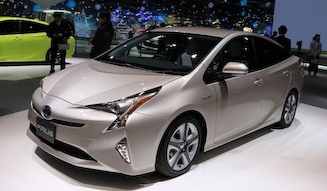
Toyota Prius
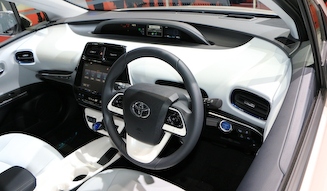
Toyota Prius
The keyword proclaimed at the press conference was "WOW." President Akio Toyoda stated, "Cars need WOW," using the American exclamation of pleasant surprise. He added that they aimed for all Toyota cars at the venue to embody this "WOW" factor. Following this, Ichiro Suzuki, the star player for the Miami Marlins, took the stage, smiling as he said, "I'm not a great driver, but I love cars."
What Toyota wants to communicate now, perhaps to investors, is "Toyota New Global Architecture (TNGA)." This is described as a concept. While it largely refers to the newly developed platform used in the fourth-generation Prius, it also encompasses the company's car manufacturing philosophy and work processes.
In addition to performance improvements, the goal is to enhance efficiency (profitability). During the exchange between President Toyoda and Ichiro Suzuki at the venue, batting form was used as an analogy. "We don't know if changing our form will necessarily improve our batting average, but we want to take the leap of faith and try," said President Toyoda.
President Toyoda remarked that while it might be more comfortable to remain in a familiar place, there is no future without challenging new things. Looking at the show model "FCV Plus," he stated that the future of fuel cell vehicles extends beyond the MIRAI. Meanwhile, one car garnered significant attention from car enthusiasts.
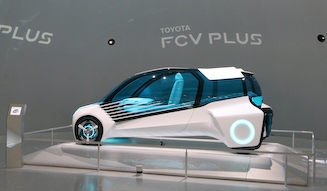
Toyota FCV Plus
Toyota
Tokyo Motor Show 2015 Report
Proposing the Joys of Cars from Various Angles (2)
Compact Sports Cars, Visualizing the Car, and Robots
At the Toyota booth, the yellow sports car "S-FR" frequently drew questions like, "When will this be released?" This compact 2+2, roughly the same size as a Vitz, features a classic layout with a front-mounted engine driving the rear wheels through a manual transmission.
The developer once told us, "We wanted people getting their licenses to understand that cars are fun." The "S-FR," like a younger sibling to the Toyota 86, boasts an appealing design that evokes the classic Lancia Fulvia Zagato from the 1960s. In an era of advancing autonomous driving technology, it may face sales headwinds, but it's a concept that pursues the inherent joy of driving. One hopes it makes it to production.
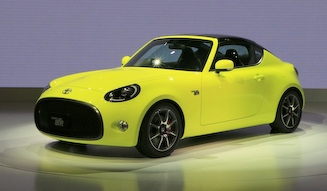
Toyota S-FR
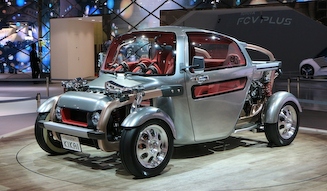
Toyota KIKAI
The "KIKAI," on the other hand, is a concept model that captures the interest of car enthusiasts for different reasons. With the exception of the cabin, everything is exposed. Its defining feature is a design that deliberately showcases the engine and suspension, which are normally hidden within the monocoque body and inner/outer panels.
"There's a modern anxiety about things that are usually hidden or invisible. Young people's trends like a preference for quality coffee or 'factory tourism' also stem from a desire to see the things that underpin our lives. We proposed a design for automobiles that counters this 'black box' trend by making everything visible." The designer's somewhat philosophical explanation resonated.
Modern trends often involve concealing advanced technology within a soft exterior. Toyota is also investing in robot development, and "Kirobo" is their humanoid robot, co-developed with the University of Tokyo and Takahashi Robot Laboratory (Robo Garage).
It was previously reported that Kirobo was transported to the International Space Station aboard the "Kounotori 4" cargo spacecraft. At this Tokyo Motor Show, a smaller version, "Kirobo mini," made its appearance.
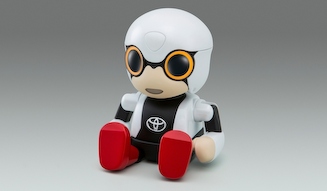
Toyota Kirobo mini
The "Kirobo mini" is palm-sized and is a humanoid computer designed to improve its "human-like" communication skills through verbal interaction with people. It's envisioned that this could eventually be integrated into cars. Similar to docking a smartphone, Kirobo mini could be placed (integrated) into the dashboard, enabling autonomous driving devices that can be operated through conversation.
New technologies arrive in various forms. Toyota's exhibition effectively demonstrates this.