Tokyo Motor Show 2015 Report | Honda
Honda
Tokyo Motor Show 2015 Report
Honda: Shaping the Power of Dreams
While the new "NSX" and "Civic Type R," sports models nearing production, garnered significant attention, Honda also focused on showcasing its new fuel cell vehicle, the "Clarity Fuel Cell," and personal mobility concepts. Fumio Ogawa reports on the Honda booth, where the company's corporate slogan, "Power of Dreams," was brought to life.
Text by OGAWA FumioPhotographs by ARAKAWA Masayuki
Sports Models Rooted in a Sports Car Manufacturer's DNA
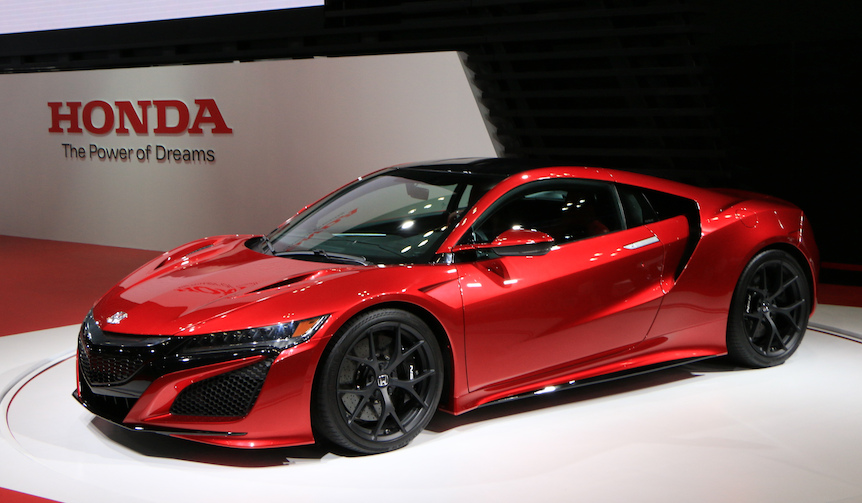
From sports cars to personal mobility aids, or even from the Cub to jet aircraft. Honda's booth was remarkably diverse (though the HondaJet itself wasn't present). The production model of the "NSX", a three-motor hybrid sports car, and the "Civic Type R," eagerly anticipated by sports car enthusiasts, were prominently featured as models embodying the sports car manufacturer's DNA, especially given Honda's return to F1 in 2015.
The Honda booth, with its floor painted in the company's corporate red, showcased a variety of models across two genres: two-wheeled and four-wheeled vehicles. Among them was the "Honda Project 2&4 powered by RC213V", described by Honda as a "sports hybrid trike that balances cornering enjoyment with stability," and featuring the V4 engine (for road use) from the RC213V, which achieved two consecutive MotoGP championships. This crossover between two and four wheels is a concept uniquely suited to Honda.
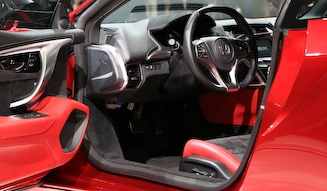
Honda NSX
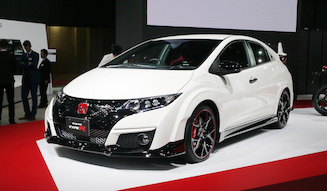
Honda CIVIC TYPE R
The company's slogan, "Power of Dreams," was repeatedly emphasized by President and CEO Takahiro Hachigo during the press conference. One of the symbols of this was the panel exhibit detailing the development of the aforementioned Honda Project 2&4 powered by RC213V.
This project, based on the theme of merging two and four wheels, involved designers from Honda's global design studios competing. The resulting work by American designer Martin Pettersen was displayed alongside numerous engaging concept sketches.
The new NSX adopts the same layout as the original, featuring a two-seater configuration with a 3.5-liter V6 engine mounted behind the rear wheels. However, the new model adds electric motors, with the front wheels also driven independently by motors, creating a four-wheel-drive system.
Honda proudly explained that the torque-vectoring function, which controls the distribution of driving force to the left and right drive wheels, aims to dramatically improve cornering performance.
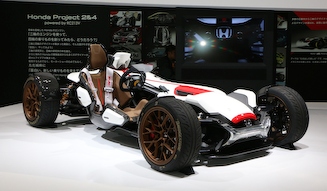
Honda 2&4 powered by RC213V
In 2014, Lamborghini also presented a concept for the future of sports cars, featuring motors controllingthe left and right front wheelsthe front wheels. However, CEO Stephan Winkelmann stated in an interview in autumn 2015 that production was still undecided. Although production startup is delayed from the original schedule, the NSX appears poised to lead the charge for a new generation of sports cars. The new NSX, with a system output of 573 horsepower, is rumored to be priced around 18 million yen in the US under the Acura brand.
In terms of innovation, the "Clarity Fuel Cell," advertised as the "only five-seater," attracted considerable attention.
Honda
Tokyo Motor Show 2015 Report
Honda: Shaping the Power of Dreams (2)
The Next-Generation FCV Embodies Honda's Vision
Honda, which has been developing fuel cell vehicles and has previously operated the "FCX Clarity" on public roads, announced the sale of the "Clarity Fuel Cell." Its flowing, elegantly designed large body evoked a sense of wonder, prompting car enthusiasts to imagine what a next-generation large sedan from Citroën might look like. The Clarity Fuel Cell will be available for lease in March 2016 for 7.66 million yen.
At the press conference, President Hachigo introduced the keywords "create, use, connect," and explained that the vehicle, along with its charging system from smart hydrogen stations, could supply approximately seven days' worth of electricity for a typical household when using the power supply function.
While images of the car driving smoothly were shown, the emphasis on the fuel cell's overall potential in daily life was particularly striking. Although fuel cell vehicles are generally considered less efficient than hybrids in terms of "well-to-wheel" efficiency, Honda seemed to be conveying that there are numerous possibilities.
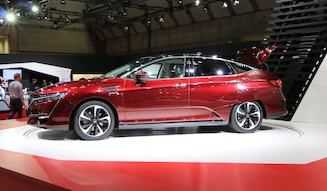
Honda CLARITY FUEL CELL
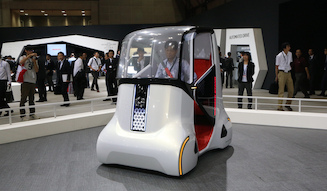
Honda WANDER STAND
Honda's commitment to personal mobility proposals was also impressive. The "Uni-cub," an electric seat-like device powered by a lithium-ion battery, garnered attention at the 2013 Tokyo Motor Show as a personal mobility tool. At the 2015 Honda booth, it was amusing to see staff members zipping around on Uni-cubs while explaining the vehicles. Honda also exhibited the "Wander Walker," a scooter-type personal mobility concept, and the "Wander Stand," a two-seater concept with a roof.
Alongside the F1 machine "MP4-30," the near future society, with an increasing elderly population facing mobility challenges, demands solutions for transportation. The Uni-cub, Wander Walker, and Wander Stand represent such proposals. Honda's stance, advocating for the social responsibility of an automobile manufacturer, is commendable.